
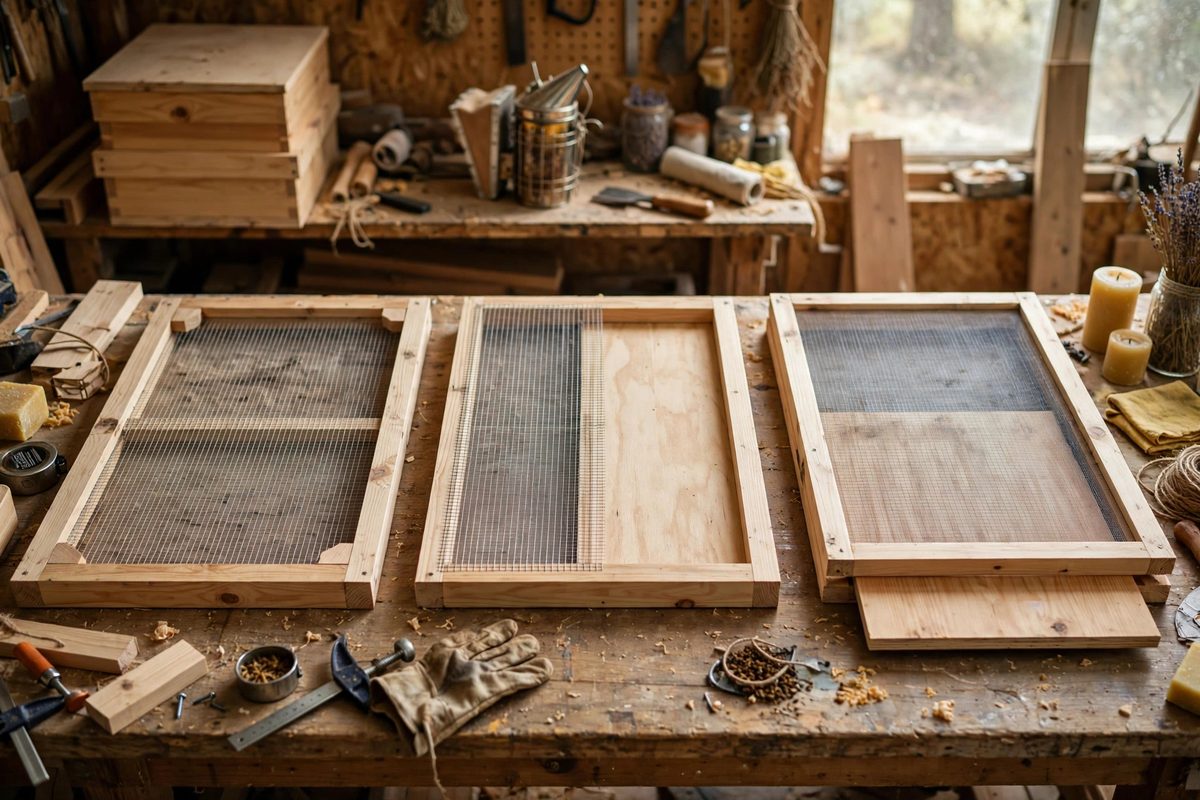
The screened bottom board replaces the hive's solid floor with mesh, and the question every beekeeper asks is how much screening is right: full open mesh, partial, or screened with a closable insert? The answer is about airflow ratios, balancing the colony's need to shed moisture and heat against its need to maintain brood-nest temperature. There is no single correct answer, but there are solid principles.
What the bottom board does
A colony is a moisture factory: respiring bees and evaporating nectar release significant water vapor, which must leave the hive or it condenses on cold surfaces and drips onto the cluster. In summer, the colony also needs to dump heat. The screened bottom provides a large, low exit path for moist, warm air, working with the entrance and top ventilation as a system. But the brood nest must stay near 93-95°F for proper development, and every opening is a heat leak the bees must compensate for by burning honey. Ventilation is a trade, not a virtue.
Full screen versus partial
A fully screened bottom maximizes moisture and heat escape, which suits hot, humid climates and strong summer nectar flows when the hive is wettest inside. In cooler climates or during spring buildup, full screening can chill the brood nest's lower edges and slow development; bees will compensate, but at a honey cost. The practical compromise most beekeepers land on is a screened board with a removable solid insert: screen open in summer's heat and humidity, insert slid in during cold snaps and early spring. The insert also serves as a monitoring tray for mite drop counts, which is a separate and valuable function.
Sizing the opening
The effective ventilation is set by the open area relative to the hive's volume. A standard full-screen bottom on a ten-frame Langstroth gives a large ratio, which is why the insert matters as a throttle. If building custom, a screened area of roughly half to two-thirds of the floor, positioned toward the rear away from the entrance, gives good moisture shedding without turning the brood nest into a wind tunnel. Mesh size matters too: standard #8 hardware cloth (eight wires per inch) keeps bees in and lets debris and mites fall through while excluding mice; finer mesh restricts airflow and clogs with propolis faster.
Interaction with entrances and tops
The bottom board does not ventilate alone. Air enters at the entrance, rises warmed through the hive, and exits at the top; the screened bottom adds a parallel low exit for the heaviest moisture. If the top is sealed tight with no upper ventilation, the screen's effectiveness drops because there is no draw. Conversely, a wide-open top plus a full screen can over-ventilate in cool weather. Tune the system as a whole: entrance reducer, bottom insert, and top ventilation adjusted together for the season, not as independent decisions.
Seasonal management
Run open screen through the hot, humid months when moisture shedding is the priority. Slide the insert in when nighttime temperatures drop consistently, and keep it in through winter in cold climates; a winter cluster needs still air more than it needs a screened floor. In spring, pull the insert as the colony builds and moisture from brood rearing rises. Watch the bees: bearding in heat says more ventilation, while a cluster hugging the top in cold says less. The colony's behavior is the final gauge.
Screen for the season, throttle with the insert, and treat the bottom board as part of the hive's whole airflow system. The bees will tell you when the ratio is right.
Related Guides
- Screened Hive Base Airflow Ratios for Varroa Drops: A screened bottom board does two jobs for a hive: it ventilates the colony, and it gives falling varroa mites a one-way trip out of the hive. Mites
- Langstroth Bee Space Tolerances to Prevent Burr Comb: The Langstroth hive works because of a single measurement: bee space, the gap that bees treat as a passageway rather than as space to fill. Get the
- Horizontal Frame Spacing for Top Bar Natural Beekeeping: Top bar hives do away with frames and foundation, letting bees build natural comb hanging from wooden bars. The spacing of those bars is the
- Top Bar Hive Comb Width Spacing for Brood Frame Health: In a top bar hive, the width you give each bar decides the shape of the comb the bees draw, and comb shape decides brood health. Too wide and the