
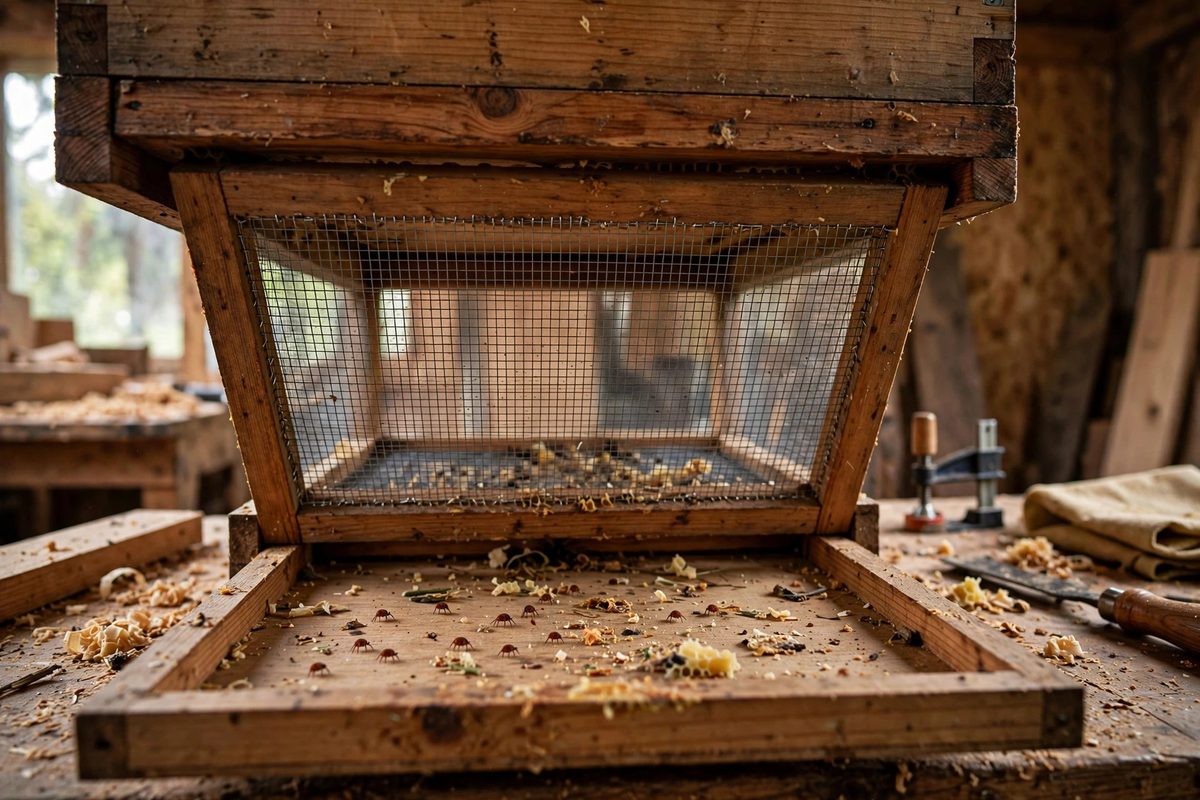
A screened bottom board does two jobs for a hive: it ventilates the colony, and it gives falling varroa mites a one-way trip out of the hive. Mites that drop through the screen cannot climb back up to reattach to bees, which makes the screen a passive, always-on form of mite control. But the screen's mesh size, open area, and relationship to the hive above it all interact, and getting the airflow ratio wrong either chokes ventilation or lets the colony's heat escape too freely.
Mesh Size: What Falls Through, What Stays Out
The standard choice is #8 hardware cloth, with openings around 3 mm. That size passes varroa mites (about 1 mm) and small debris easily while blocking bees, robber bees, and most wasps. Finer mesh clogs with propolis and wax debris faster, defeating the drop-through function; coarser mesh invites robbing insects and lets bees chew at the edges. Stainless or galvanized #8 cloth both work, with stainless lasting far longer in the corrosive hive environment. Whatever you use, inspect it annually, because a corroded screen develops holes that bees will find.
Open Area and Ventilation Balance
A full screened bottom exposes nearly the entire hive footprint to outside air, which is a lot of ventilation. In warm climates that is a blessing; in cold climates it can be a liability, chilling the brood nest and forcing the cluster to burn more honey. The practical answer is a removable insert board (often called a mite board or sticky board) that slides under the screen. Run it out for maximum ventilation and mite drop in summer; slide it in during cold snaps to retain heat. This single feature turns the screened base from a fixed compromise into an adjustable system.
The Mite Board as a Monitoring Tool
That insert board doubles as your varroa census. Coat it lightly with petroleum jelly or cooking spray, slide it under the screen for 24 to 72 hours, then count the mites stuck to it. A natural daily mite drop number, tracked across the season, tells you whether the population is stable or exploding, which is the information you need to decide on treatment. Do the counts monthly during the active season and log them; a rising trend over two consecutive counts is the signal, not any single number.
Airflow Ratios in Practice
Think of hive ventilation as a ratio between intake at the bottom and exhaust at the top. A screened bottom with no top ventilation can trap humid air rising from the cluster, because air needs an exit to flow. Pair the screened base with a small upper entrance or a ventilated inner cover, and you get gentle convective flow: cool air enters low, warm moist air exits high. In winter, reduce the bottom opening with the insert board and keep the top vent open, since moisture is the winter killer, not cold. Condensation dripping onto the cluster kills more bees than low temperatures do.
Building the Base Right
The screened base should be rigid enough to support a full hive's weight without sagging, because a sagging screen lets the insert board bind and creates gaps at the edges. Frame the screen in solid wood with the cloth stapled and then capped by a second strip, so bees cannot reach the raw stapled edge to chew. Slope the whole assembly very slightly toward the front so rain and condensation drain out instead of pooling. And make the insert board slide smoothly in a dado; a board that swells and jams in humidity will never get used, and an unused board is just dead weight.
A screened hive base with a sliding insert is one of the cheapest upgrades in beekeeping: passive mite reduction, adjustable ventilation, and a built-in monitoring station, all from a rectangle of hardware cloth and a board. Build it rigid, manage the insert seasonally, and count what drops; the mites will tell you the rest.
Related Guides
- Screened Bottom Board Airflow Ratios for Hives: The screened bottom board replaces the hive's solid floor with mesh, and the question every beekeeper asks is how much screening is right: full open
- Top Bar Hive Comb Width Spacing for Brood Frame Health: In a top bar hive, the width you give each bar decides the shape of the comb the bees draw, and comb shape decides brood health. Too wide and the
- Langstroth Bee Space Tolerances to Prevent Burr Comb: The Langstroth hive works because of a single measurement: bee space, the gap that bees treat as a passageway rather than as space to fill. Get the
- Horizontal Frame Spacing for Top Bar Natural Beekeeping: Top bar hives do away with frames and foundation, letting bees build natural comb hanging from wooden bars. The spacing of those bars is the