
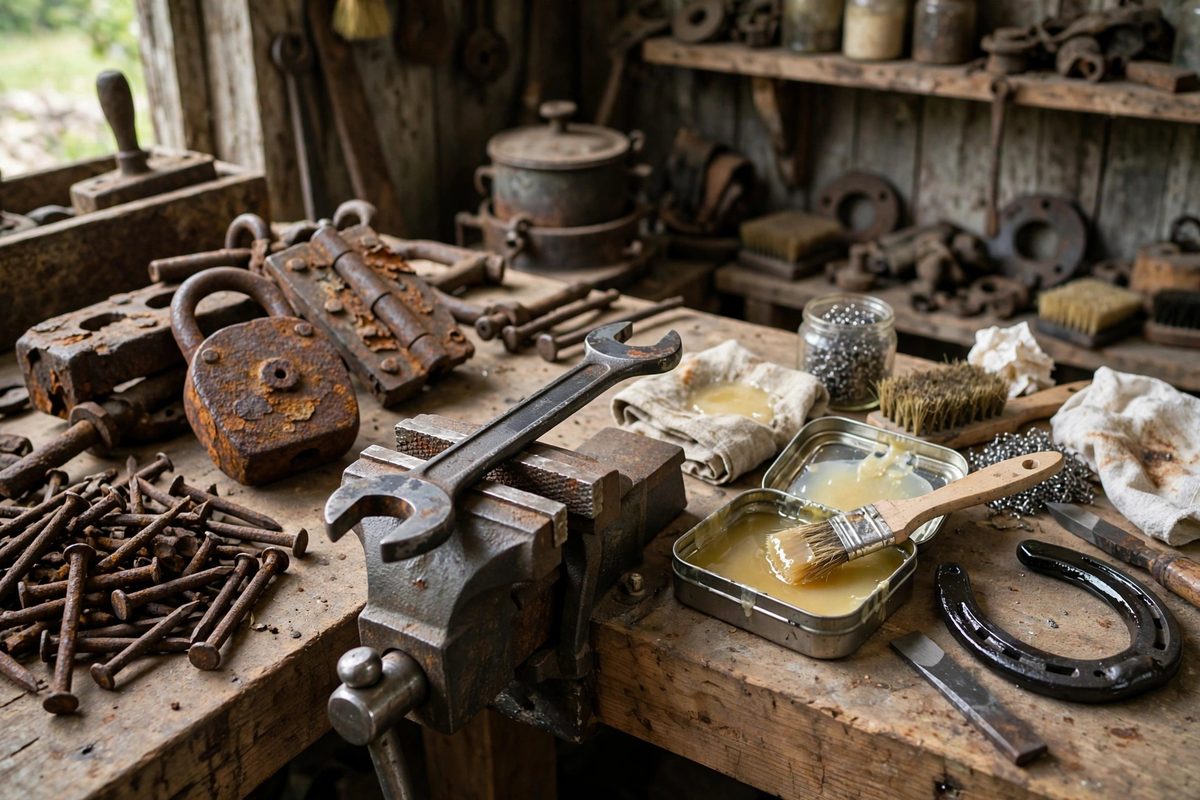
Old iron tools, hardware, and artifacts arrive at the restorer's bench carrying centuries of corrosion, and after cleaning, the bare or partially corroded surface needs protection or it simply rusts again. Microcrystalline wax is the conservator's standard sealant for iron: it blocks moisture and oxygen, stays reversible, and does not change the object's appearance the way lacquers and oils can. Applied correctly, it preserves iron for decades.
Why microcrystalline wax
Microcrystalline wax differs from paraffin and beeswax in its fine crystal structure, which makes it more flexible, more adhesive, and less prone to cracking or whitening with age. It forms a thin, tough, moisture-resistant film that conforms to corroded surfaces without filling in texture. Critically for conservation, it is reversible: it dissolves in mineral spirits, so a future conservator can remove it without harming the object. Oils like linseed darken and become irreversible; lacquers yellow and trap moisture if breached. Wax is the honest, removable choice.
Preparing the iron surface
Wax seals in whatever is underneath, so preparation determines the result. Remove loose corrosion mechanically: wire brushes, scalpel work, and careful abrasion, stopping at the stable surface. The goal is not bright metal; on historic iron, a stable dark patina with the corrosion stabilized is the correct finish, and stripping to shiny metal destroys historic value. After cleaning, the surface must be completely dry; warming the object gently drives off residual moisture from the corrosion's pores. Any moisture sealed under the wax will continue corroding invisibly, which is worse than no wax at all.
Applying the wax
Warm the object slightly, to roughly hand-hot, so the wax flows into the surface texture rather than sitting on top. Apply the wax sparingly with a brush or cloth, working it into pits and crevices; corroded iron is a landscape, and the wax must reach the valleys. Less is more: a thick coat looks cloudy and attracts dust, while a thin, well-worked coat is nearly invisible. Let the wax cool and haze, then buff gently with a soft brush or cloth to consolidate the film and bring up a soft sheen. Two thin coats outperform one thick one.
Dealing with active corrosion
Wax alone does not stop active, chloride-driven corrosion, the weeping orange rust that continues no matter the environment. If the iron shows active corrosion, it needs treatment first: desalination soaks or tannic acid conversion, depending on the object and its value. Waxing over active corrosion just hides the problem while it continues underneath. Learn to distinguish stable patina (dark, hard, dry) from active corrosion (powdery, orange, sometimes damp); when in doubt, consult a conservator before proceeding, especially for anything of historic significance.
Maintenance and environment
Waxed iron still needs a decent environment: stable, moderate humidity and no direct water contact. Inspect annually; the wax film wears at handling points and may need local reapplication. Re-waxing is simple: clean the area, warm slightly, apply thinly, buff. Keep waxed objects out of heat, which softens the film, and away from solvents, which dissolve it. With basic care, a microcrystalline wax seal protects iron for many years, and its reversibility means no future restorer will curse your work.
Clean to stable, dry completely, wax thin and warm, buff, and maintain. The iron keeps its history and gains a future.
Related Guides
- Chelating Agent Baths for Delicate Cast Iron Salvage: Delicate cast iron, thin-walled skillets, ornate hardware, antique tools with fine detail, rusts in ways that aggressive restoration destroys. Wire
- Chelating Agent Baths for Delicate Rusted Iron Plating: Delicate ironwork (thin plated items, fine tools, ornamental pieces) presents a restoration dilemma: the rust must go, but every aggressive method
- Restore a Rusty Vintage Hand Plane: Bring Old Tools Back to Life! There's something deeply satisfying about taking a rusty, neglected hand plane from a flea market and transforming it
- Electrolytic Rust Removal Baths for Antique Planes: An antique plane body caked in decades of rust presents a dilemma: aggressive mechanical cleaning removes the rust but also the patina, the crisp
- Low-Deacidification Soaking for Antique Steel Tools: Antique steel tools often arrive from barns and estate sales carrying more than rust: they carry acidity. Decades of exposure to acidic environments