
Tunisian crochet has a notorious lean: the fabric biases, pulling diagonally instead of hanging straight. Extended stitches make it worse, because the extra height gives the bias more leverage. Understanding why the pull happens is the first step to knitting Tunisian fabric that stays square.
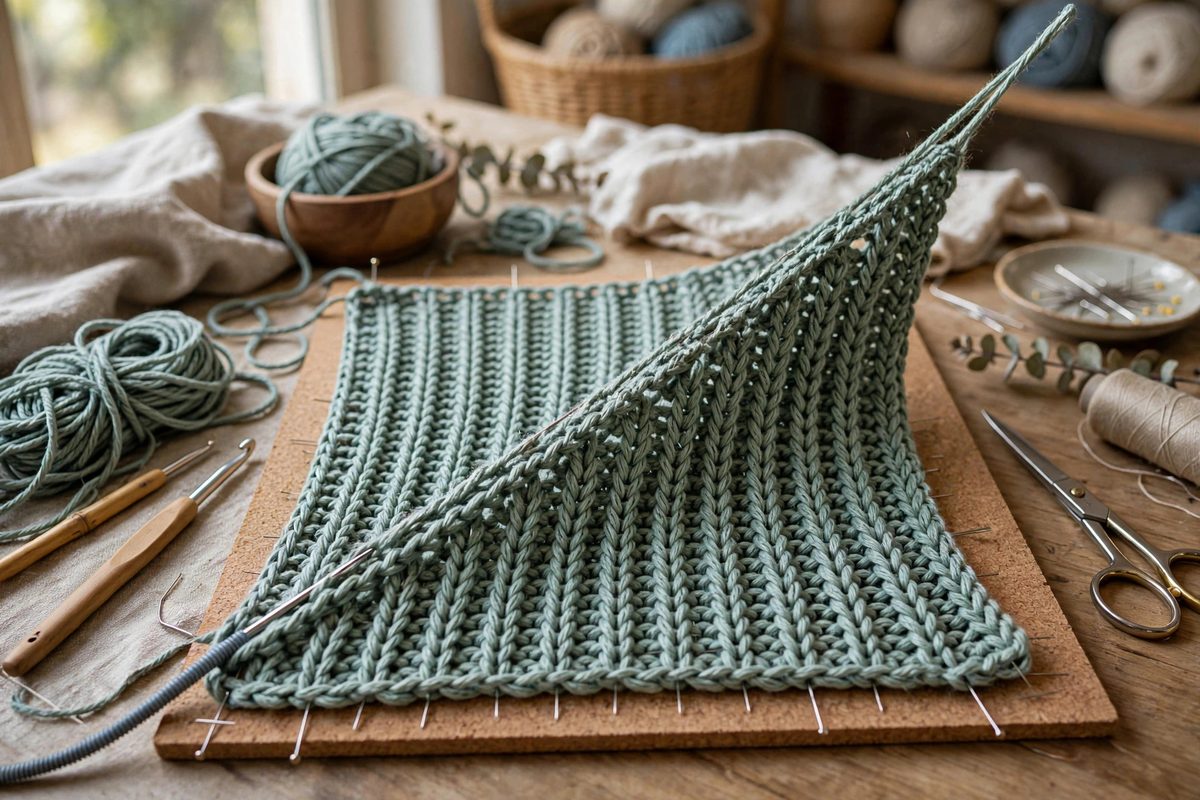
Where the bias comes from
Every Tunisian stitch is worked in two passes: the forward pass picks up loops, the return pass works them off. The forward pass pulls each loop slightly to one side, and because the loops stay on the hook through the whole row, that sideways pull accumulates across the fabric. The result is a parallelogram where you wanted a rectangle. Extended stitches, with their extra chain at the base, amplify the effect because the taller stitch has more room to lean. The bias is structural, not a tension error, which is why "just crochet tighter" never fixes it.
Stitch choice as the first lever
Some Tunisian stitches bias more than others. The Tunisian knit stitch, which pulls the loop through the front vertical bar, is among the worst offenders. The Tunisian purl stitch biases the opposite direction, which is useful: alternating knit and purl rows, or working in patterns that combine them, lets the opposing biases cancel. The Tunisian simple stitch biases less than the knit stitch. Choosing or designing stitch patterns with bias cancellation built in is more effective than fighting a single stitch's nature.
Hook and tension adjustments
A larger hook loosens the fabric and gives the bias more room to express itself; a smaller hook tightens the stitches and resists the lean somewhat. This is a tradeoff, because too tight a hook makes the fabric stiff and hard to work. The practical approach is to swatch the exact stitch pattern at a couple of hook sizes and measure the bias angle in each. Pick the hook that gives acceptable fabric hand with the least lean. Write the winning combination down; Tunisian swatches are easy to misremember.
Blocking as correction
Blocking can straighten a biased piece, pinning it square while it sets. It works best as a final correction on a mildly biased fabric, not as a rescue for a severe lean. Fibers matter: wool blocks and holds well, acrylic needs heat to set, and some fibers spring back toward the bias no matter what. Block the swatch before committing to the project; if the swatch will not stay square, the project will not either, and the stitch plan needs revisiting.
Designing around the bias
Sometimes the smart move is to design with the bias instead of against it. A scarf or wrap can absorb a consistent lean gracefully, especially if the bias is symmetric or the piece is worn draped. Garments with fitted shaping need the bias controlled, but accessories are more forgiving. Alternatively, work the piece and then cut the bias out: some makers work Tunisian fabric oversized and trim to square after blocking. It feels wasteful until you compare it to frogging a whole project.
Edgings that stabilize
A firm edging worked after the main fabric is complete can lock in the blocked shape. A row of single crochet or a applied border around all four sides resists the fabric's urge to creep back toward the bias. Work the edging after blocking, while the piece is still pinned square if possible. The border becomes a frame that holds the geometry, and it finishes the raw Tunisian edges attractively at the same time.
Choose stitches that counteract the lean, swatch for the hook that minimizes it, block honestly, and stabilize with an edging. Tunisian's bias is a known property, not a personal failing, and it yields to methodical handling.
Related Guides
- Return Pass Slant Correction in Extended Tunisian Stitches: Tunisian crochet's extended stitches create a tall, elegant fabric, but they also introduce a persistent annoyance: the return pass slants. Because
- Return Pass Tension Balance in Tunisian Purl Stitches: Tunisian crochet works in two passes: the forward pass picks up loops onto the hook, and the return pass works them off. The Tunisian purl stitch
- Return Pass Tension Balance in Tunisian Rib Stitches: Tunisian crochet builds fabric in two passes: the forward pass picks up loops, and the return pass works them off. In Tunisian rib, where knit and
- Preventing Edge Curling in Tunisian Simple Stitch: Tunisian simple stitch produces a beautiful dense woven-like fabric, and it curls. The forward pass builds up loops on the hook, the return pass