
Tunisian crochet's extended stitches create a tall, elegant fabric, but they also introduce a persistent annoyance: the return pass slants. Because each extended stitch is taller than a standard one, the loops accumulate on the hook with a built-in lean, and the return pass, worked back across those loops, follows the lean instead of running true. The result is a fabric that biases diagonally no matter how carefully the forward pass is worked. Understanding why the slant happens points directly at the corrections that straighten it.
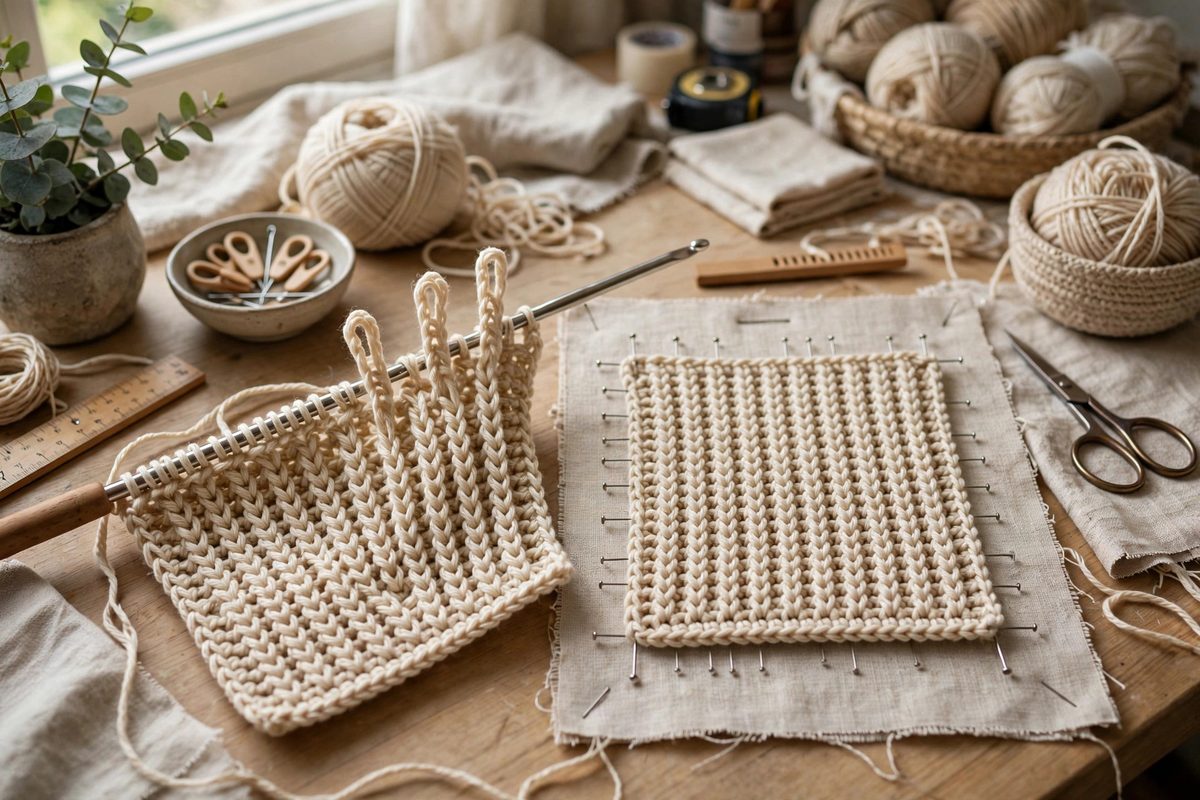
Why extended stitches slant
A standard Tunisian stitch occupies roughly one row height of vertical space. An extended stitch adds an extra chain or an elongated pull-through, making it taller, and that extra height has to lean somewhere. On the hook, each tall loop tilts slightly toward the direction of work, and the tilts accumulate across the row. When the return pass works back through these leaning loops, the yarn-over-pull-through sequence follows the existing geometry rather than correcting it, so the return pass itself slants. The slant is structural, not a tension error: it appears even in perfectly even work because it comes from the stitch architecture. This is why simply tightening up does not fix it, and why the corrections must also be structural.
Reading the slant direction
Before correcting, diagnose precisely. Work a sample of at least twenty stitches wide and several inches tall in the extended stitch, then lay it flat without stretching. Sight along the vertical columns: they will lean consistently to one side, typically toward the end where the forward pass finishes. Note the direction and the severity, since the correction must oppose the actual slant, not the assumed one. Also check whether the slant worsens toward one edge; uneven slant across the row points to inconsistent stitch height rather than the structural lean, and that needs a technique fix before any correction is applied. A stable, uniform slant is the signature of the architectural problem and the green light for structural correction.
Correction one: alternating the return pass
The most direct correction alternates the return pass direction or structure to counteract the accumulated lean. One approach works the return pass with a modified sequence on alternate rows, effectively leaning the return against the forward slant so the two cancel. Another varies the return pass by changing where the pull-throughs anchor, shifting the geometry back toward vertical. These corrections require swatching: the exact modification depends on the stitch height and the yarn, so test on a sample and measure the column verticality before committing to a project. Document the corrected sequence row by row, because an alternating correction is easy to lose track of mid-project, and a project that is half corrected slants worse than one left alone.
Correction two: balancing with stitch architecture
A more fundamental fix pairs the extended stitch with a counterbalancing element in the stitch pattern itself. Working extended stitches in alternating directions, or combining them with standard-height stitches in a planned rhythm, lets the opposing leans cancel within the fabric. Lace and texture patterns in Tunisian crochet often do this naturally, which is why the slant problem is most visible in plain extended-stitch fabrics and less so in complex ones. When designing with extended stitches, consider the bias as a design variable: a deliberate, consistent slant can become a diagonal texture feature, while an unintentional one reads as a mistake. The difference between a flaw and a feature is intention plus consistency.
Blocking and finishing realities
Blocking can improve a slanted fabric but cannot truly straighten a structural bias; pinning forces the columns vertical while wet, but the stitches retain their lean and the fabric relaxes back toward slant with handling and gravity. Treat blocking as a finishing step for evenness, not as a correction for bias. The honest corrections happen in the stitching. That said, the choice of edge treatment matters: a firm border worked perpendicular to the slant can visually anchor the piece and mechanically resist some bias, particularly in smaller projects. For garments, cut and seaming must account for the bias, since a slanted fabric hangs and drapes asymmetrically; either correct the slant or design the garment around it, but do not ignore it.
Yarn and hook factors
Slippery yarns let the tall loops slide and settle into their lean more readily, worsening the visible slant, while grippier yarns hold the loops nearer to where they were formed. A hook size matched to the yarn, not oversized, keeps the loops from having excess room to tilt. Tension consistency remains important: while even tension does not prevent the structural slant, uneven tension adds a second, irregular bias on top of it, and the combination is much harder to correct. Work the extended stitches with deliberate, uniform height, using the hook's shaft as a gauge for the extension; consistent stitch architecture gives the corrections a stable target.
Extended Tunisian stitches slant because tall loops lean, and the return pass follows the lean. Correct it structurally: alternate or modify the return pass against the bias, balance the stitch architecture, keep tension and stitch height consistent, and verify on a swatch before committing. Or embrace the diagonal deliberately. What you cannot do is ignore it and hope blocking fixes physics.
Related Guides
- Return Pass Tension Balance in Tunisian Purl Stitches: Tunisian crochet works in two passes: the forward pass picks up loops onto the hook, and the return pass works them off. The Tunisian purl stitch
- Return Pass Tension Balance in Tunisian Rib Stitches: Tunisian crochet builds fabric in two passes: the forward pass picks up loops, and the return pass works them off. In Tunisian rib, where knit and
- Mitigating Bias Pull in Extended Tunisian Knit Stitches: Tunisian crochet has a notorious lean: the fabric biases, pulling diagonally instead of hanging straight. Extended stitches make it worse, because
- Preventing Edge Curling in Tunisian Simple Stitch: Tunisian simple stitch produces a beautiful dense woven-like fabric, and it curls. The forward pass builds up loops on the hook, the return pass