
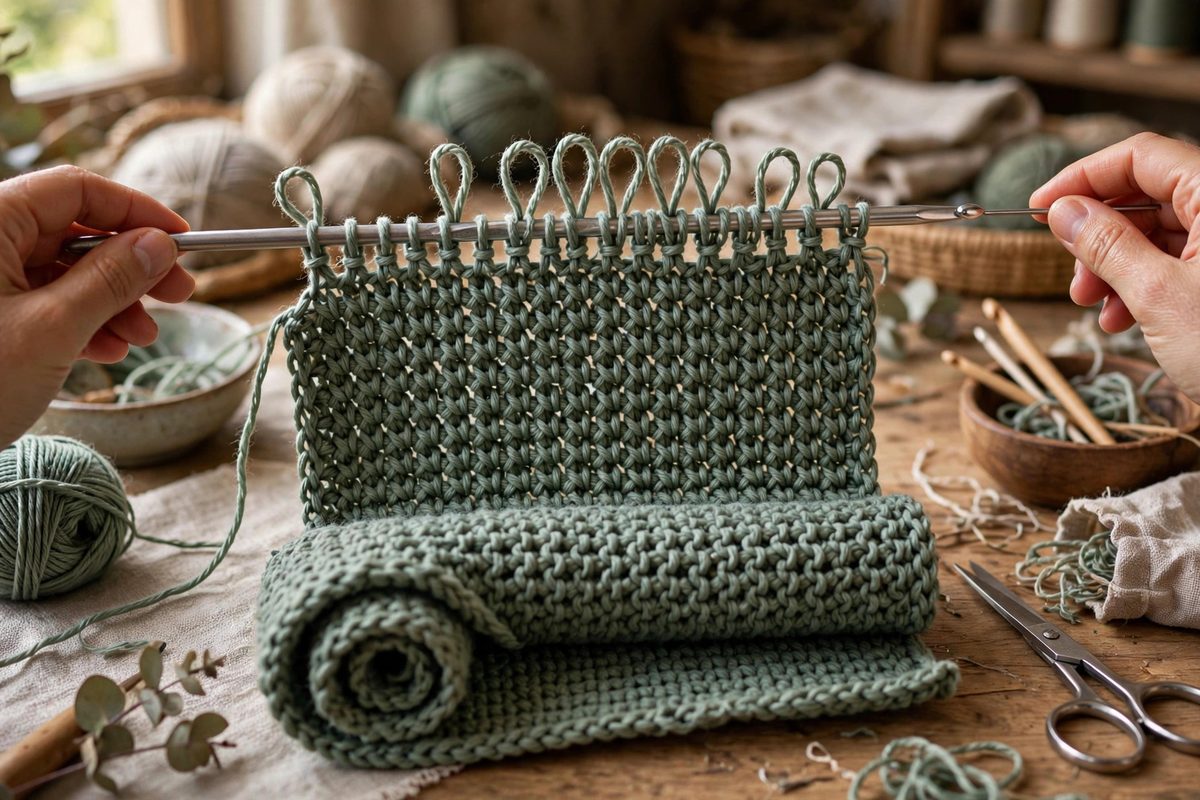
Tunisian simple stitch produces a beautiful dense woven-like fabric, and it curls. The forward pass builds up loops on the hook, the return pass works them off, and the resulting fabric rolls toward the front at the bottom and toward the back at the sides with a persistence that frustrates every beginner. The curl is structural, not a tension error, which means it needs structural solutions, not just tighter stitching. Accepting that fact early saves a lot of ripped-out rows.
Why the fabric curls
The curl comes from the stitch's asymmetry: the front of each stitch carries more yarn than the back, and the fabric's faces have different tension. Like a bimetallic strip, the differential pulls the fabric into a curl. Every row adds to the imbalance in the same direction, so the curl is cumulative and gets worse as the piece grows. This is inherent to the stitch architecture, which is why no amount of careful tensioning alone defeats it.
Understanding this reframes the problem: you are not doing something wrong, you are using a stitch that curls. The solutions either counteract the curl mechanically or choose contexts where the curl does not matter.
Border strategies that work
The most reliable fix is a non-curling border worked around the Tunisian panel: several rows of single crochet, ribbing, or another balanced stitch at the bottom and sides. The border's own structural stability resists the panel's curl, holding the edges flat. The border needs enough rows to develop real stiffness, typically a half inch or more, and it must be worked at a compatible gauge so it does not pucker the panel.
Work the border as part of the piece, not as an afterthought sewn on later. A border crocheted directly into the Tunisian edge shares tension with the panel and controls it; a sewn-on border fights it. Plan the border from the start, including its stitch count, so the finished dimensions land where intended. Swatch the border stitch at the same gauge you will use, because a border worked tighter or looser than the panel introduces its own distortion.
Stitch and hook adjustments
Some Tunisian stitch variants curl less than simple stitch. Tunisian purl stitch curls in the opposite direction; alternating rows of simple stitch and purl stitch roughly balance the forces and produce a much flatter fabric with an interesting texture. Tunisian knit stitch curls similarly to simple stitch; reverse stitch variants offer the counter-curl. Learning one counter-curling stitch doubles your design options.
Hook size affects curl severity. A larger hook produces a looser fabric with less differential tension and therefore less curl, at the cost of a more open fabric. For projects where the dense Tunisian hand is essential, the border solution beats hook upsizing; for projects where drape matters more than density, the larger hook is the simpler path.
Blocking: temporary versus permanent
Blocking flattens Tunisian fabric impressively, and for wall hangings or framed pieces it is sufficient: the piece never moves again. For wearables and blankets, blocking is temporary; the curl returns with handling and washing as the fibers relax back to their structural preference. Know which kind of project you are making before relying on blocking.
Steam blocking sets acrylic and wool blends more permanently than wet blocking, but even steamed edges on a much-handled piece eventually curl. Treat blocking as a finishing step that perfects a structurally sound solution, not as the solution itself.
Designing with the curl
Sometimes the answer is to let the stitch be what it is. Rolled edges make excellent design features: a Tunisian cowl whose edges roll naturally, a basket where the curl forms the rim, a rug where weight defeats the curl. Projects worked in the round, hats, cowls, bags, have no free edges to curl, which is why Tunisian shines in circular construction.
When the project demands flat fabric, combine approaches: a counter-curling stitch pattern plus a sturdy border plus a final blocking. No single fix is as reliable as the layered defense, and the combination handles the curl so thoroughly you can forget the stitch ever misbehaved.
Tunisian curl is physics, not failure: asymmetric stitches roll, and the fixes are borders, counter-curling stitch combinations, appropriate hook sizing, and honest blocking. Design around it or design with it, but never pretend it is a tension problem you can stitch your way out of.
Related Guides
- Return Pass Tension Balance in Tunisian Purl Stitches: Tunisian crochet works in two passes: the forward pass picks up loops onto the hook, and the return pass works them off. The Tunisian purl stitch
- Return Pass Tension Balance in Tunisian Rib Stitches: Tunisian crochet builds fabric in two passes: the forward pass picks up loops, and the return pass works them off. In Tunisian rib, where knit and
- Mitigating Bias Pull in Extended Tunisian Knit Stitches: Tunisian crochet has a notorious lean: the fabric biases, pulling diagonally instead of hanging straight. Extended stitches make it worse, because
- Return Pass Slant Correction in Extended Tunisian Stitches: Tunisian crochet's extended stitches create a tall, elegant fabric, but they also introduce a persistent annoyance: the return pass slants. Because