
Tunisian crochet works in two passes: the forward pass picks up loops onto the hook, and the return pass works them off. The Tunisian purl stitch, which brings the yarn to the front to create the purl bump, is notorious for tension problems on the return pass: the fabric curls, the edge tightens, or the purl bumps sit unevenly. The culprit is tension imbalance between the passes. The forward pass sets the loop sizes; the return pass must work them off without distorting them, and the purl's yarn-front geometry makes this balancing act trickier than in the simple stitch. Understanding the mechanics produces even, beautiful purl fabric.
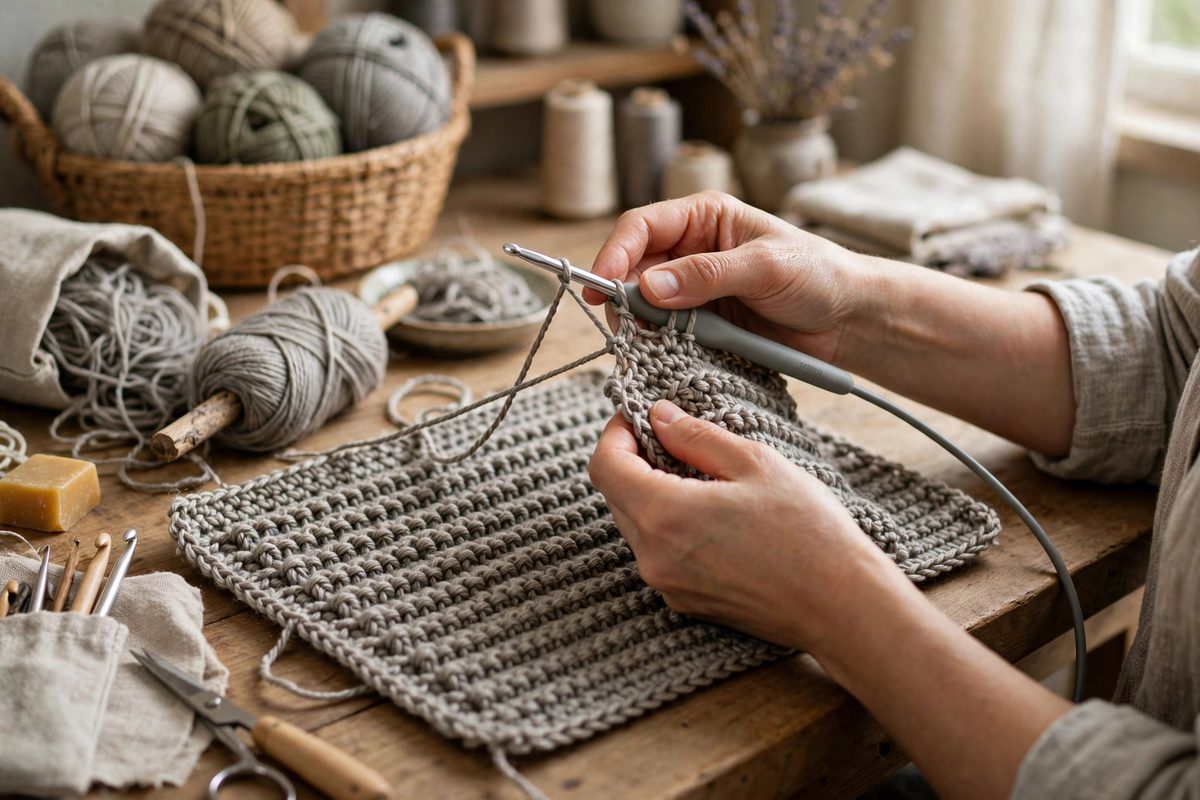
The Two-Pass Tension System
In Tunisian crochet, tension is a negotiation between the passes. The forward pass determines each loop's size as it is drawn up; the return pass, working the loops off with yarn-overs pulled through, determines how tightly those loops are locked into the fabric. If the return pass is worked tighter than the forward pass, it cinches the loops smaller than they were picked up, and the fabric draws in: the classic too-tight Tunisian edge. If the return pass is looser, the loops relax larger and the fabric grows. In the Tunisian simple stitch this balance is relatively forgiving, but the purl stitch adds a complication: bringing the yarn forward wraps extra yarn around each stitch, changing the loop geometry. The return pass must accommodate that extra wrap without either strangling it or letting it flop, which demands more precise tension matching than the simple stitch requires.
Forward Pass Setup for Purls
The return pass can only balance what the forward pass provides, so the forward pass must be consistent. Draw each purl loop up to the same height: the purl's yarn-front position tempts inconsistent loop heights because the working yarn's path differs from the simple stitch. Keep the loops relaxed on the hook, not jammed tight: tight forward loops give the return pass nothing to work with and force it to fight the fabric. Maintain even spacing along the row; the purl bumps should sit in a regular rhythm, and irregular spacing telegraphs through the return pass as uneven tension. Count the loops on the hook before starting the return pass, especially in pattern work where purls mix with other stitches: a missed or doubled loop discovered mid-return is far harder to fix than one caught at the turning point.
Return Pass Technique
Work the return pass deliberately: yarn over, pull through two loops (or one, per the pattern's edge treatment), and let the motion be smooth rather than snatched. The critical moment is pulling through the purl loops: the yarn-over must travel around the purl bump's extra wrap without catching or tightening unevenly. Keep the working yarn at a consistent angle and tension throughout the pass; many crocheters unconsciously tighten as they approach the row's end, producing the tapered edge that plagues Tunisian purl fabric. If the edge pulls in, the return pass is too tight relative to the forward pass: consciously loosen the yarn-overs, or go up a hook size for the return pass alone, a legitimate technique that mechanically enforces the balance. The return pass should feel like guiding the yarn, not wrestling it.
Diagnosing Common Defects
Each defect points to a specific imbalance. Fabric curling toward the purl side excessively: the purl bumps are pulling the fabric, often from return passes worked too tightly, cinching the bumps. Uneven purl bumps, some prominent, some swallowed: inconsistent forward-pass loop heights, fixable only at the forward pass. A tight, corded edge: the return pass's edge stitches are too tight, or the turning chain is too short; work the edge stitches deliberately loose. A flared, wavy edge: the return pass is too loose, letting loops expand. The diagnostic discipline is to change one pass at a time: if you suspect the return pass, work a test row with a consciously looser return while keeping the forward pass identical, and read the result. Tunisian tension problems are almost always solvable once correctly attributed, because the two-pass structure isolates the variables.
Blocking and the Final Fabric
Even well-balanced Tunisian purl fabric benefits from blocking: the purl texture relaxes into its final character with a wash and pin-out, and minor tension variations even out. Block to the intended dimensions, not to force the fabric into shape it does not want: blocking corrects small irregularities but cannot fix a fundamentally imbalanced tension, which springs back when unpinned. For garments, swatch in the purl pattern and block the swatch before measuring gauge: Tunisian purl gauge shifts significantly with blocking, and unblocked measurements produce mis-sized garments. Steam blocking suits wool blends; wet blocking suits plant fibers and acrylics. The blocked fabric is the truth of your tension balance: if it lies flat and the purls sit evenly, the passes were balanced; if it fights the pins, revisit the technique, not the blocking.
Tunisian purl tension is a two-pass negotiation: consistent forward loops, a return pass matched to them, and diagnosis by isolating the passes. Balance the two and the purl bumps sit in even rows on fabric that lies flat, which is the whole quiet beauty of the stitch.
Related Guides
- Return Pass Tension Balance in Tunisian Rib Stitches: Tunisian crochet builds fabric in two passes: the forward pass picks up loops, and the return pass works them off. In Tunisian rib, where knit and
- Return Pass Slant Correction in Extended Tunisian Stitches: Tunisian crochet's extended stitches create a tall, elegant fabric, but they also introduce a persistent annoyance: the return pass slants. Because
- Mitigating Bias Pull in Extended Tunisian Knit Stitches: Tunisian crochet has a notorious lean: the fabric biases, pulling diagonally instead of hanging straight. Extended stitches make it worse, because
- Preventing Edge Curling in Tunisian Simple Stitch: Tunisian simple stitch produces a beautiful dense woven-like fabric, and it curls. The forward pass builds up loops on the hook, the return pass