
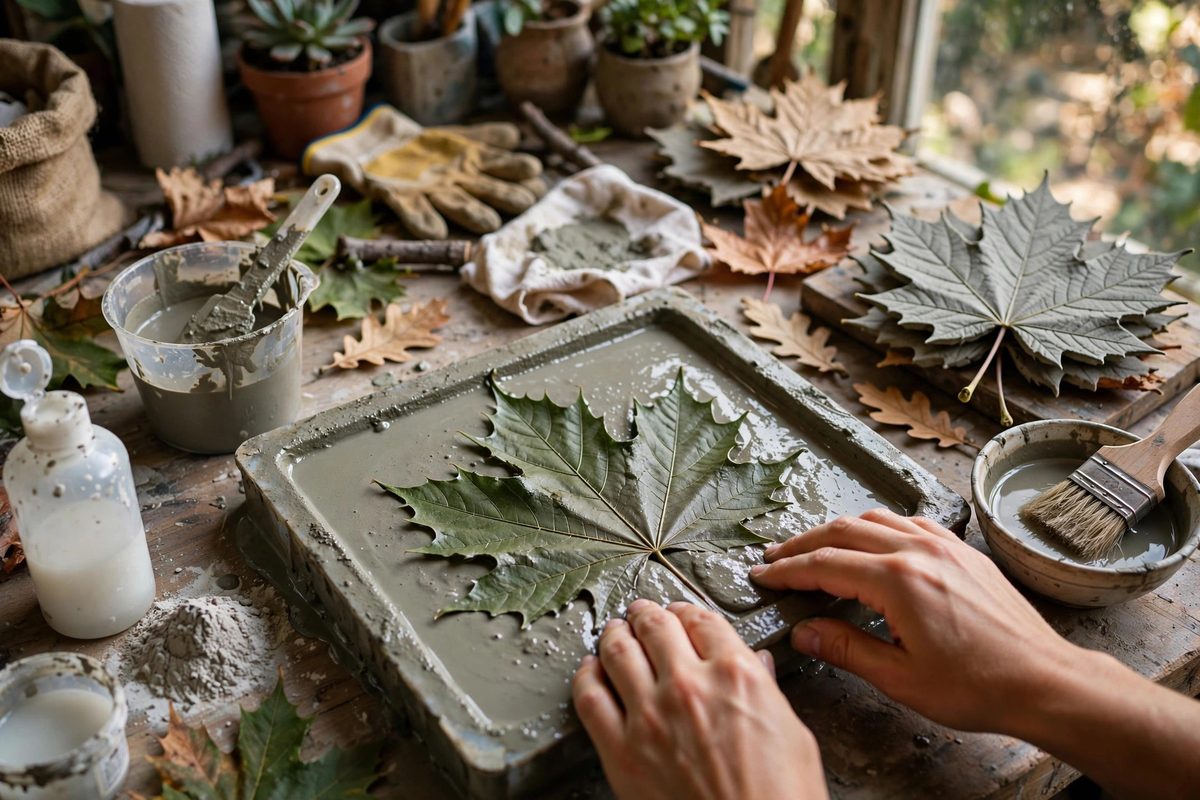
Pressing a leaf into wet cement captures every vein and serration in stone, making garden art that outlasts the plant by decades. But plain cement is brittle in thin sections, and a leaf casting is mostly thin sections. Polymer fortifiers (liquid acrylic or latex admixtures) transform the slurry: they add flexural strength, reduce cracking, and bond the mix to itself in thin layers, which is exactly what a delicate leaf impression demands.
Why Plain Cement Fails Thin Castings
Cement's compressive strength is excellent and its tensile strength is poor, and a leaf casting lives in tension: the thin edges flex when handled, freeze-thaw cycles pry at the veins, and the leaf's own curl creates stress risers. Plain cement in a quarter-inch section cracks under all three. Polymer admixtures form a flexible film throughout the cured matrix, bridging micro-cracks before they propagate and giving the casting the toughness to survive handling and weather. The result is a piece you can pick up by the edge without hearing that dreaded tick.
Mixing the Fortified Slurry
Start with a sand-and-cement mix (no coarse aggregate; aggregate would show through the thin sections and fight the leaf detail). Replace part of the mixing water with the polymer admixture according to the product's ratio, typically around 1 part polymer to 3 or 4 parts water by volume, and mix to a thick pancake-batter consistency. The slurry should flow enough to take the leaf's impression fully but hold its shape without slumping off a mound. Mix only what you can place in about 30 minutes; polymer-modified mixes set faster than plain cement, and re-tempering with water weakens the cure.
Preparing the Leaf and the Mold
Choose fresh, firm leaves with strong vein structure; wilted leaves impress poorly. Large hosta, rhubarb, or gunnera leaves are classics because their veins read boldly. Build a mound of damp sand to the rough shape of the finished piece and lay the leaf vein-side up on it, smoothing it flat without tearing. The sand mound gives the casting its gentle dome and lets you form a natural edge thickness that tapers from a sturdy center to a thinner rim. Mist the leaf lightly so the slurry does not stick, and press the mix onto the leaf with your fingers, working from the center outward to push out air bubbles.
Building Thickness Where It Counts
Apply the slurry in a layer roughly 3/4 to 1 inch thick at the center, feathering toward the edges. The center carries handling loads; the edges are decorative. Press a piece of wire mesh or fiberglass mesh into the middle of the layer for extra insurance on large castings; the mesh disappears inside the mix and adds exactly the tensile reinforcement that cement lacks. Keep the back reasonably smooth, since the piece will sit on this face. Cover the casting with plastic and let it cure slowly for at least 48 hours; rapid drying is the main cause of surface crazing.
Curing and Finishing
Polymer-modified cement wants a moist cure: keep it covered and damp for several days, longer than you would for plain concrete. After the initial cure, peel the leaf away (it usually releases cleanly; any stuck bits scrub off with a soft brush and water). The vein detail will be crisp. You can leave the casting natural gray, stain it with concrete stain for color, or seal it with a penetrating sealer for freeze-thaw protection. Sealing is worth doing for any piece that will live outdoors through winter; water in the pores plus freezing is what kills unsealed castings.
Troubleshooting Common Flaws
Air bubbles trapped under the leaf show up as pocks in the veins; prevent them by working the slurry from the center outward and tapping the mound gently. Cracks radiating from the center mean the mix dried too fast or was too wet; cover it and slow the cure next time. A casting that feels chalky or soft never got enough cement to polymer ratio or was re-tempered; it will not harden with age, so remix rather than hoping. Each failure teaches the mix, and the mix is simple enough that the second casting is usually the keeper.
Polymer-fortified slurry turns leaf casting from a fragile craft into durable garden art. Mix it thick, build the center stout, cure it slow, and the veins you press this summer will still be crisp when the garden has changed around them.
Related Guides
- Alkali-Resistant Fiber Mesh Layouts for Cement Leaves: Cement leaf castings, made by pressing real leaves into a cement mold or casting cement over them, are garden art with a structural problem: thin
- Reinforced Concrete Slurry Mixes for Leaf Castings: A leaf casting captures a leaf's veining in concrete with a fidelity no carving can match: you press a real leaf into sand, pour concrete over it
- High Strength Aggregate Mixes for Detailed Leaf Casts: A leaf cast lives or dies on the mix. The plaster or cement has to capture vein detail fine enough to read, then survive being handled, hung, and
- Vibrating Mortar Slurry to Stop Air Pockets in Casts: Leaf casting, pressing real leaves into mortar to capture their veining in concrete, lives or dies on surface quality: the leaf's delicate detail