
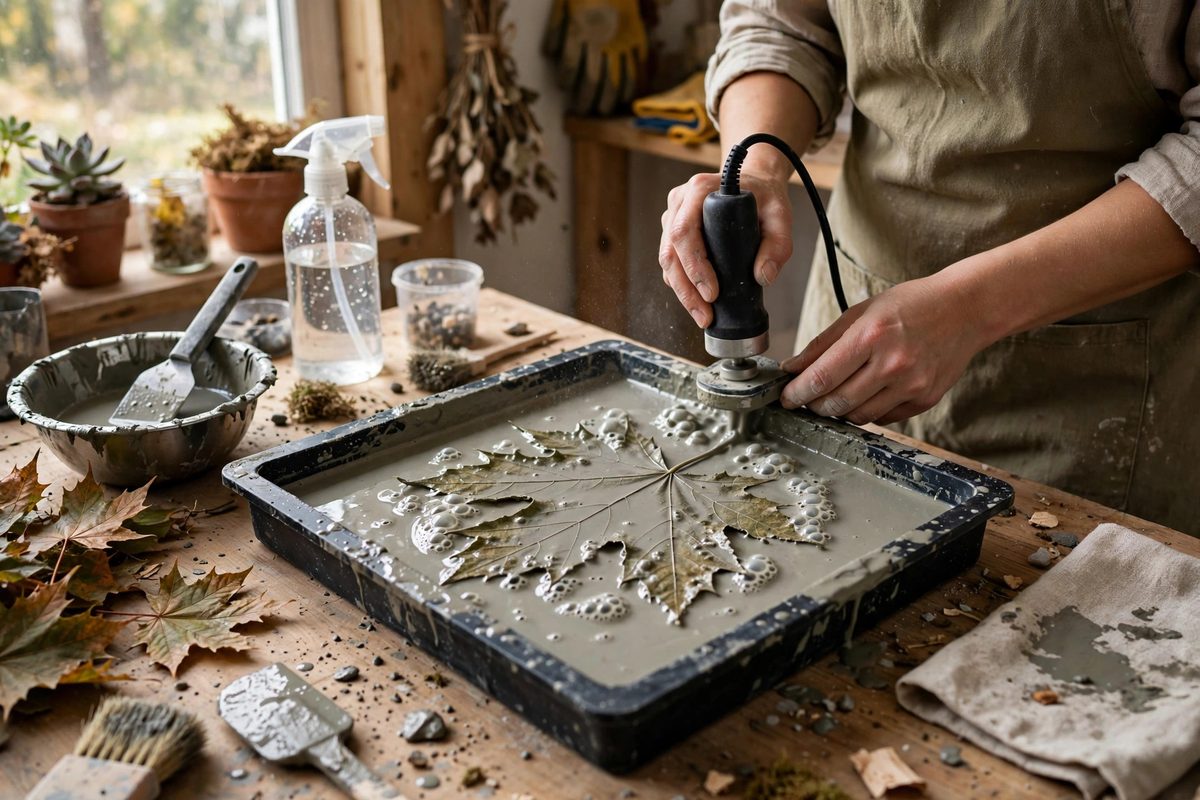
Leaf casting, pressing real leaves into mortar to capture their veining in concrete, lives or dies on surface quality: the leaf's delicate detail only transfers if the mortar flows into every vein and serration without trapping air. Air pockets show up as pocks and voids that ruin the fossil-like detail. Vibration is the maker's solution: shaking the mold at the right frequency and amplitude lets trapped air rise out while the slurry settles into the leaf's texture.
Why air gets trapped
Mortar is a thick suspension of cement, sand, and water. When it is placed over a leaf, its viscosity prevents it from flowing into fine detail on its own, and air gets caught in the leaf's veins, under its edges, and in the mold's corners. Troweling and poking help but cannot reach everywhere, and overworking the surface drives air deeper. Vibration temporarily liquefies the mix: the aggregate particles jiggle apart, the slurry flows like a much thinner liquid, air bubbles rise through it, and when the vibration stops the mix stiffens back up, now fully in contact with the leaf.
Vibration methods that work
For small leaf castings, the simplest effective method is hand vibration: lift the mold a fraction of an inch and tap it firmly and repeatedly against the workbench, or tap the mold's sides with a rubber mallet. The impacts send shock waves through the slurry that release bubbles. For larger castings, a palm sander (without sandpaper) pressed against the underside or side of the mold provides continuous vibration; run it in slow passes across the mold's bottom. Purpose-built concrete vibrators exist but are overkill for craft-scale leaf casting. Whatever the method, vibrate promptly after placing the mortar; once the mix starts to set, vibration does more harm than good.
Slurry consistency and timing
Vibration cannot fix a mix that is too dry: the slurry must be wet enough to flow under vibration, roughly a thick milkshake consistency for leaf casting detail work. Too wet, though, and the cement paste separates from the sand, weakening the casting and causing shrinkage cracks. Mix to the right consistency first, place promptly, then vibrate. Watch the surface during vibration: bubbles rising and popping is the process working. When bubbling stops and the surface looks uniformly settled, stop vibrating; continuing past this point segregates the mix.
Mold and leaf preparation
Seat the leaf firmly in the mold before the mortar goes in, vein-side up, smoothing out any curled edges that would trap air beneath them. A light misting of the mold with water (or a proper release agent) prevents the mortar from sticking and lets it flow against the mold surface. Pour or place the mortar from one side and let it flow across the leaf rather than dumping it on top; the flowing front pushes air ahead of it instead of trapping it. Then vibrate to finish what the pour started.
Curing for detail preservation
Keep the casting damp while it cures: cover with plastic for several days. Rapid drying shrinks the surface and can craze the fine detail the vibration worked so hard to capture. Do not demold early; the leaf detail is fragile until the mortar gains strength. When the casting is fully cured, the leaf residue brushes or washes away, leaving the crisp veining that makes the piece.
Right consistency, placed to push air ahead, vibrated until the bubbles stop, cured damp. The leaf's detail will be there in stone.
Related Guides
- High Strength Aggregate Mixes for Detailed Leaf Casts: A leaf cast lives or dies on the mix. The plaster or cement has to capture vein detail fine enough to read, then survive being handled, hung, and
- Reinforced Concrete Slurry Mixes for Leaf Castings: A leaf casting captures a leaf's veining in concrete with a fidelity no carving can match: you press a real leaf into sand, pour concrete over it
- Alkali-Resistant Fiber Mesh Layouts for Cement Leaves: Cement leaf castings, made by pressing real leaves into a cement mold or casting cement over them, are garden art with a structural problem: thin
- Polymer-Fortified Cement Slurries for Leaf Impressions: Pressing a leaf into wet cement captures every vein and serration in stone, making garden art that outlasts the plant by decades. But plain cement is