
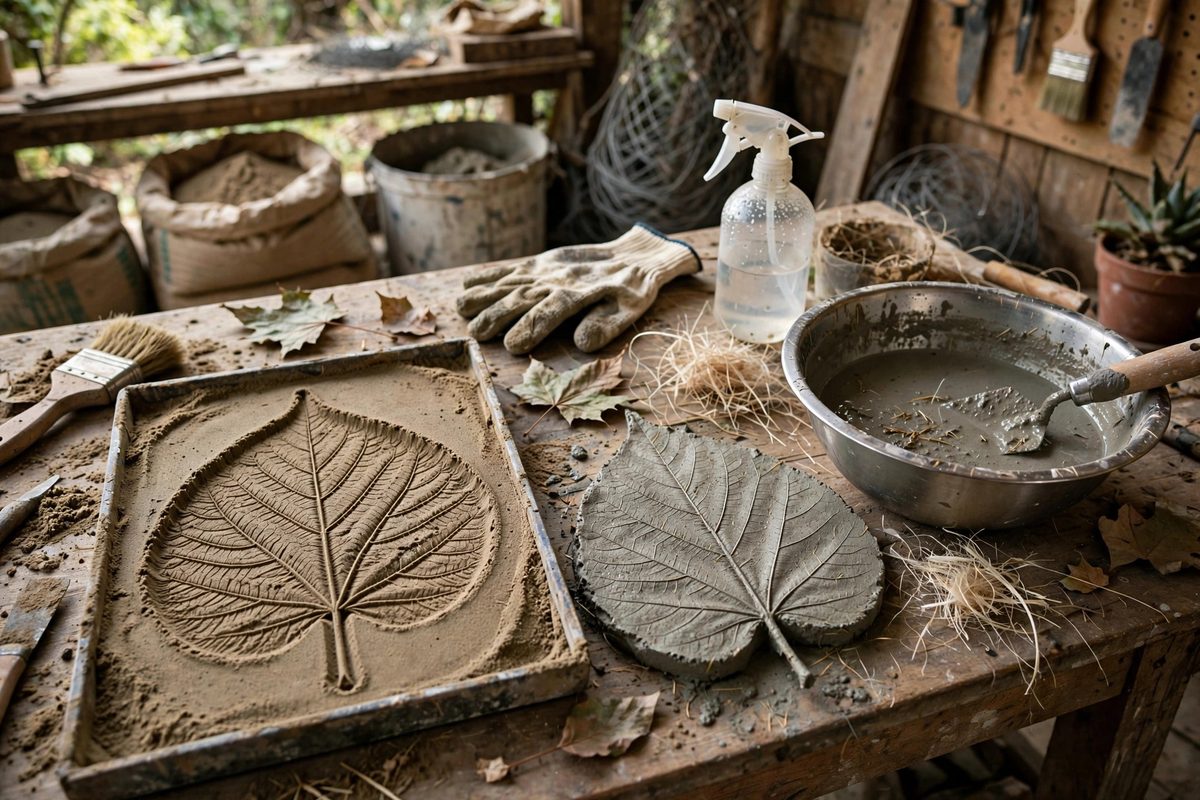
A leaf casting captures a leaf's veining in concrete with a fidelity no carving can match: you press a real leaf into sand, pour concrete over it, and peel away a permanent fossil of summer. The mix is everything. Too stiff and it bridges over the fine veins instead of flowing into them; too wet and it shrinks, cracks, and cures weak. A reinforced slurry, fluid enough to capture detail and fiber-reinforced against cracking, is the mix that makes leaf castings crisp, strong, and durable outdoors.
Why slurry captures detail
Detail capture is a flow problem. The leaf's veins are tiny valleys, some a fraction of a millimeter deep, and the concrete must flow into every one before it stiffens. A stiff, low-slump mix cannot do this; its aggregate particles bridge across the fine features and leave voids. A slurry, a mix fluid enough to self-level, flows into the veins under its own weight, reproducing them faithfully. The trade-off is that fluid mixes contain more water, and excess water weakens concrete as it cures: the water that does not get consumed in hydration leaves pores behind. The art of the casting mix is hitting the narrow window between fluid enough to capture veins and dry enough to cure strong. A water-reducing admixture, the kind sold for concrete countertops, helps enormously here: it makes the mix flow at a lower water content, giving you the best of both worlds.
The base mix and proportions
Start with a sand-only mix, no coarse gravel: portland cement and fine sand in roughly equal parts by volume, sometimes with a little extra cement for a creamier paste. The fine sand flows into detail that gravel would block, and the high cement content gives a smooth surface that takes the leaf's texture cleanly. Mix the dry ingredients thoroughly before adding water, then add water gradually until the mix reaches a thick pancake-batter consistency: it should flow off the trowel in a slow ribbon, not run like soup and not clump like dough. Test it on a scrap leaf pressed into sand before committing to your showpiece; the test pour reveals whether the mix is capturing veins or bridging them, and it costs almost nothing. Adjust with tiny water additions, because the window between too stiff and too wet is narrow.
Fiber reinforcement against cracking
Thin concrete cracks; that is its nature. A leaf casting is often only half an inch to an inch thick at its center, tapering to almost nothing at the leaf's edge, which makes it fragile by concrete standards. Fiber reinforcement changes the equation: tiny fibers distributed through the mix bridge micro-cracks as they form, holding the casting together where unreinforced concrete would snap. Alkali-resistant glass fibers or polypropylene fibers, sold for concrete countertops and overlays, mix in easily: add a small handful per batch and blend until the fibers disappear into the mix. The fibers are invisible in the finished casting but they transform its toughness, especially at the thin, vulnerable leaf margins. For larger castings, consider also pressing a piece of wire mesh or hardware cloth into the middle of the pour as macro-reinforcement, keeping it centered in the thickness so it does not show on either face.
Casting technique
Prepare the leaf by pressing it vein-side up into a mound of damp sand, shaping the sand so the leaf lies naturally with its edges supported; unsupported edges curl and distort the casting. Mist the leaf lightly with a release agent, plain cooking spray works, so the concrete releases cleanly. Pour or trowel the slurry onto the leaf starting at the center, working outward, and vibrate the mold by tapping the table or the sand mound to release trapped air bubbles; bubbles trapped against the leaf become permanent pocks in the casting. Build the thickness up to at least half an inch at the center, feathering toward the edges but never paper-thin. Cover the casting with plastic immediately after shaping: slow, moist curing is critical for strength, and a casting that dries out in the sun will be weak and prone to surface crazing regardless of how good the mix was.
Curing, demolding, and safety
Leave the casting covered for at least several days; concrete gains strength slowly, and leaf castings are handled and displayed, so they need real curing, not just setting. Demold by lifting the casting and peeling the leaf away, then let it cure further before placing it outdoors. Now the safety notes, stated plainly because they matter: wet portland cement is strongly alkaline and causes chemical burns on prolonged skin contact, so wear gloves and long sleeves when mixing and casting. Dry cement powder contains silica; wear a dust mask when handling the bag and mixing dry ingredients, and mix in ventilated air. These are not exotic hazards, but they are real, and they are entirely preventable with basic precautions.
Fluid enough to flow into veins, fiber-tough enough to survive handling, and cured slowly under plastic: that mix turns a leaf into a garden ornament that will outlast the tree it came from.
Related Guides
- High Strength Aggregate Mixes for Detailed Leaf Casts: A leaf cast lives or dies on the mix. The plaster or cement has to capture vein detail fine enough to read, then survive being handled, hung, and
- Polymer-Fortified Cement Slurries for Leaf Impressions: Pressing a leaf into wet cement captures every vein and serration in stone, making garden art that outlasts the plant by decades. But plain cement is
- Vibrating Mortar Slurry to Stop Air Pockets in Casts: Leaf casting, pressing real leaves into mortar to capture their veining in concrete, lives or dies on surface quality: the leaf's delicate detail
- Alkali-Resistant Fiber Mesh Layouts for Cement Leaves: Cement leaf castings, made by pressing real leaves into a cement mold or casting cement over them, are garden art with a structural problem: thin