
Reed is wood, and wood bends only when its fibers are willing. Dry reed snaps. Properly soaked reed bends around stakes, cinches tight, and holds its shape as it dries. The whole craft of basketry rests on this one material behavior, yet soaking times are rarely taught with precision: most instruction stops at "soak until pliable." Understanding what pliable actually means, how long different reeds take to get there, and what happens when you overshoot will quietly upgrade every basket you weave.
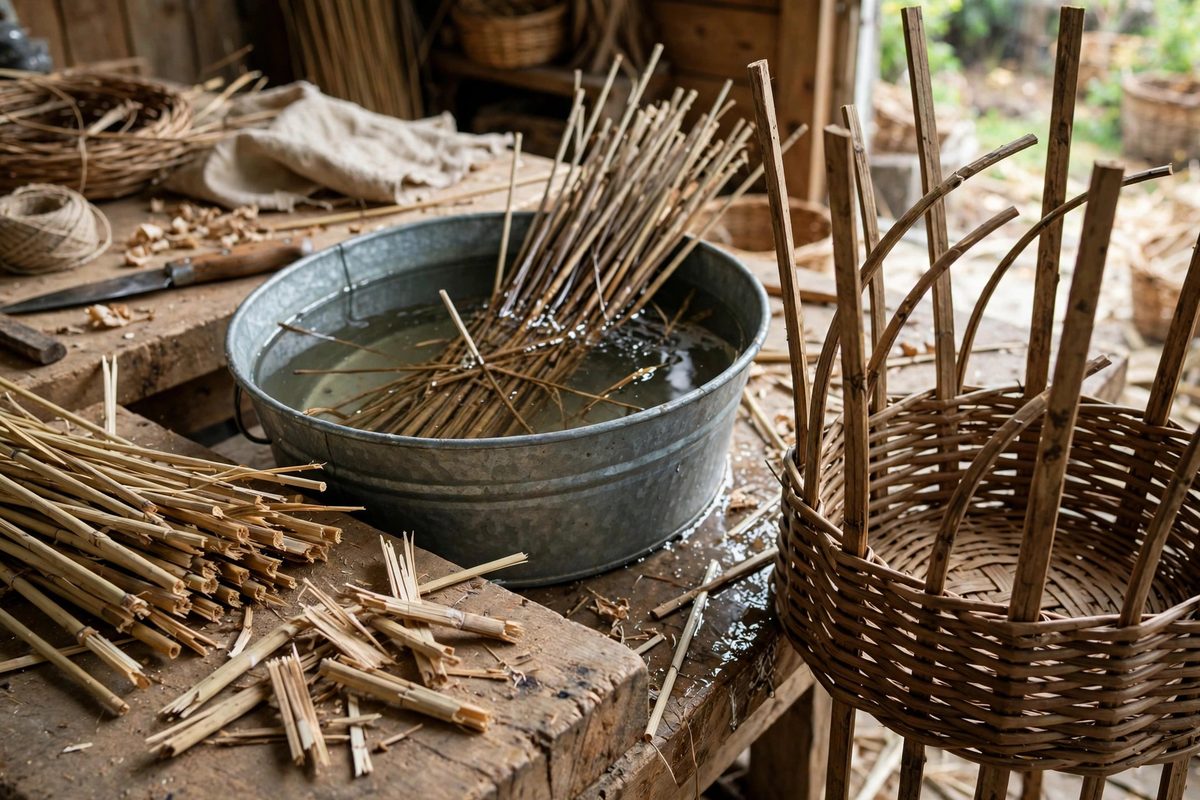
Why water makes reed bend
Reed is rattan palm fiber, a bundle of cellulose fibers glued together by lignin. Dry lignin is rigid, which is why dry reed behaves like a stick. Water plasticizes the lignin, softening the bonds between fibers so they can slide past each other as the reed bends. This is the same principle behind steam bending lumber, just gentler and slower. The key insight is that the water needs to reach the interior of the reed, not just wet the surface. A reed that is wet outside and dry inside will bend partway and then crack along the dry core. Soaking time is really penetration time, and it scales with thickness: thin weavers saturate in minutes, while fat stakes need much longer.
Soaking times by reed type
As rough shop guidance: fine weavers and thin flat reed, around 1/4 inch and under, usually become pliable after about 5 to 10 minutes in room-temperature water. Medium round reed and standard stakes, in the 3/8 to 1/2 inch range, typically need 15 to 30 minutes. Heavy stakes and thick flat reed for large work can need 30 minutes to an hour. Warm water speeds penetration noticeably; cold water works but takes longer. These are starting points, not rules, because reed varies by harvest, age, and storage. Old, dry reed from the back of the closet always needs longer than fresh stock. Test rather than timing blindly: pull a piece out, bend it into a tight U, and watch. Ready reed bends smoothly with no crackling and holds a curve without springing straight. If you hear or feel fibers popping, it needs more time.
Stakes versus weavers
Stakes and weavers want different moisture levels, and this is where many beginners go wrong by soaking everything together. Stakes are the structural skeleton; they need to be pliable enough to bend into the base and set upright, but firm enough to resist the tension of weaving. Slightly under-soaked stakes are better than over-soaked ones, because a stake that is too soft will not hold its shape against the weavers' pull. Weavers, by contrast, want to be fully supple, since they do all the tight bending around the stakes. A practical approach is to soak stakes for a shorter time and weavers longer, or to soak everything together and pull the stakes out first. Keep a spray bottle handy during weaving to re-wet weavers that start drying out, because reed begins stiffening the moment it leaves the water.
The trouble with over-soaking
More water is not always better. Reed left soaking for hours becomes mushy: the fibers separate, the surface fuzzes, and the reed loses the spring it needs to pack tightly. Over-soaked weavers stretch as you pull them, so rows that felt tight during weaving shrink and loosen as the basket dries. Even worse, a basket woven with saturated reed shrinks significantly in drying, loosening the whole structure. If you over-soak, lay the reed out on a towel for a while and let the surface dry back to a damp state before weaving. The ideal condition is often described as "like a damp towel": wet through, but not dripping. Err on the side of re-wetting during work rather than starting saturated.
Drying and setting the shape
Reed has memory, and it remembers the shape it dries in. This is why baskets hold their form: you weave the reed wet and pliable, and as it dries the lignin re-hardens, locking in the curves. Use this deliberately. Pack rows tightly while the reed is damp, because they will only loosen slightly as they dry, never tighten. If a stake drifts out of position during weaving, correct it while everything is still wet; once dry, the position is set. Let finished baskets dry slowly and evenly, away from direct heat, so the whole piece shrinks uniformly. A basket dried too fast on one side can warp. When it is fully dry, the reed should feel hard and make a crisp sound when tapped: the sound of lignin that has done its job.
Soaking is the least glamorous step in basketry and one of the most consequential. Learn to read reed with your hands instead of watching the clock, and the material will tell you exactly when it is ready to work.
Related Guides
- Moisture Regain Elasticity Changes in Bast Fibers: Bast fibers, flax, hemp, jute, ramie, the long fibers drawn from plant stems, behave differently wet than dry in ways that matter at every stage from
- Moisture Absorption Impact on Hemp Cordage Strength: Hemp cordage has held the world together for millennia: rigging, nets, lashings, and garden twine. It is strong, sustainable, and pleasant to work
- Tensile Strength Testing in Natural Braid Fibers: Natural fibers for braiding, hemp, jute, linen, cotton cord, vary enormously in strength from batch to batch, and a braid is only as strong as its
- Tensile Elasticity Loss in Wet Spun Flax Cordage: Flax spun wet, the traditional method for fine linen thread, produces cordage with remarkable strength and smoothness. But flax fiber's relationship
- Calculating Split Cane Taper Ratios for Ribs: Basket ribs, the structural stakes that radiate from the base and define the basket's shape, are usually tapered: thick and strong at the base where