
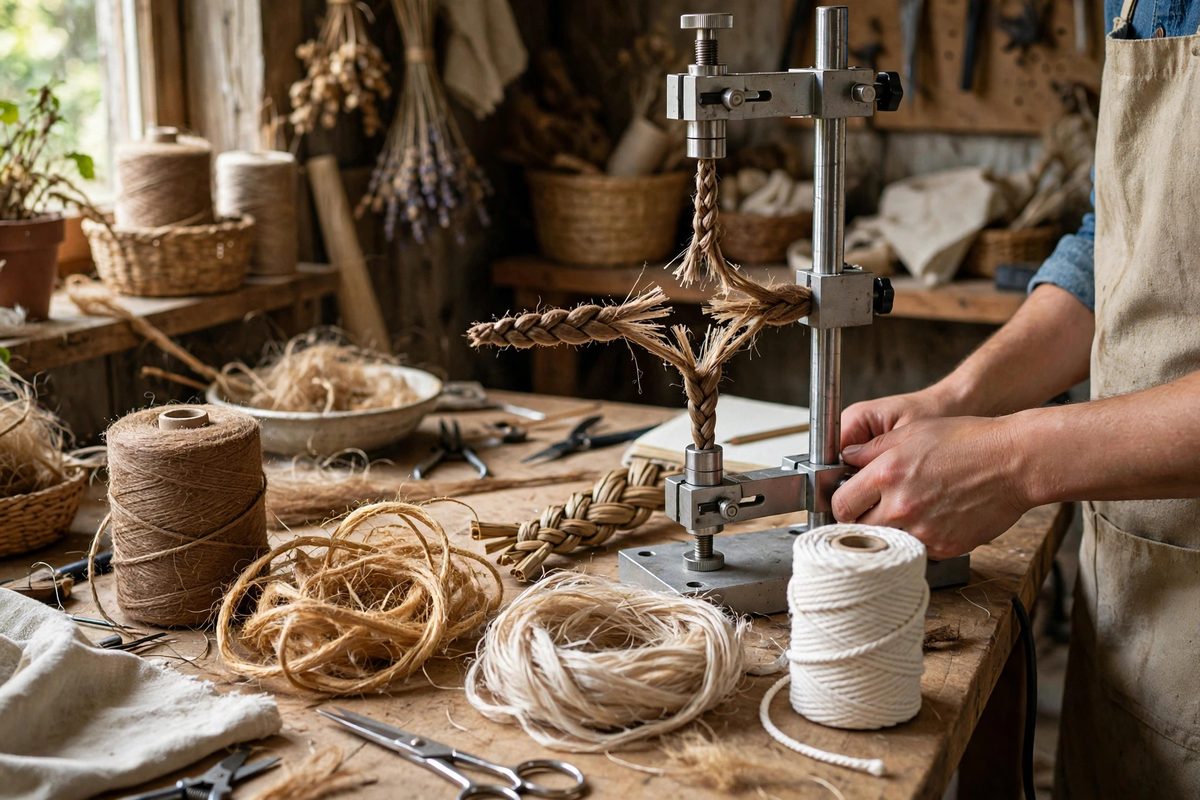
Natural fibers for braiding, hemp, jute, linen, cotton cord, vary enormously in strength from batch to batch, and a braid is only as strong as its weakest strand. Tensile testing, pulling samples to failure and recording the force, replaces guesswork with numbers: which fiber suits a plant hanger versus a market bag, whether a bargain cord is actually a bargain, and how much safety margin a load-bearing braid really has. The testing is simple; the knowledge is durable.
Why test instead of trusting labels
Fiber strength varies with growing conditions, processing, storage age, and even the position in the bale. Labels state nominal values for ideal material, if they state anything at all; craft cord often carries no rating whatsoever. A quick pull test on the actual spool in your hands tells you what you actually bought, which is the only number that matters for the project.
Testing also reveals degradation. Natural fibers weaken with UV exposure, moisture cycling, and age; a cord that tested strong last year may not test strong today. Periodic testing of stored stock prevents building structural pieces from tired fiber.
A practical test setup
You do not need a lab tensile tester. A luggage scale or a hanging scale, a secure anchor overhead, and a way to grip the fiber without cutting it at the grip will do. The critical detail is the grip: fibers break at stress concentrations, so clamping directly in a jaw or tying a sharp knot at the attachment invalidates the test. Wrap the fiber several turns around a smooth dowel or carabiner at each end; the wraps distribute the load and the break occurs in the free span, where it should.
Pull slowly and steadily, straight along the fiber's axis, and record the peak force at failure. Test at least five samples from different parts of the spool and average them; single tests are noisy, and the average plus the lowest value together describe both typical strength and worst-case weakness.
Testing braids, not just strands
A braid's strength is not the sum of its strands' strengths. Braiding introduces angle: the strands run diagonally to the load, so only a component of each strand's strength resists the pull, and the interlacing creates stress concentrations at the crossovers. Test the finished braid structure, prepared exactly as the project will use it, including any knots or splices, because knots typically cut fiber strength substantially.
Test the braid the way it will be loaded: a plant hanger braid tested in straight pull behaves differently from one loaded over a ring or hook. Reproduce the project's loading geometry in the test, or the numbers mislead. This is more work than testing strands, and it is the testing that actually predicts project performance.
Interpreting results for project design
Apply a safety factor to the measured breaking strength: the working load should be a fraction of the breaking load, with the fraction shrinking as consequences grow. A decorative wall hanging can run closer to the limit than a hammock or a child's swing, where the safety factor should be generous. Natural fiber's variability and degradation over time both argue for conservative factors.
Consider the load case honestly: static hanging weight is the easy case; dynamic loads from wind, handling, or a shifting load spike far above static. Design for the dynamic case. And remember that moisture weakens most natural fibers temporarily and UV weakens them permanently; an outdoor braid needs its safety factor computed against degraded strength, not fresh-spool strength.
Keeping test records
Log every test: fiber type, source, date, sample count, average and minimum breaking force, and the test geometry. This log becomes a material library that informs every future project: which suppliers' hemp runs strong, how fast stored jute degrades, what a given braid pattern actually holds. Over time it is worth more than any single project's plans.
Re-test when anything changes: new supplier, new batch, fiber stored for a season, braid pattern modified. Strength is a property of the specific material in front of you, not of the fiber type in general, and the log keeps that truth visible.
Tensile testing turns fiber selection from folklore into engineering: grip without stress risers, pull to failure, average several samples, test the braid as loaded, apply honest safety factors, and log everything. The braid will hold what you claim it holds, because you measured it.
Related Guides
- Tensile Elasticity Loss in Wet Spun Flax Cordage: Flax spun wet, the traditional method for fine linen thread, produces cordage with remarkable strength and smoothness. But flax fiber's relationship
- Moisture Regain Elasticity Changes in Bast Fibers: Bast fibers, flax, hemp, jute, ramie, the long fibers drawn from plant stems, behave differently wet than dry in ways that matter at every stage from
- Moisture Absorption Impact on Hemp Cordage Strength: Hemp cordage has held the world together for millennia: rigging, nets, lashings, and garden twine. It is strong, sustainable, and pleasant to work
- Reed Moisture Soaking Times for Tension Stake Weaving: Reed is wood, and wood bends only when its fibers are willing. Dry reed snaps. Properly soaked reed bends around stakes, cinches tight, and holds its
- Calculating Split Cane Taper Ratios for Ribs: Basket ribs, the structural stakes that radiate from the base and define the basket's shape, are usually tapered: thick and strong at the base where