
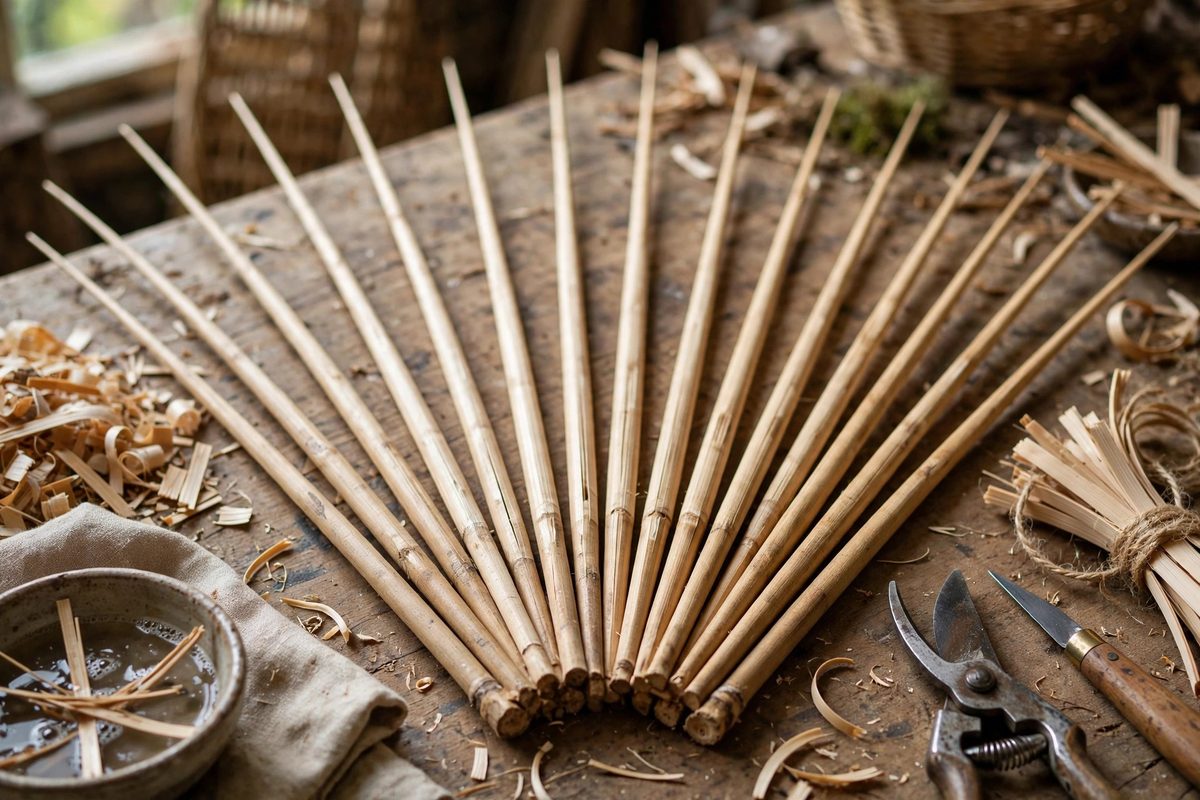
Basket ribs, the structural stakes that radiate from the base and define the basket's shape, are usually tapered: thick and strong at the base where stress concentrates, thinning toward the rim where flexibility matters. Split cane takes tapering beautifully, but the taper ratio, how much thinner the tip is than the base, determines whether the basket holds its shape or goes floppy. Here is how to calculate and cut tapers that work.
Why ribs taper
A rib is a cantilever beam anchored at the basket's base. The bending stress is highest at the anchor point and decreases toward the free tip, so the rib needs the most material where it meets the base and progressively less toward the rim. A rib of uniform thickness is overbuilt at the tip and, paradoxically, harder to bend into the basket's curve up high, where you want it to flex. Tapering matches the material to the stress diagram: strong at the bottom, supple at the top. It also saves weight and lets the rim finish cleanly without bulky rib ends.
Choosing a taper ratio
A practical starting ratio for round or oval baskets is a tip about one-third to one-half the thickness of the base. For a rib that starts at 6mm thick at the base, that means tapering to roughly 2 to 3mm at the tip. Sturdy utility baskets that will carry loads favor the heavier end of that range (half), since the ribs double as load-bearing structure. Light decorative work can go finer (a third or even a quarter), gaining elegance at the cost of strength. The taper should be gradual and smooth along the rib's full length, not stepped; a sudden thin spot becomes a hinge where the rib will eventually crack.
Measuring and marking the taper
Split your cane to the base thickness first, then mark the taper. Measure the rib's working length, from where it leaves the base to the rim, and mark the midpoint and the tip target thicknesses. A simple marking gauge, two pencil lines on a board at the base and tip thicknesses with a straight line between them, gives you a visual taper template to check against. Shave with a sharp knife or a spokeshave, working from the middle toward the tip, and check frequently with calipers. Remove material from the inner face of the rib (the side facing the basket's interior) so the outer face stays smooth and unbroken; the outer fibers carry the most tension when the rib bends.
Accounting for the bend
Ribs do not stay straight; they bend outward from the base and then inward to the rim, and bending changes the effective requirement. A rib bent into a tight curve needs to be thinner at the bend than a straight rib of the same length, because the outer fibers stretch. If your basket has a pronounced belly, taper slightly more aggressively through the belly section. Soak the tapered ribs before bending: wet cane bends without the outer fibers splitting, and the taper lets the bend distribute evenly instead of kinking at one point. Let the ribs take their set before weaving begins.
Consistency across the set
All ribs in a basket should taper identically, or the basket will weave up lopsided: thicker ribs resist the weavers more and push the shape outward at their stations. Cut and taper all ribs as a batch, checking each against the template. Number them if you are tapering in multiple sessions. Consistent ribs are the invisible foundation of a basket that looks effortless.
Match the taper to the stress, shave it smooth, and keep the set consistent. The basket's strength and its silhouette both come from those quiet calculations.
Related Guides
- Willow Cane Splitting Ratios for Curved Basket Rims: A basket's rim takes the most abuse of any part: it is grabbed, bumped, and loaded, and it must hold the stakes' tops in a neat, strong circle. The
- Steam Bending Willow Ribs for Rigid Ribbed Baskets: Ribbed baskets, built on a skeleton of bent ribs like an upturned boat hull, are among the oldest and strongest basket forms. The ribs define the
- Tensile Strength Testing in Natural Braid Fibers: Natural fibers for braiding, hemp, jute, linen, cotton cord, vary enormously in strength from batch to batch, and a braid is only as strong as its
- Reed Moisture Soaking Times for Tension Stake Weaving: Reed is wood, and wood bends only when its fibers are willing. Dry reed snaps. Properly soaked reed bends around stakes, cinches tight, and holds its
- Tensile Elasticity Loss in Wet Spun Flax Cordage: Flax spun wet, the traditional method for fine linen thread, produces cordage with remarkable strength and smoothness. But flax fiber's relationship