
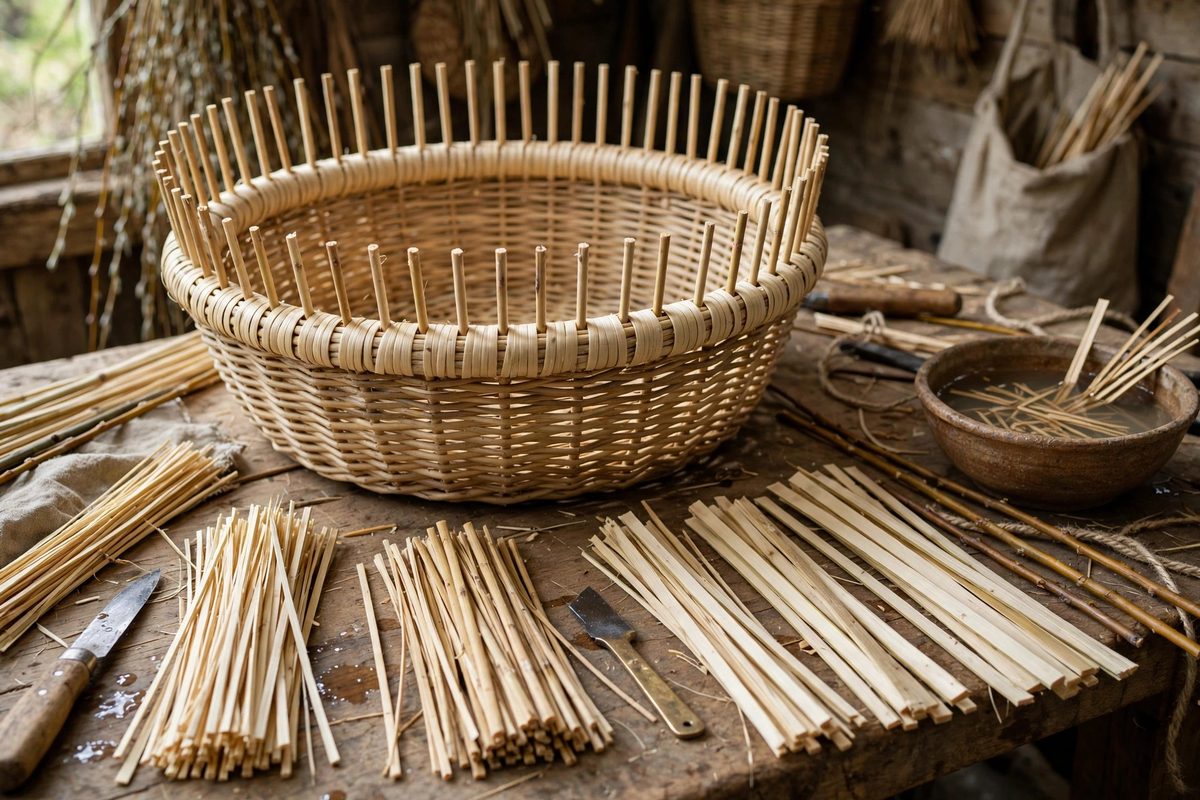
A basket's rim takes the most abuse of any part: it is grabbed, bumped, and loaded, and it must hold the stakes' tops in a neat, strong circle. The traditional solution is a rim of split willow cane, often a double or triple rim lashed over the stake tops, curved to the basket's shape. Splitting the cane, dividing a round rod into halves, thirds, or quarters along its length, is what makes this possible: the split sections bend to tighter curves than whole cane, and the splitting ratio, how many splits from one rod, determines the balance between strength and flexibility. Choosing the right ratio for the rim's curvature is the difference between a rim that bends sweetly into place and one that snaps or springs back.
Why rims use split cane
Whole willow cane is strong but stiff; bending it to a basket's rim curve, especially on smaller baskets, stresses the outer fibers past their limit and they fracture. Splitting the cane along its length divides the cross-section, and each split bends far more readily because bending stiffness falls dramatically with thickness. A quarter-split bends to curves that would snap the whole rod, while retaining enough strength for rim duty when doubled or tripled with lashing. The split also exposes the cane's inner pith, which grips lashing better than the slick bark exterior, making for a more secure rim assembly. Splitting is thus both a bending solution and a joining improvement, which is why it is universal in traditional rim work.
Splitting ratios and their character
The ratio describes how many usable splits come from one rod. Halves are the stoutest: each half retains substantial strength and bends to moderate curves, suiting large baskets with generous rim radii. Thirds split the difference, offering good flexibility for medium baskets while keeping enough body for a single or double rim. Quarters are the finest: very flexible, bending to tight curves on small baskets, but individually too slight for a structural rim, so they are used doubled or tripled. The choice follows the rim's radius and the basket's scale: tighter curves need finer splits, larger baskets can use coarser ones. When in doubt between ratios, choose the finer split and double it; two fine splits lashed together exceed one coarse split in both strength and curve-hugging, at the cost of more work.
Splitting technique
Good splits start with good cane: straight, sound rods without branches or damage in the splitting length. Begin the split with a knife at the rod's end, dividing it evenly, then pull the halves apart steadily, guiding the split with slight lateral pressure to keep it centered; the split follows the grain, and even pressure keeps it from running off to one side. For thirds and quarters, split in stages: halve first, then split the halves. Keep the splits even in thickness, since a split that tapers from thick to thin bends unevenly and weakens at the thin sections. Work with the cane at the right moisture: too dry and it splits brittlely and cracks on bending, too wet and the splits are spongy; traditionally, cane is soaked and then allowed to surface-dry to a flexible, leathery state before splitting and bending.
Fitting the rim to the curve
Form the split cane around the basket's rim shape before lashing, letting it take the curve gradually; forcing a dry or unwilling split invites fracture. The rim assembly typically sandwiches the stake tops between an inner and outer rim piece, with the lashing binding the whole sandwich; the splits' flexibility lets them conform to the stake tops' irregular line. Overlap the rim pieces' ends with long, tapered scarf joints rather than butt joints, since the rim's strength must be continuous around the circle. Lash tightly and evenly, spacing the lashing uniformly; the lashing is structural, clamping the rim sandwich together, and sloppy lashing lets the rim work loose under handling. The finished rim should feel like a single solid ring, with no spring or rattle.
Common failures and prevention
Rim failures follow patterns. Splits that crack during bending were usually too dry, too coarse for the curve, or forced; the prevention is proper soaking, correct ratio selection, and patient forming. Rims that spring away from the basket after lashing indicate the splits were fighting the curve, storing elastic energy that the lashing cannot permanently restrain; finer splits or a gentler curve resolve it. Lashing that loosens over time points to cane that shrank as it dried after assembly; assemble at the working moisture and expect some settling, or seal the finished rim to slow moisture cycling. A rim that feels flexible and creaky in use is underbuilt for the basket's scale; add another rim layer rather than accepting the movement, since flexing works the lashing loose progressively.
Finishing and care
Trim and tuck all lashing ends securely; loose ends catch and unravel. Some makers seal rims with oil or wax to moderate moisture uptake, which stabilizes the assembly through humidity changes. Store and display baskets so the rim is not bearing weight or catching passersby; the rim is strong in its designed direction and vulnerable to knocks from the side. A well-split, well-lashed rim lasts as long as the basket, aging into the patina that makes old basketry beautiful. The splitting ratio decision, made in minutes at the workbench, echoes through the basket's whole life.
Split willow cane to the ratio the rim's curve demands: halves for generous radii, thirds for the middle, quarters doubled for tight curves. Split evenly at the right moisture, form patiently, scarf the joints, lash tightly. The rim is the basket's handshake; make it firm and true.
Related Guides
- Splitting Willow Whips for Flexible Wicker Corner Posts: Basket corners take the most stress and need the most flexible material. Splitting willow whips, dividing a round rod into flat, pliable strips
- Calculating Split Cane Taper Ratios for Ribs: Basket ribs, the structural stakes that radiate from the base and define the basket's shape, are usually tapered: thick and strong at the base where
- Steam Bending Willow Ribs for Rigid Ribbed Baskets: Ribbed baskets, built on a skeleton of bent ribs like an upturned boat hull, are among the oldest and strongest basket forms. The ribs define the
- Tensile Strength Testing in Natural Braid Fibers: Natural fibers for braiding, hemp, jute, linen, cotton cord, vary enormously in strength from batch to batch, and a braid is only as strong as its
- Reed Moisture Soaking Times for Tension Stake Weaving: Reed is wood, and wood bends only when its fibers are willing. Dry reed snaps. Properly soaked reed bends around stakes, cinches tight, and holds its