
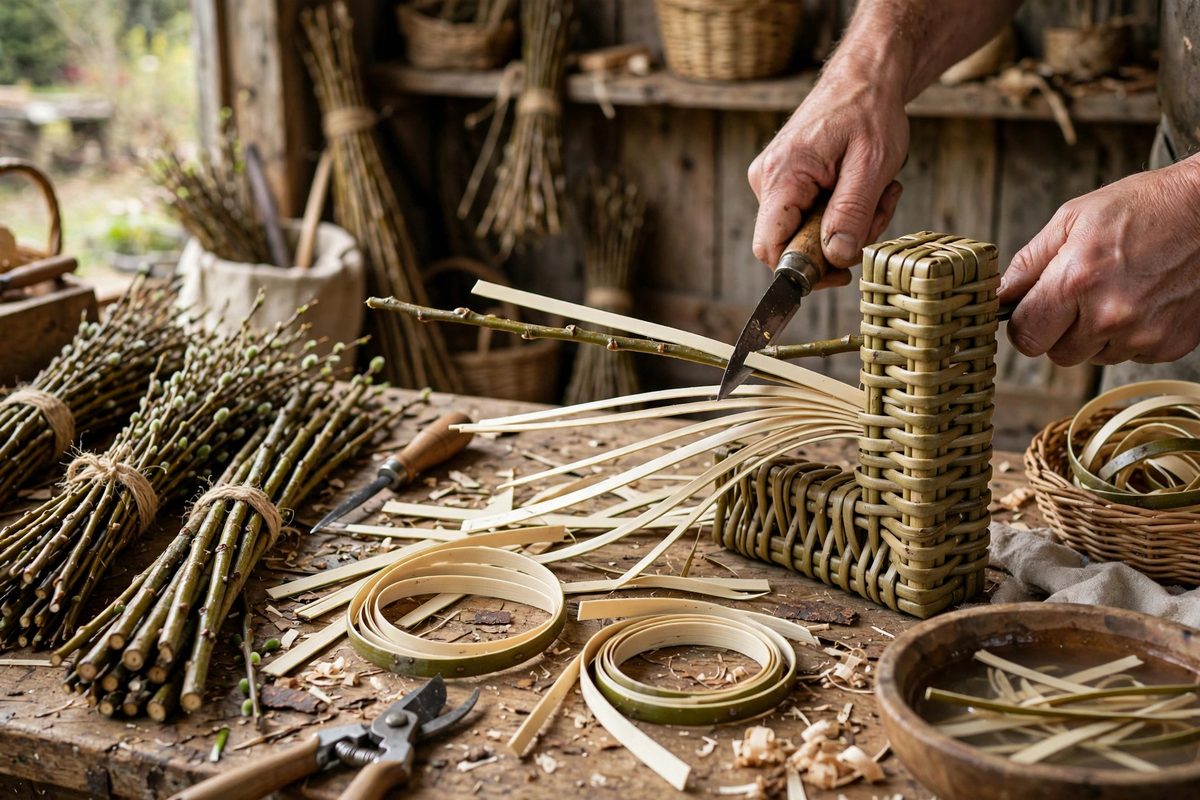
Basket corners take the most stress and need the most flexible material. Splitting willow whips, dividing a round rod into flat, pliable strips, produces corner posts that bend without breaking and weave tightly into the basket's structure. It is traditional basketry's answer to a hard problem.
Why split for corners
A whole willow rod is strong but stiff; bent around a tight basket corner, it kinks or snaps. Splitting the rod into two or three flat strips keeps most of the strength while multiplying the flexibility, because each thin strip bends easily. The flat profile also weaves more neatly, lying flush against the basket's side instead of rolling. Corner posts take the basket's weight when it is lifted and the impact when it is set down; split willow handles both better than whole rods.
Choosing the whips
Choose straight, knot-free willow whips of even thickness for splitting. The willow should be prepared for weaving: soaked until pliable, but not so long it gets slimy. Thicker whips split into more strips; a good corner-post whip yields two or three usable splits. Inspect each whip before splitting; a hidden knot or a weak spot will cause the split to run off, wasting the rod. Straight grain splits straight; anything else is a gamble.
The splitting technique
Start the split at the butt end with a knife, dividing the rod into the desired number of sections. Then pull the sections apart steadily, guiding the split with your thumbs to keep it centered. The key is even, continuous pressure; jerking or twisting sends the split off to one side. If the split starts to run off, bend the thicker side back toward the center to steer it. Experienced splitters use a simple wooden tool to hold the sections apart, but thumbs and patience work. Split the full length in one continuous motion for the cleanest strips.
Preparing the splits for use
Fresh splits have sharp edges and uneven thickness. Shave them lightly with a knife to even the thickness and ease the edges, working with the grain to avoid tearing. Keep the splits damp while working; dry splits are brittle and crack at the corner bend. The prepared split should bend around your finger without complaint. If it resists, it needs more soaking or more shaving; do not force it into the basket and hope.
Weaving the corner posts in
Set the corner posts first, before the side weaving, so the basket's structure grows around them. Anchor each post deeply into the base, and weave the side stakes around the posts as you work up. The posts should stand true and vertical; a leaning post leans the whole basket. At the top, the posts are typically bent over to form the border or rim, which is the final test of the split's flexibility. A well-split post makes the turn smoothly; a poor one cracks at exactly the visible moment.
Drying and finishing
Willow shrinks as it dries, so a basket woven with wet willow will loosen slightly. Weave tightly to account for this, and let the finished basket dry slowly out of direct sun to minimize distortion. Once dry, trim any fuzzy edges on the splits and check the corners for looseness. A basket whose corners were woven with well-split, well-fitted posts will tighten into itself as it dries and stay sound for years.
Split straight-grained whips with steady pressure, shave the strips even, keep them damp, and weave the corners first. The basket's hardest-working parts will be its most flexible, which is exactly as it should be.
Related Guides
- Willow Cane Splitting Ratios for Curved Basket Rims: A basket's rim takes the most abuse of any part: it is grabbed, bumped, and loaded, and it must hold the stakes' tops in a neat, strong circle. The
- Steam Bending Willow Ribs for Rigid Ribbed Baskets: Ribbed baskets, built on a skeleton of bent ribs like an upturned boat hull, are among the oldest and strongest basket forms. The ribs define the
- Tensile Strength Testing in Natural Braid Fibers: Natural fibers for braiding, hemp, jute, linen, cotton cord, vary enormously in strength from batch to batch, and a braid is only as strong as its
- Reed Moisture Soaking Times for Tension Stake Weaving: Reed is wood, and wood bends only when its fibers are willing. Dry reed snaps. Properly soaked reed bends around stakes, cinches tight, and holds its
- Tensile Elasticity Loss in Wet Spun Flax Cordage: Flax spun wet, the traditional method for fine linen thread, produces cordage with remarkable strength and smoothness. But flax fiber's relationship