
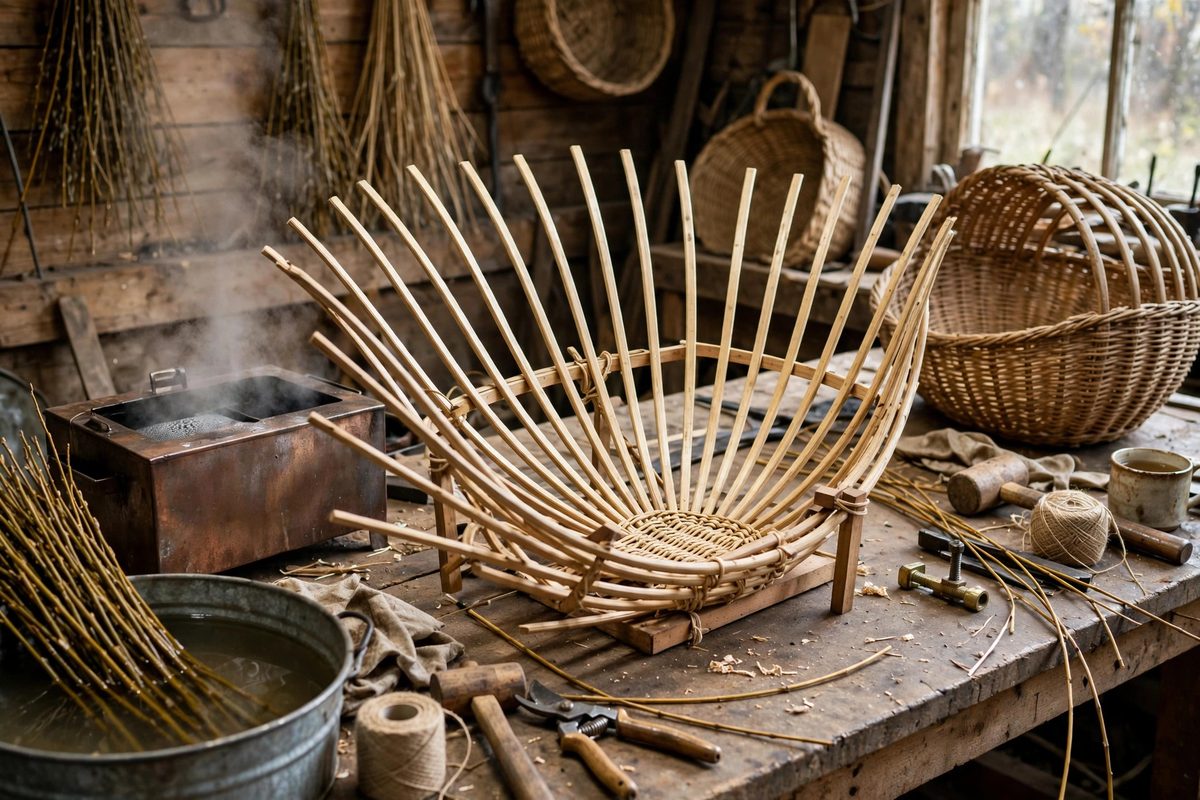
Ribbed baskets, built on a skeleton of bent ribs like an upturned boat hull, are among the oldest and strongest basket forms. The ribs define the basket's shape and carry its structure; the weaving fills between them. Willow is the traditional rib material because it steam-bends beautifully: heat and moisture plasticize the wood fibers, letting you bend a stout rib into a tight curve that would snap it cold. Done well, the ribs set into rigid, permanent curves that give the basket a lifetime of strength.
Why Steam Bending Works on Willow
Wood bends because its fibers can slide past each other when the lignin binding them softens, and heat plus moisture softens lignin. Willow is particularly cooperative: it is diffuse-porous with relatively uniform structure, so it bends evenly without the weak spots that plague ring-porous woods, and it grows in the long, straight, flexible rods (withies) that basketry needs. Steaming, as opposed to just soaking, drives heat deep into the rib quickly: the combination of near-boiling temperature and saturated moisture plasticizes the full thickness, not just the surface. A properly steamed willow rib bends like a wet noodle and then, as it cools and dries, the lignin re-sets, locking in the curve permanently.
Selecting and Preparing Ribs
Choose straight, knot-free willow rods of even thickness: knots and grain deviations are where bends fail, because the fibers cannot slide uniformly around the defect. The ribs should be slightly oversized in length for the intended basket, since bending consumes length and you need material for the handle or rim joinery. Peel the bark if the design calls for it (peeled willow bends slightly more readily and gives a cleaner look), or leave it on for rustic strength: bark-on ribs are tougher but less predictable in the bend. Soak the ribs before steaming: pre-soaking ensures the interior is moist, so the steam's job is heating rather than wetting, which gives more even plasticization.
Steaming: Time, Temperature, and Setup
Steam the ribs in an enclosed chamber, a length of pipe, a wooden box, or even a improvised trough with a kettle spout feeding steam, until they are heated through: the rule of thumb is roughly an hour per inch of thickness, but willow ribs are thin, so the actual time is much shorter. What matters is that the rib is hot and moist to the core: test with a scrap piece bent to the target radius. Work quickly once the ribs leave the steam: the plasticized state lasts only minutes as the rib cools, and a rib that cools mid-bend will crack rather than curve. Have your bending form ready before you open the steamer, and bend decisively: hesitation wastes the heat window.
Bending Technique and Forms
Bend each rib around a form that matches the basket's intended curve: a plywood template, a barrel, or a purpose-built bending jig. Apply the bending force gradually and evenly along the rib, supporting it so it does not kink: kinks happen when the bend concentrates at one point instead of distributing along the curve, and a kinked rib is a weakened rib. For tight curves, a backing strap (a thin metal strip on the outside of the bend) prevents the outer fibers from stretching and splitting: the strap forces the bend to compress the inner fibers rather than tear the outer ones. Clamp or tie the rib to the form and let it cool and dry in position: the set is not reliable until the rib has dried in the bent shape.
Drying and Setting the Curve
Leave the ribs on the forms until fully dry: rushing this step lets the ribs spring back partially, and a rib that has partially straightened cannot be re-bent to the same curve reliably. Drying time depends on thickness and conditions, but plan on days, not hours, for full setting. The ribs will shrink slightly as they dry: account for this in the form dimensions if precision matters. Once dry, the ribs are rigid: they should hold their curve with no tendency to straighten, and they should ring with a crisp tone when tapped, indicating the fibers have set solidly. Any rib that feels rubbery or springs back needs more drying time.
Weaving Between the Ribs
With the ribs set, the basket takes shape quickly: the ribs are lashed or woven at the base, spread to their final positions, and the weavers are woven between them. The rigid ribs make the weaving easier, not harder: they hold their spacing and shape, so the weaver's job is filling, not structural. Lash the ribs securely at the handle and rim: these joints carry the basket's loads in use, and they deserve the strongest lashing you can manage. A ribbed basket with well-bent, fully set willow ribs is remarkably strong: the rib skeleton carries loads that would crush a purely woven basket.
Select straight willow, steam it through, bend decisively on a form, and dry it fully in position. The ribs that result are the bones of the basket: rigid, permanent, and strong enough to carry the form for generations.
Related Guides
- Calculating Split Cane Taper Ratios for Ribs: Basket ribs, the structural stakes that radiate from the base and define the basket's shape, are usually tapered: thick and strong at the base where
- Willow Cane Splitting Ratios for Curved Basket Rims: A basket's rim takes the most abuse of any part: it is grabbed, bumped, and loaded, and it must hold the stakes' tops in a neat, strong circle. The
- Splitting Willow Whips for Flexible Wicker Corner Posts: Basket corners take the most stress and need the most flexible material. Splitting willow whips, dividing a round rod into flat, pliable strips
- Tensile Strength Testing in Natural Braid Fibers: Natural fibers for braiding, hemp, jute, linen, cotton cord, vary enormously in strength from batch to batch, and a braid is only as strong as its
- Reed Moisture Soaking Times for Tension Stake Weaving: Reed is wood, and wood bends only when its fibers are willing. Dry reed snaps. Properly soaked reed bends around stakes, cinches tight, and holds its