
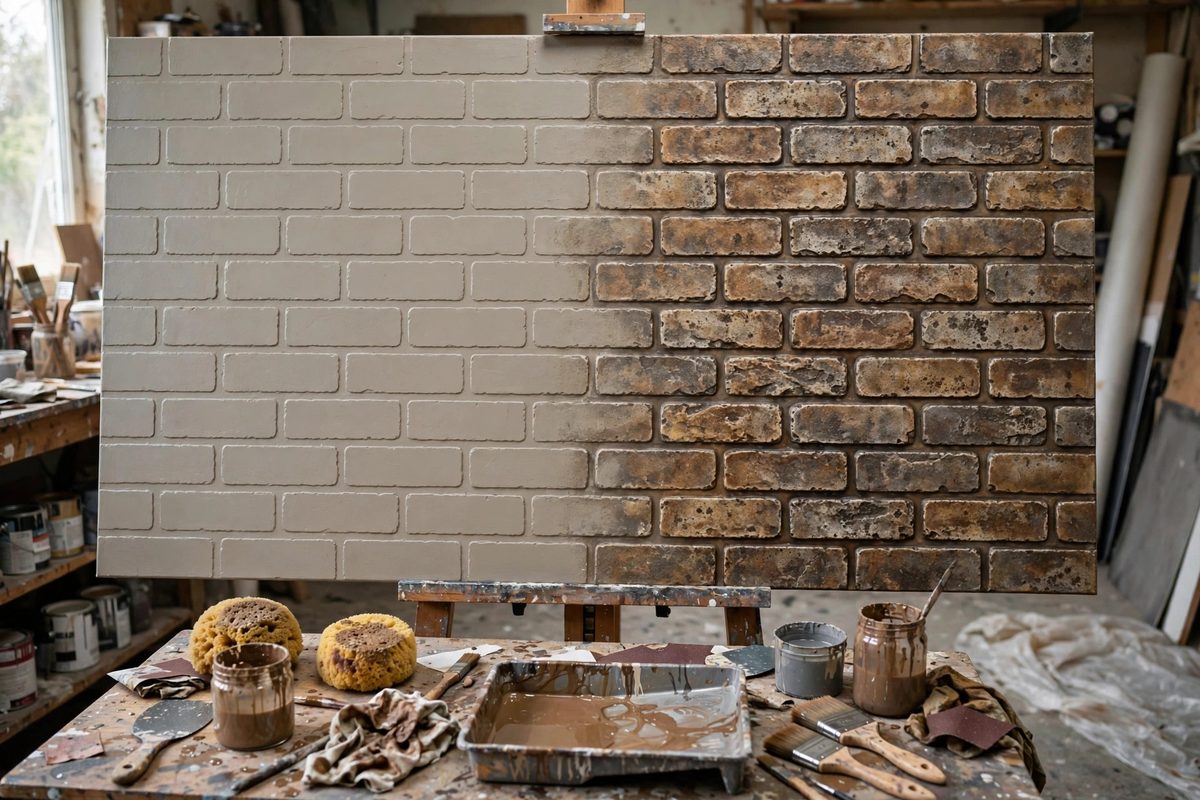
Faux masonry, painted stone or brick on a flat backdrop, succeeds or fails on texture. Flat, uniform paint reads as flat paint no matter how accurate the drawing; the eye knows instantly that real stone has depth. Scumble glazing is the scenic painter's primary tool for faking that depth: a broken, translucent layer of glaze dragged over a base coat so that the underlying color shows through unevenly. The result reads as the mottled, weathered surface of real masonry from any distance past the first few rows. It is fast, forgiving, and one of the most useful techniques in the scenic paint kit.
What scumbling does optically
Real stone varies in value and hue across its surface: lichen spots, weathering, mineral variation, shadows in the texture. The eye reads this variation as three-dimensionality even on a perfectly flat wall. Scumbling replicates the variation without any actual relief. A glaze, paint thinned with a transparent medium, goes over the base coat in a broken pattern: some areas get more glaze, some less, some none. Where the glaze sits, the color deepens and shifts; where the base shows through, the original value remains. The broken edge between glazed and unglazed areas is what sells the illusion, because natural weathering never has hard edges. Multiple scumble layers in different hues build the complexity that single-color paint lacks. From the house, the brain assembles these value variations into stone.
Mixing the glaze
A scumble glaze is mostly medium with a little paint: enough pigment to shift the color where it lands, transparent enough that the base coat dominates. Acrylic glaze medium is the standard vehicle; it extends the paint, slows drying slightly, and dries to a flexible film. Mix the glaze to roughly the consistency of heavy cream, and test it on a scrap of the base-coated flat before touching the backdrop. The test tells you two things: whether the color shift is right, and whether the transparency is right. A glaze that is too opaque covers the base like paint and kills the broken effect; a glaze that is too thin does nothing. Keep several glaze colors mixed for a masonry job: a dark umber for shadow and grime, a warm ochre for sun-struck variation, a cool gray for stone's natural coldness. Work from the same palette as the base so the layers harmonize.
Application: the broken touch
Scumbling is applied with a nearly dry brush, a rag, or a sponge, using a light, skipping touch that deposits glaze unevenly. Load the applicator, offload most of it on a scrap, then drag, stipple, or pounce it across the surface, letting the texture of the applicator and the lightness of the touch create the broken pattern. Work in the scale of the stone: large mottling for large blocks, finer variation for small brick. Follow the logic of weathering: more grime glaze near the bottom of the wall and in the mortar joints, more light variation on the upper faces that would catch sun. Step back frequently to check the effect at viewing distance, because scumbling that looks blotchy up close often reads perfectly from twenty feet, and the house is where it will be judged. Build the effect in passes, letting each dry before the next, rather than trying to achieve it in one heavy application.
Mortar joints and the final read
Masonry is stone plus joints, and the joints need their own treatment. Paint or glaze the mortar lines slightly darker and cooler than the stone faces, which pushes them back visually and lets the stones advance. A common sequence is: base coat the whole wall in the mortar color, paint the individual stones over it leaving thin joint lines, then scumble the stones for texture, then run a final thin dark glaze into the joints to deepen them. Keep the joints irregular: perfectly uniform mortar lines scream "painted," while slight wobbles and width variations read as hand-laid masonry. The final step is always the distance check: view the backdrop from the farthest seat in the house, under stage lighting if possible, and adjust. What reads as stone there is stone.
Sealing and practical notes
Scumble glazes are thin and can be fragile; on flats that will be handled, toured, or stored, seal the finished paint job with a clear flat sealer to protect it. Keep your glaze mixes labeled and save the recipes, because touch-ups months later need to match. And remember that scumbling is a background technique: it creates believable surfaces that the audience's eye slides over on its way to the actors. That is its triumph. Nobody leaves a show talking about the convincing mortar joints, but everyone would notice if they were wrong.
Thin glaze, broken touch, layered hues, distance check. Scumbling turns flat paint into stone the audience believes without ever noticing the trick.
Related Guides
- Faux Stone Texture Glazing Over Carved Polystyrene: Carved polystyrene takes a stone shape beautifully and weighs almost nothing, which is why it is the backbone of scenic rockwork and masonry. But raw
- Trompe L'Oeil Cast Shadow Values on Stage Flats: Trompe l'oeil, fool-the-eye painting, turns a flat piece of scenery into apparent three-dimensional architecture: moldings, panels, and stonework
- Spattering and Rag-Rolling Blends for Old Brick Effects: A flat painted brick wall reads as exactly that: flat paint. Old brick has centuries of soot, lime, patching, and weather in its surface, and two
- Cast Shadow Trompe L'Oeil Glazing on Stage Flats: Trompe l'oeil (French for "fool the eye") is scenic painting's highest trick: flat surfaces painted to read as three-dimensional architecture. The