
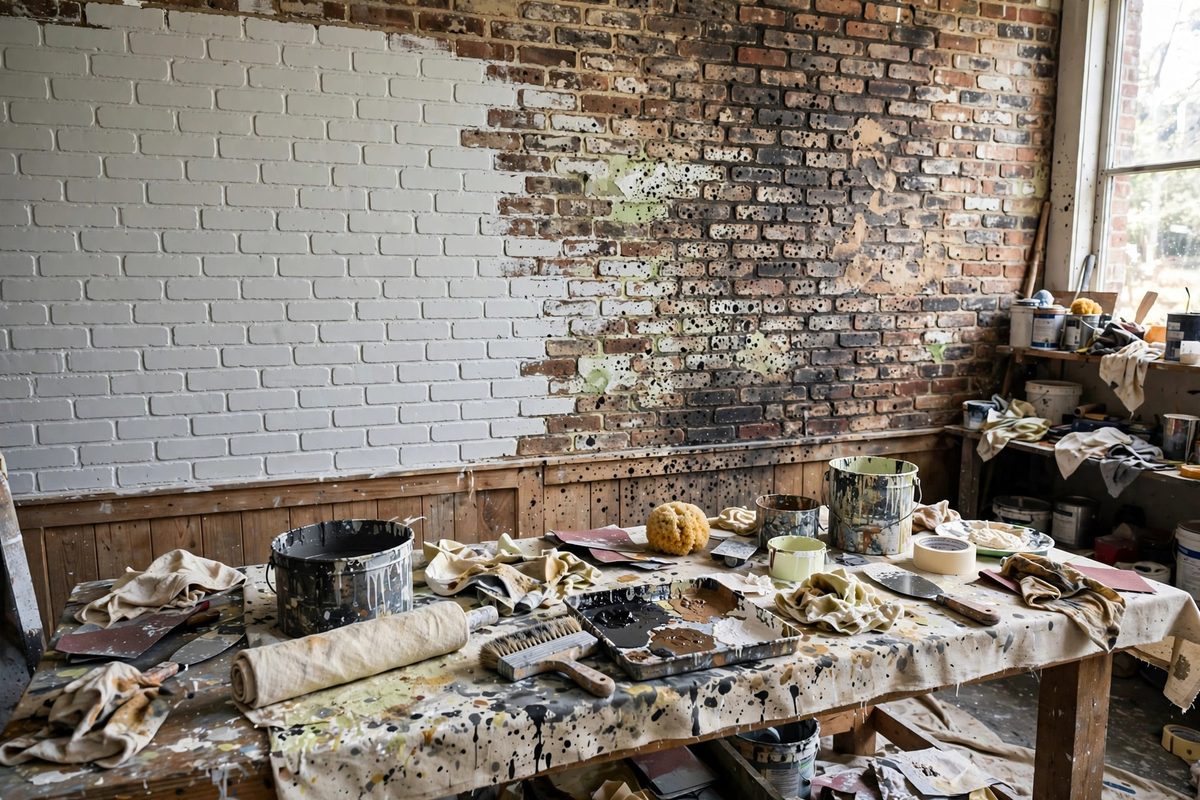
A flat painted brick wall reads as exactly that: flat paint. Old brick has centuries of soot, lime, patching, and weather in its surface, and two classic scenic techniques, spattering and rag-rolling, build that history back in layers. Both are fast, forgiving, and scaled for the large surfaces of stage scenery.
Laying the Brick Base
Start with the brick courses themselves: a base coat in a muted brick tone, then individual bricks picked out in varied reds, browns, and ochres, with mortar lines in a grayed tone. The key at this stage is variation; real old brick is never one color. Mix a handful of brick tones and apply them randomly across the wall, letting some bricks go darker and a few go nearly gray. Keep the mortar lines slightly irregular. This base does not need to be perfect because the aging layers will unify it, but it needs the value structure: light bricks, dark bricks, and mid mortar. Step back frequently; a wall that looks right from fifteen feet is done, and fussing at arm's length wastes paint.
Spattering for Age and Texture
Spattering flicks fine droplets of paint onto the surface to simulate grime, pitting, and weathering. Load a stiff brush, a toothbrush for fine work or a larger fitch for broad areas, and strike it against a stick or your hand to throw the droplets. Work with thin paint so the droplets are fine rather than blobby, and build up in passes: dark umber for soot and age, gray for lime and dust, occasionally a rust tone near the bottom of the wall where water would stain. Spatter from a consistent distance for even coverage, and mask or shield adjacent surfaces you want to keep clean. The technique also works beautifully in reverse: spattering a light tone over a dark wash lifts the surface and suggests worn, sun-bleached brick. Let each pass dry before judging it; wet spatter always looks heavier than it will when dry.
Rag-Rolling for Mottled Blends
Rag-rolling breaks up flat areas with soft, irregular mottling. Bunch a rag, dip it lightly in a glaze or thinned paint, roll off the excess, then roll it across the wall in random directions. The rag deposits paint unevenly, creating the cloudy variation of old limewash remnants, smoke staining, and patch repairs. Use it to knock back bricks that are too bright, to drag soot down from the top of the wall, or to blend the edges of painted damage. Change the rag's fold often so the pattern does not repeat, and work in large sections to keep the effect continuous. Rag-rolling over a still-tacky glaze lets you lift paint back off as well as apply it, which is useful for creating worn patches where the brick shows through an old whitewash.
Layering the History
Old brick tells a story in layers, so apply the techniques in a logical order. After the brick base, rag-roll a thin grime glaze over the whole wall to knock down the brightness. Spatter dark tones for age and pitting. Rag-roll patches of lighter lime or plaster remnants in a few areas. Spatter again lightly to tie the patches into the wall. Add heavier soot near the top if the scene suggests a fireplace or industrial setting, and water staining streaking down from the top edge. Each layer should be subtle on its own; the aged effect comes from the accumulation. Stop before it gets muddy. The most common mistake in scenic aging is overworking: five restrained layers beat two heavy ones.
Sealing and Practical Notes
Stage scenery takes abuse, so seal the finished wall if it will be handled or flown repeatedly; an unsealed spattered surface sheds dust and the spatter can rub off on costumes. Test your techniques on a sample board first, and keep that board as the reference standard so touch-ups match. Work with the wall flat on the floor or on sawhorses when possible; spattering upward onto a standing wall puts as much paint on the painter as on the scenery. Clean brushes and rags before the paint skins over, because dried lumps in a spatter brush ruin the fine droplet pattern. Label your custom mixes on the paint cans; the touch-up you need in tech week will use the same colors.
Spatter for the fine grain of age, rag-roll for the broad clouds of history, and layer both over a varied brick base. Restraint and accumulation do the work; the wall should look like it earned its grime over decades, not like it was painted yesterday.
Related Guides
- Scumble Glaze Texturing on Faux Masonry Backdrops: Faux masonry, painted stone or brick on a flat backdrop, succeeds or fails on texture. Flat, uniform paint reads as flat paint no matter how accurate
- Trompe L'Oeil Cast Shadow Values on Stage Flats: Trompe l'oeil, fool-the-eye painting, turns a flat piece of scenery into apparent three-dimensional architecture: moldings, panels, and stonework
- Faux Stone Texture Glazing Over Carved Polystyrene: Carved polystyrene takes a stone shape beautifully and weighs almost nothing, which is why it is the backbone of scenic rockwork and masonry. But raw
- Cast Shadow Trompe L'Oeil Glazing on Stage Flats: Trompe l'oeil (French for "fool the eye") is scenic painting's highest trick: flat surfaces painted to read as three-dimensional architecture. The