
Trompe l'oeil, fool-the-eye painting, turns a flat piece of scenery into apparent three-dimensional architecture: moldings, panels, and stonework that are not really there. The illusion stands or falls on cast shadows: the dark shapes painted where the fake architecture would block the stage light. Get the shadow values right and the flat reads as solid; get them wrong and it reads as a painting of a shadow, which fools no one.
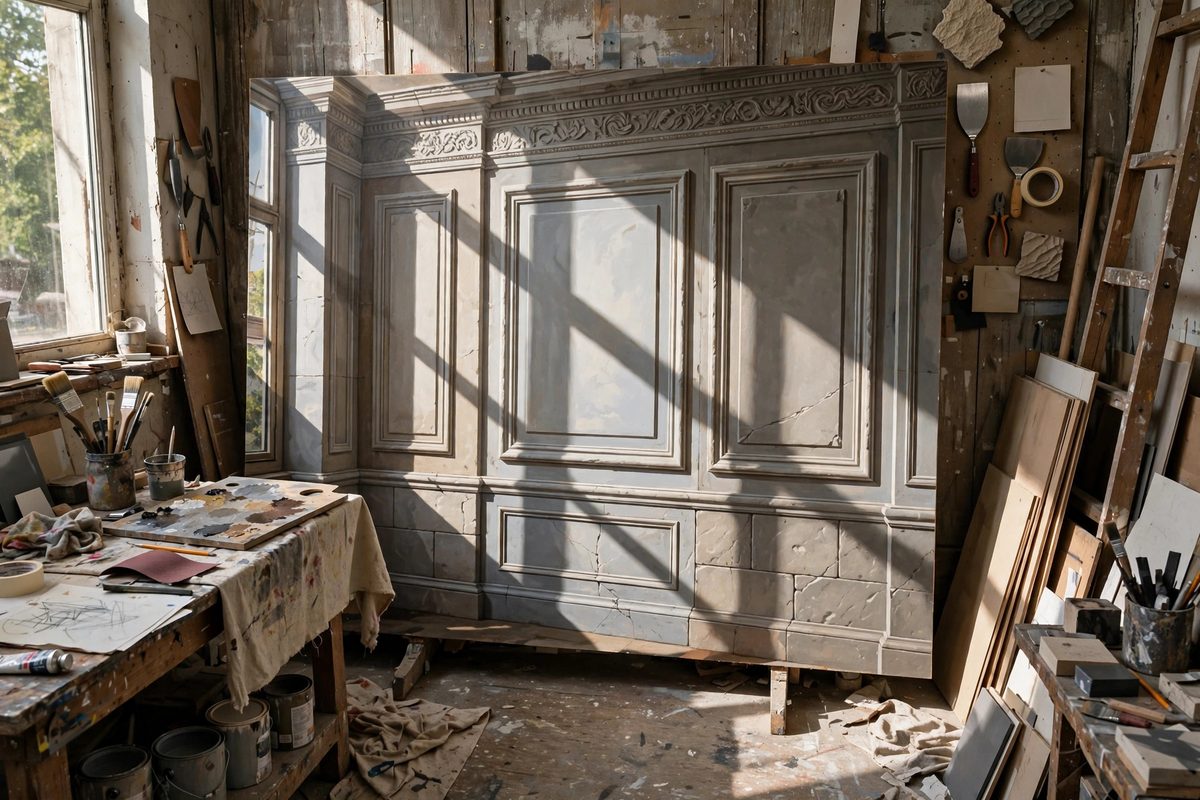
What a cast shadow actually looks like
A real cast shadow is not black and not uniform. It has a darkest core where the light is fully blocked (the umbra), softening edges where partial light leaks around the obstruction (the penumbra), and, crucially, it is never darker than the ambient reflected light allows: a shadow on a sunlit wall is still fairly luminous because the sky fills it in. On stage, the equivalent ambient is the general wash and bounce light. Painted shadows must respect this: a shadow value only a step or two darker than the lit surface, with soft edges, reads as real; a pitch-black hard-edged shape reads as paint.
Establishing the light source
Every shadow on the flat must agree on a single light direction, and that direction should match the actual stage lighting as closely as possible. Before painting, decide: light comes from upstage-left at roughly this angle. Then every molding casts its shadow down and to the right by the corresponding amount, every panel's inner shadow falls on the same side, every highlight sits opposite. Inconsistent shadows, one molding lit from the left and its neighbor from the right, shatter the illusion instantly, because the eye is exquisitely sensitive to lighting inconsistency even when it cannot articulate why.
Mixing shadow values
Mix shadow colors from the local surface color darkened and cooled, not from black. A shadow on a warm cream wall is a cooler, darker cream; adding black makes it dead and chalky. Step the values: the lit surface, then a half-shadow for the penumbra transition, then the full shadow core, each mixed deliberately on the palette. Keep the value range narrow; stage lighting is high-contrast, but painted shadows that go too dark look like holes. Test under stage light if at all possible: paint mixed under shop fluorescents shifts dramatically under theatrical lighting, and the shadow values are the first thing to look wrong.
Painting the shadow shapes
Lay in the shadow shapes with their soft edges from the start: use a dry brush, a sponge, or a scumbled transition rather than painting a hard shape and trying to soften it later. The shadow's edge should be sharpest nearest the casting object and softer farther away, following real shadow behavior. Keep the shadow's shape geometrically true to the imaginary architecture: a molding's shadow is a parallel band offset by the light angle, a corbel's shadow is its silhouette projected. Sloppy shadow geometry betrays the trick faster than wrong values.
Highlights complete the lie
Shadows alone make a flat look dirty; highlights make it look dimensional. Every cast shadow implies an adjacent lit edge catching the light: paint that edge slightly lighter and warmer than the base surface. The highlight-shadow pair is what the eye reads as form. Step back frequently and view from house distance; trompe l'oeil is designed for the audience's viewpoint, not the painter's nose distance, and details that look crude up close often resolve perfectly at twenty feet.
One light source, shadows mixed from the surface color, soft edges, and highlights to complete the form. Paint the light, and the flat becomes architecture.
Related Guides
- Cast Shadow Trompe L'Oeil Glazing on Stage Flats: Trompe l'oeil (French for "fool the eye") is scenic painting's highest trick: flat surfaces painted to read as three-dimensional architecture. The
- Scumble Glaze Texturing on Faux Masonry Backdrops: Faux masonry, painted stone or brick on a flat backdrop, succeeds or fails on texture. Flat, uniform paint reads as flat paint no matter how accurate
- Spattering and Rag-Rolling Blends for Old Brick Effects: A flat painted brick wall reads as exactly that: flat paint. Old brick has centuries of soot, lime, patching, and weather in its surface, and two
- Faux Stone Texture Glazing Over Carved Polystyrene: Carved polystyrene takes a stone shape beautifully and weighs almost nothing, which is why it is the backbone of scenic rockwork and masonry. But raw