
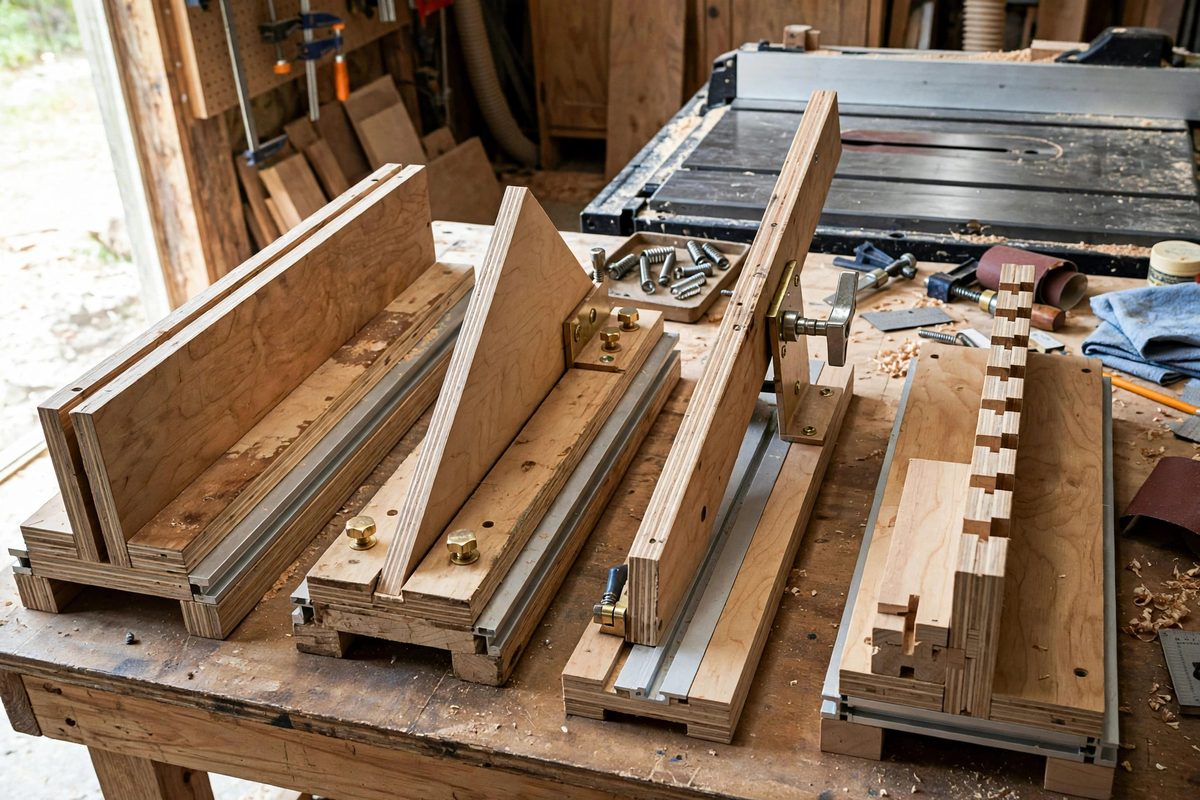
Every table saw owner eventually builds a small fleet of sleds: a crosscut sled, a miter sled, a tapering jig, a box-joint sled. Each one rides in the miter slot, and each one was fitted to that slot by hand. Standardizing the runners and adding detents turns that fleet from a collection of one-offs into an interchangeable system.
The case for a standard runner
Miter slots vary slightly between saws and even between the two slots on one saw, so every sled builder fits runners to the specific slot. The result is sleds that fit one slot on one saw and bind or slop in any other. A standardized runner, built to a consistent dimension with a consistent adjustment method, breaks that lock-in. Build every new sled to the standard, retrofit the old favorites, and any sled fits any slot on any saw you own. The standard pays for itself the first time a sled moves between saws without a fitting session.
Defining the standard dimension
Pick a runner width slightly under the narrowest slot you need to serve, then make up the difference with adjustment. A common approach is a runner of hardwood or UHMW plastic sized a hair under the slot, with adjustment screws or expanding hardware that take up the slack. Document the standard: runner width, thickness, length range, and the adjustment method. Write it down and tape it inside the sled storage area, because a standard that lives only in your head is not a standard.
Detents for repeatable positions
Detents take the system further: fixed, repeatable sled positions for common operations. A spring-loaded plunger in the sled base engaging dimples or a notched strip along the slot gives you positive stops at, say, the blade centerline or a common offset. This turns setups that used to need measuring into setups that click. The detent positions should match your actual work: the 90-degree crosscut position, the common miter angles, the box-joint indexing point. Calibrate each detent once, carefully, and the sled repeats it forever.
Building the detent hardware
The hardware is simple: a spring plunger or ball detent in the sled, and a strike strip with notches mounted alongside the slot or on the saw table. The strike strip must be positioned so the detent engages at exactly the right sled position, which means calibrating with a test cut, not a ruler. Make the strike strip adjustable with slotted screw holes so you can fine-tune it. Keep the detent force light enough to override by hand; a detent you have to fight is a detent you will stop using.
Retrofitting existing sleds
Existing sleds can join the system. Replace their runners with the standard runner, checking that the sled base is still flat and true first; a warped base fitted with perfect runners is still a warped sled. Add the detent plunger in a consistent location on every sled so one strike strip serves the whole fleet. This is also the moment to true up fences and check squareness, since the retrofit touches everything anyway. A weekend of retrofitting converts years of accumulated sleds into a system.
Maintaining the system
Standards drift without maintenance. Check runner fit periodically; wood runners swell and shrink with humidity, which is an argument for UHMW or aluminum runners in the standard. Verify detent positions with a test cut after any saw maintenance that moves the table or trunnions. Keep a spare runner blank and a spare plunger with the sleds. The system stays interchangeable only as long as someone, you, keeps it honest.
Define the runner, build every sled to it, add detents at the positions you actually use, and maintain the fit. The sled fleet stops being a pile of one-offs and starts being a tooling system.
Related Guides
- Standardized T-Track Spacing for Modular Jigs: T-track turns jigs from single-purpose contraptions into a modular system: stops, hold-downs, and fences slide, lock, and reposition along
- Mitering Dual Extrusion Rail Corners for Bench Jigs: Aluminum extrusion rails, the T-slot building blocks of bench jigs and fixtures, join at corners to make frames. The mitered corner, two rails cut at
- Extrusion Profile Deflection Limits Under Spindle Load: Aluminum extrusion is the default construction set for machine frames: modular, straight, and easy to assemble. But a CNC gantry or a 3D printer
- T-Track Extrusion Rigidity Limits Under Lateral Loads: T-track is the backbone of modular jigs and fixtures: a slot in the bench or fence that accepts sliding bolts and hold-downs anywhere along its