
T-track is the backbone of modular jigs and fixtures: a slot in the bench or fence that accepts sliding bolts and hold-downs anywhere along its length. It feels infinitely reconfigurable, but the aluminum extrusion has real rigidity limits, and lateral loads, forces pushing sideways across the track rather than straight down into it, are where those limits show up. Understanding what T-track can and cannot resist keeps your fixtures accurate and your workpieces where you put them.
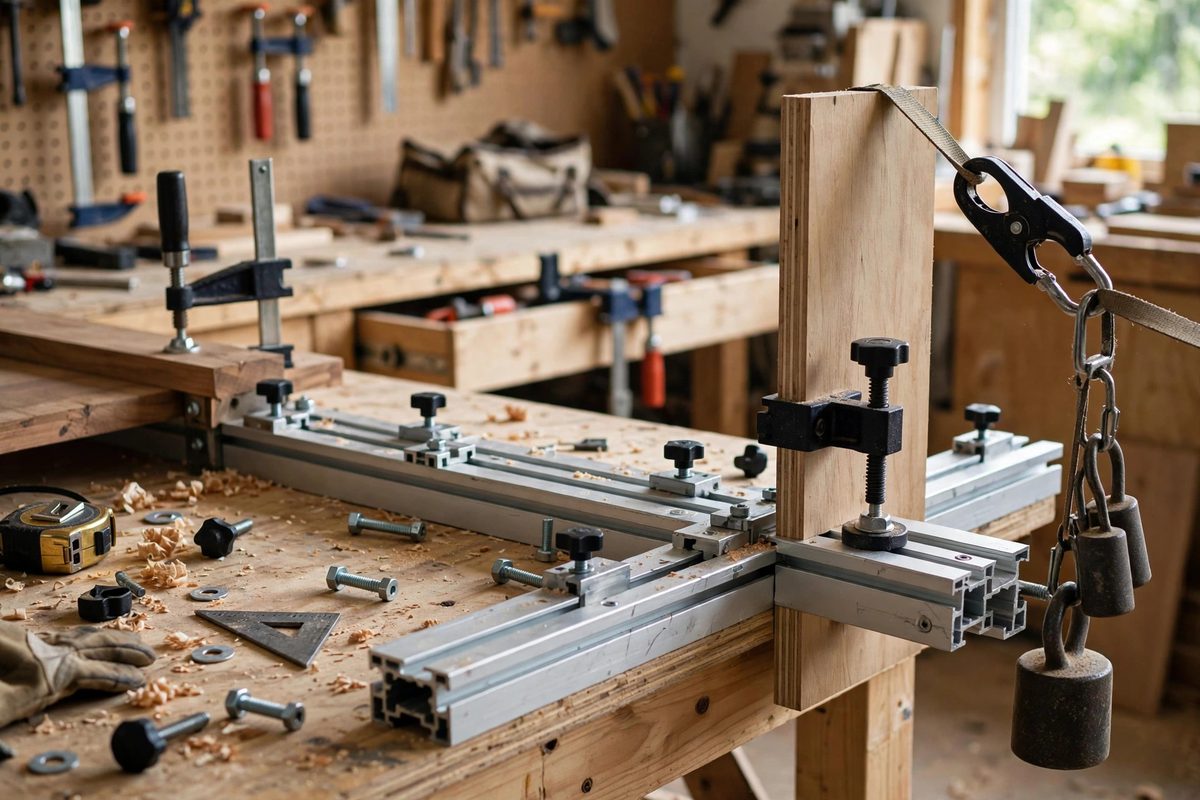
How T-Track Carries Load
A T-track extrusion is essentially a thin-walled aluminum channel with an inward-facing slot. Vertical loads, clamping force pressing straight down, are its strong suit: the load transfers directly through the track walls into the bench or substrate below, and the extrusion is well supported along its whole length. Lateral loads are a different story: a sideways push on a fence or stop mounted in the track tries to pry the slot open, lever the track out of its dado, or bend the thin walls of the extrusion. Aluminum extrusions are strong for their weight, but the T-track profile is optimized for clamping access, not for resisting sideways leverage.
Where Lateral Loads Come From
In typical jig use, lateral loads arise whenever the cutting force has a sideways component relative to the track. A fence used as a stop for crosscutting sees the workpiece pushed sideways into it; a miter sled's fence sees lateral pressure from the work; a router fence sees the bit's cutting force pushing the work sideways. Hand pressure adds more: operators lean on fences and push workpieces in directions the designer never intended. These loads are not huge in absolute terms, but they act at a leverage disadvantage: a fence six inches tall turns a modest push at the top into a serious prying force at the track slot.
The Failure Modes to Watch For
T-track under excessive lateral load fails in predictable ways. The slot walls spread, and the T-bolts that once slid smoothly now bind or pull through. The track itself lifts out of its dado, especially if it was installed with screws alone and no adhesive, because the lateral load peels it upward at the edges. The extrusion bends between mounting screws, creating a wavy slot that no longer holds fences straight. And the mounting screws wallow out their holes in the substrate, loosening the whole installation progressively. None of these fail catastrophically; they creep, and the symptom is a fixture that slowly loses accuracy: fences that will not stay square, stops that drift mid-cut.
Designing Within the Limits
The first defense is mechanical advantage in reverse: keep lateral loads low and their lever arms short. Use low fences where possible, position stops close to the track rather than on tall risers, and direct cutting forces into the bench or into a solid fence rather than into a track-mounted component. The second defense is installation: bed the track in its dado with adhesive as well as screws, use plenty of screws on close centers, and make the dado a snug fit so the substrate supports the track walls against spreading. The third is redundancy: for fixtures that see real lateral load, add a second parallel track so the load splits, or back up the track-mounted fence with a fixed reference the track only positions, not resists.
When T-Track Is the Wrong Choice
Some fixtures exceed what any T-track installation can handle gracefully. A tall fence that takes heavy lateral loads, a fixture that gets hammered or pried regularly, or anything where a failure would be dangerous rather than merely inaccurate, deserves a more rigid solution: a bolted steel or hardwood fence, a dedicated fixed jig, or a track system with a heavier extrusion profile. T-track's virtue is reconfigurability, not strength; using it where strength is the requirement is asking for the creeping inaccuracy described above. Choose the mounting system for the loads, not for the convenience.
Inspection and Maintenance
Check track installations periodically, especially on heavily used jigs. Slide a T-bolt the full length and feel for tight or loose spots that indicate spreading or bending. Check that mounting screws are still tight and the track has not lifted at the ends. Clean chips and debris out of the slots, because packed debris under a T-bolt creates a false tight that loosens mid-cut. A few minutes of inspection keeps the modular system trustworthy.
T-track is a wonderful system used within its limits: superb for positioning and clamping, limited against lateral leverage. Install it solidly, keep the loads honest, and reach for sturdier mounting where the forces demand it. The fixture is only as rigid as its weakest connection, and the track slot is often that connection.
Related Guides
- Extrusion Profile Deflection Limits Under Spindle Load: Aluminum extrusion is the default construction set for machine frames: modular, straight, and easy to assemble. But a CNC gantry or a 3D printer
- Standardized T-Track Spacing for Modular Jigs: T-track turns jigs from single-purpose contraptions into a modular system: stops, hold-downs, and fences slide, lock, and reposition along
- Mitering Dual Extrusion Rail Corners for Bench Jigs: Aluminum extrusion rails, the T-slot building blocks of bench jigs and fixtures, join at corners to make frames. The mitered corner, two rails cut at
- Standardized Miter Slot Detents for Swappable Sleds: Every table saw owner eventually builds a small fleet of sleds: a crosscut sled, a miter sled, a tapering jig, a box-joint sled. Each one rides in