
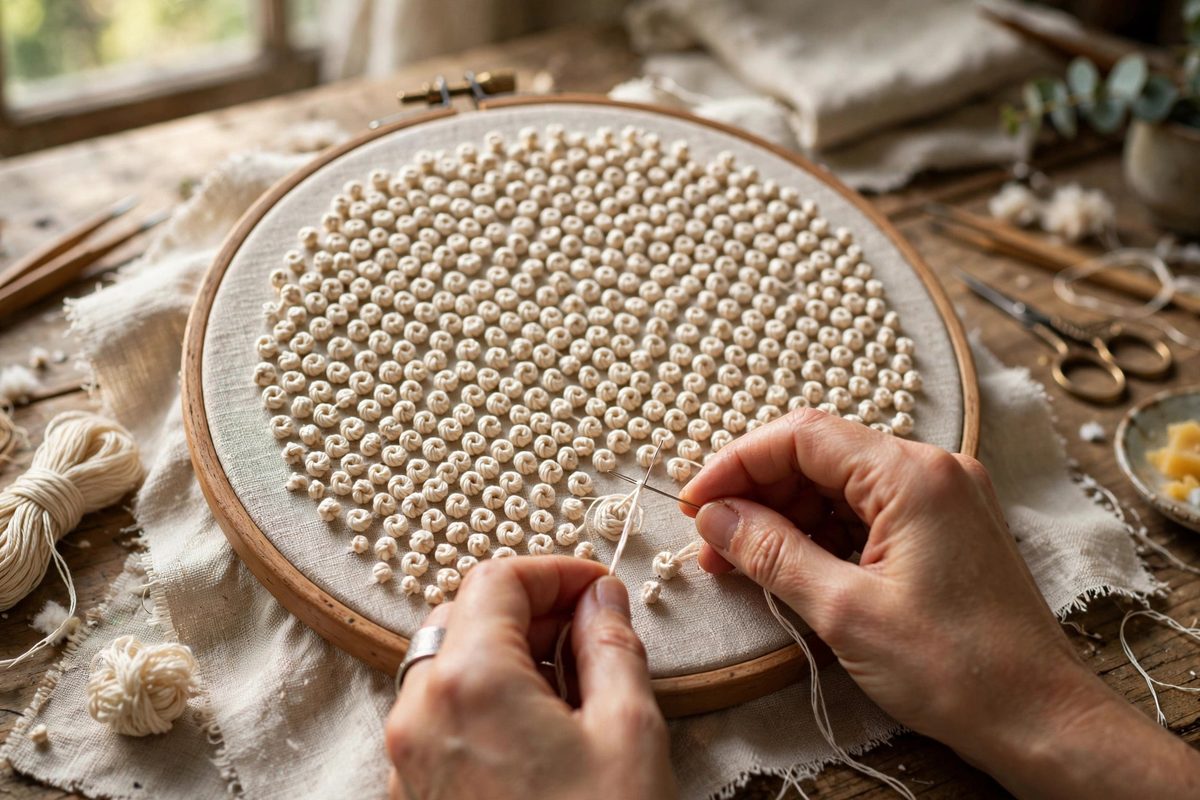
The French knot is embroidery's perfect little bump, a coiled knot that stands proud of the fabric, and a field of them creates a texture no other stitch matches. But French knots are notoriously temperamental: too loose and they collapse into messy loops, too tight and they sink into the fabric or pop through to the back. Uniform tension across dozens or hundreds of knots is the skill that turns a lumpy attempt into professional texture relief.
Anatomy of a good knot
A French knot forms by wrapping the working thread around the needle two or three times, then pulling the needle through the wraps and down through the fabric near the entry point. The wraps become a coil sitting on the fabric surface, locked by the thread passing through them. A good knot is round, firm, and consistent in size; it sits on the surface rather than sinking in, and all its siblings match it.
The number of wraps sets the knot's size: two wraps for delicate work, three for standard texture, more for bold relief. Whatever count you choose, use it consistently across the piece; mixed wrap counts read as mistakes, not variety.
The tension sequence
Tension control happens in two phases. First, hold the working thread taut, but not strangled, while forming the wraps around the needle; slack wraps tangle instead of coiling. Second, keep gentle tension on the thread tail while pulling the needle through the wraps and into the fabric; this seats the coil snugly against the surface. Release the tail tension only once the needle is through and the knot is formed.
The most common failure is pulling the needle through without holding the tail, which lets the wraps slide off into a tangle. The second most common is yanking the tail too hard after formation, which drags the knot through to the back of the fabric. Firm guidance, not force, is the touch.
Achieving uniformity across many knots
Uniformity comes from ritual: same wrap count, same thread length in play, same hand position, same pull speed. Work knots in batches rather than scattered singly, so your hands settle into the rhythm; the tenth knot in a session matches its neighbors better than the first. If you must stop mid-field, work a few practice knots on scrap before resuming, to recover the rhythm.
Thread length matters more than beginners expect. A very long working thread twists and tangles as it passes through the wraps repeatedly, degrading knot quality as the session wears on. Work with comfortable lengths, around 18 inches, and re-thread rather than fighting a twisted length. Fresh thread makes better knots.
Thread and fabric pairing
Knot size should suit the thread and fabric: fine threads on fine fabric, heavier threads where the weave can support them. Stranded cotton floss is the classic, with the strand count adjusted for the desired knot size; perle cotton gives a rounder, firmer knot with a lovely sheen. On loosely woven fabric, knots can pull through, so either use a stabilizer behind the work or choose a thread heavy enough to bridge the weave.
Keep the fabric taut in the hoop throughout. Slack fabric lets knots sink unevenly and distorts the spacing; re-tighten the hoop as you work, since stitching loosens it over time. The hoop is part of the tension system, not just a holder.
Fixing and placing knots
A bad knot is best removed immediately: slide the needle under it and snip, or unpick carefully, rather than leaving a lumpy intruder in a uniform field. One inconsistent knot draws the eye more than ten good ones please it. For planned texture relief, map the knot placement lightly on the fabric first; even spacing reads as intentional design, while random scattering reads as accident, even when the knots themselves are perfect.
Vary knot size deliberately for sculptural effects, larger knots for flower centers, smaller for filler texture, but keep each size group internally uniform. Controlled variation is design; uncontrolled variation is sloppiness, and the difference is entirely in the tension discipline.
French knots reward ritual: consistent wraps, guided tension through both phases, fresh thread, taut fabric, and immediate correction of strays. The field of knots then reads as a single deliberate texture, which is exactly what the stitch was invented for.
Related Guides
- Split Stitch Directional Shading in Crewel Wool Work: Split stitch is one of the oldest stitches in embroidery, and in crewel wool work it does something remarkable: it sculpts light. Because each stitch
- Directional Grain Tracking in Hard Silk Satin Stitch: Satin stitch on silk is unforgiving. Every stitch lies on the surface, fully visible, and the fabric's sheen amplifies any irregularity. Directional
- Long and Short Stitch Feathering for Realistic Shading: Realistic shading in hand embroidery, the petal that glows at its edge and deepens toward its heart, the bird's breast with its soft color
- Directional Grain Stitching in Silk Needle Painting: Needle painting, the embroidery technique that renders images in thread the way a painter renders them in oils, depends on one thing above all: the