
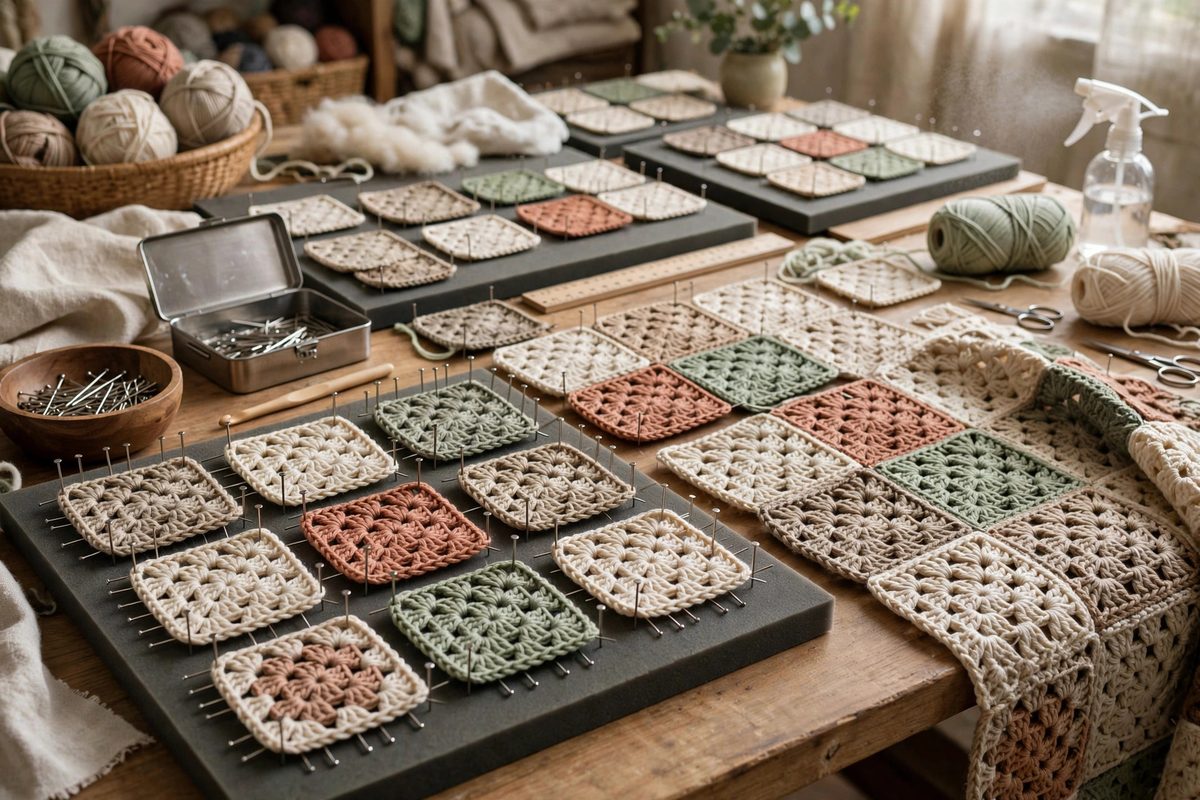
A blanket of granny squares is an assembly problem: dozens of individually crocheted units that must join into a flat, even fabric. Blocking, shaping and setting each square to identical dimensions before joining, is what makes the difference between a blanket that lies flat and one that ripples, cups, and fights its seams. Gauge symmetry, every square blocked to the same true square, is the discipline that makes joining a pleasure instead of a wrestling match.
Why squares come off the hook uneven
Hand crochet varies: tension shifts with mood, time of day, and where you are in the skein. Corners pull differently from straight sides. The result is squares that are almost the same size but not quite, almost square but slightly rhomboid, with edges that curl or ruffle. These small deviations compound across a blanket: a sixteenth of an inch per square times twenty squares is over an inch of accumulated error, and the joining bears all of it.
Blocking does not just flatten; it equalizes. Wet or steam blocking relaxes the fibers into their blocked shape and sets them there, so every square emerges at the target dimensions regardless of how it came off the hook. It is the great equalizer of handmade variation.
Setting the target dimensions
Measure a representative sample of unblocked squares and choose a target size the majority can reach without distortion: typically the size of your larger squares, since stretching a small square to size is easier on the fabric than compressing a large one. The target must be genuinely square, equal sides and right angles, because the joining math assumes it.
Make or buy a blocking template: a board marked with the target square, or a set of wires and pins. The template is the standard every square is held to; without it, blocking is eyeballing, and eyeballing reproduces the original variation. One template, used for every square, is what creates symmetry.
The blocking process
Dampen each square evenly, by soaking and gently squeezing, or by steaming, depending on the fiber. Natural fibers block beautifully and hold the set; acrylics need steam heat to relax and are more springy about returning. Pin the square to the template, easing it to the marked dimensions: pin the corners first, then the edge midpoints, then fill in, distributing any fullness evenly rather than pushing it all to one side.
Let squares dry completely before unpinning. A square unpinned damp will spring partway back toward its unblocked shape, wasting the effort. Drying takes hours; plan the workflow in batches so blocking becomes a rhythm rather than a bottleneck: pin a batch in the evening, unpin the dry batch in the morning.
Gauge checking and sorting
After blocking, verify each square against the template before it joins the blanket pile. Squares that will not hold the target size, because of a counting error or a tension excursion, should be identified now: re-block once, and if it still will not conform, set it aside for a project where it fits or rework it. One rogue square in a blanket creates a visible pucker that no joining technique hides.
Sort blocked squares by subtle color or texture variation while you are at it, distributing dye-lot differences evenly across the blanket rather than clustering them. Blocking day is quality-control day; use it fully.
Joining blocked squares
Joining identical squares is straightforward: whipstitch, slip-stitch, or single-crochet seams all work when the pieces match, because the seam only needs to connect, not to compensate. Work the joining with the same even tension throughout; a tight joining row on blocked squares cups the blanket just as surely as unblocked variation did.
Block the finished blanket lightly after joining to settle the seams into the fabric. The final blocking unifies the whole piece, relaxing the joining tension into the squares. The result lies flat, drapes evenly, and looks like the squares were always meant to be together, which, after proper blocking, they were.
Blocking is the unglamorous step that makes granny square blankets work: one template, even dampening, pinned to true square, dried completely, verified before joining. Symmetry in, flat blanket out. Skip it and the joining becomes compensation; do it and the joining becomes assembly.
Related Guides
- Joining Granny Squares With Mattress Stitch Seams: A pile of granny squares is a promise; the joining is where the promise is kept or broken. The seam between squares decides whether a blanket lies
- Corner Shell Cluster Spacing for Flat Afghan Squares: A granny square that will not lie flat is almost always a corner problem. The corners have to turn ninety degrees while the sides run straight, and
- Mattress Stitch Seam Alignment on Dense Granny Blocks: Joining granny squares with a mattress stitch gives an invisible, flexible seam that looks professional, but dense blocks, those worked tightly with
- How to Crochet a Granny Square (Step by Step): The granny square is the classic beginner crochet project. It's one small square made from the center out, and once you can make one, you can make a
- Corner Triple Treble Stacking in Flat Granny Motifs: The granny square's corner is its structural and visual anchor: the chain space where each round turns 90 degrees and where the motif grows. The