
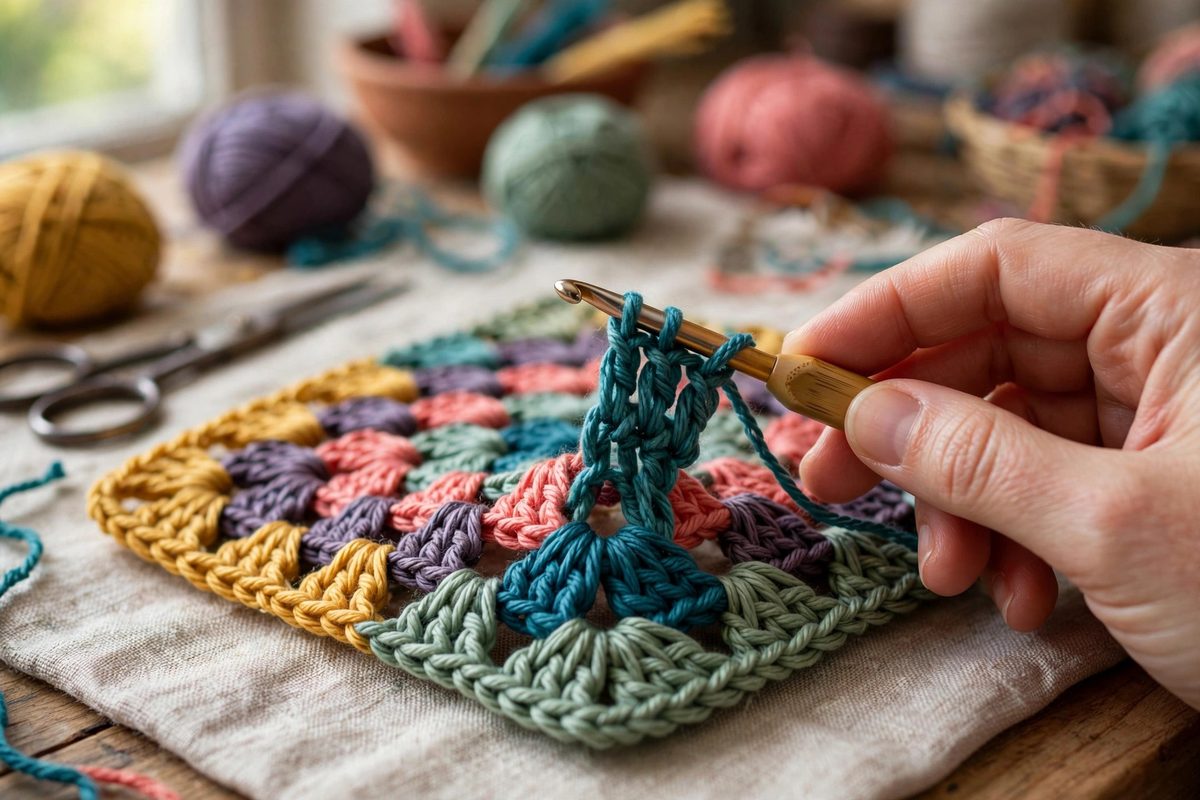
The granny square's corner is its structural and visual anchor: the chain space where each round turns 90 degrees and where the motif grows. The classic corner, a cluster of double crochets, works beautifully at small scales, but as motifs grow larger or the design calls for bolder geometry, the corner needs more presence. Triple treble corner stacking, building the corner from tall triple treble stitches, creates dramatic, lacy corners with real architectural presence. The technique demands attention to tension and proportion, because tall stitches amplify every inconsistency.
Why Tall Stitches at the Corner
The corner must accomplish two things: turn the round's direction by 90 degrees, and provide enough fabric to keep the motif flat as it grows. Each round adds stitches around a larger perimeter, and the corner, being the farthest point from the center, needs the most growth. Standard double-crochet corners handle this with chain spaces; triple treble corners handle it with stitch height. A triple treble is roughly twice the height of a double crochet, so a corner stack of triple trebles builds a tall, open corner that advances the round significantly while using few stitches. The visual effect is a bold, lacy corner that reads as a design feature rather than a construction necessity. The structural effect is a corner with more drape and openness, suited to shawls, throws, and garments where fluidity is welcome, less suited to motifs needing rigid geometry like bags.
The Stacking Technique
Work the corner as a group of triple treble stitches into the previous round's corner space, typically three to five stitches depending on the design's scale, separated from the side clusters by chain spaces. The key is consistent stitch height: triple trebles vary more in height than shorter stitches because each yarn-over adds variability, so consciously draw each loop to the same length. Work into the chain space, not into individual stitches, which keeps the corner open and lets the tall stitches fan naturally. The chains between the corner stack and the side groups set the corner's openness: more chains, lacier corner; fewer, denser. Count carefully, because a miscounted chain at a triple-treble corner throws off the entire round's symmetry visibly. Mark the corners with stitch markers until the pattern is memorized; tall-stitch rounds are easy to lose count in.
Keeping the Motif Flat
Tall corners can cup or ruffle the motif if the stitch counts are wrong, and the error shows immediately because the corner is the motif's most visible feature. Cupping, the edges curling up, means too few stitches or chains at the corner for the round's growth: add a chain or a stitch. Ruffling, wavy edges that will not lie flat, means too many: the corner fabric exceeds what the geometry needs. The correct corner lies flat without blocking, though light blocking evens out minor irregularities. Check flatness after each round, not at the end: correcting a cupped corner three rounds later means frogging three rounds. Also watch the corner's squareness: triple treble stacks can skew if the turning chains pull unevenly, so verify the motif is actually square by folding it diagonally, corners meeting corners, after each few rounds.
Tension Control for Tall Stitches
Triple trebles punish uneven tension more than any shorter stitch: a tight triple treble is dramatically shorter than a loose one, and the corner's appearance depends on uniformity. Develop a rhythmic yarn-over technique: the same number of wraps, drawn to the same length, worked at the same pace. Many crocheters find their triple trebles tighten unconsciously because the tall stitch feels unstable; counter this by deliberately relaxing the yarn-overs. If the corner stitches lean, the yarn-overs are being worked inconsistently around the hook; practice the stitch in isolation until the motion is automatic before committing to the motif. Consider going up a hook size for the corner rounds if your triple trebles run tight: the larger hook enforces the openness the design intends, and consistency matters more than the nominal hook size.
Joining Motifs With Tall Corners
When motifs join into a larger piece, the tall corners meet at quadruple points where four corners converge, and these junctions need planning. The lacy openness that looks beautiful in a single motif can become a hole at the join: plan the joining method to bridge the corners, whether with a join-as-you-go technique that works the corners together, a whipstitch that catches the corner chains securely, or a decorative join that makes the junction a feature. Test the join on four motifs before committing to the blanket: the corner junctions set the finished piece's character, and discovering they gap or pucker after joining fifty motifs is a heartbreak. Block the motifs before joining; unblocked tall-corner motifs join unevenly and the finished piece never quite lies flat.
Triple treble corner stacking gives granny motifs bold, architectural corners through stitch height rather than stitch count. Keep the tall stitches even, check flatness every round, control the tension deliberately, and plan the corner junctions before joining. The motifs will grow into pieces with corners worth looking at.
Related Guides
- Corner Shell Cluster Spacing for Flat Afghan Squares: A granny square that will not lie flat is almost always a corner problem. The corners have to turn ninety degrees while the sides run straight, and
- Mattress Stitch Seam Alignment on Dense Granny Blocks: Joining granny squares with a mattress stitch gives an invisible, flexible seam that looks professional, but dense blocks, those worked tightly with
- Joining Granny Squares With Mattress Stitch Seams: A pile of granny squares is a promise; the joining is where the promise is kept or broken. The seam between squares decides whether a blanket lies
- Blocking Gauge Symmetry in Joiner Granny Squares: A blanket of granny squares is an assembly problem: dozens of individually crocheted units that must join into a flat, even fabric. Blocking, shaping
- How to Crochet a Granny Square (Step by Step): The granny square is the classic beginner crochet project. It's one small square made from the center out, and once you can make one, you can make a