
A granny square that will not lie flat is almost always a corner problem. The corners have to turn ninety degrees while the sides run straight, and the shell clusters in the corner are what make that turn happen. Get the corner spacing right and the square blocks flat; get it wrong and it cups, ruffles, or twists no matter how carefully you worked the sides.
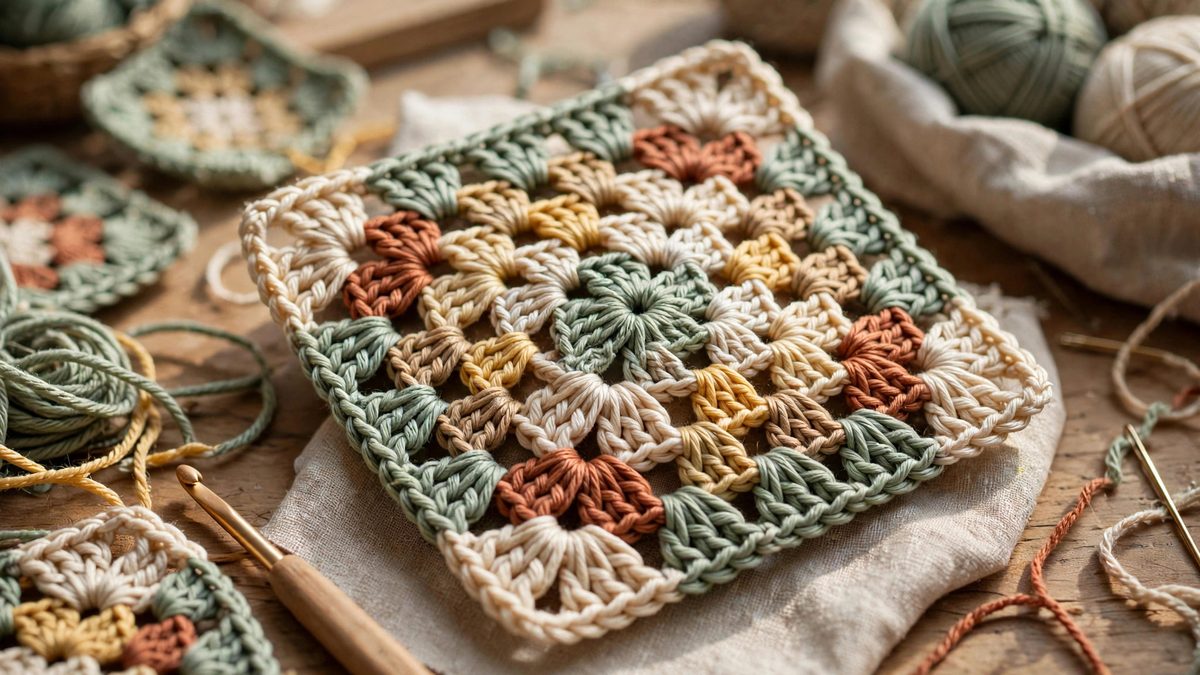
The geometry of the corner
Think of the corner as a quarter circle that must fit into a square corner. The side of the square grows by a fixed amount each round, but the corner has to accommodate the turn, which needs extra fabric. The classic solution is a corner shell of multiple double crochets separated by chain spaces, which fans out to fill the turn. The number of stitches and chains in that corner shell is the variable that controls flatness: too few and the corner pulls in and cups; too many and it ruffles.
The standard corner formula
The traditional granny corner is three double crochets, two chains, three double crochets, all in the same corner space. That two-chain gap is doing real work: it provides the slack for the turn. As squares grow larger and stitches get taller, the corner may need more: some patterns use three chains in the corner, or add an extra double crochet to each side of the shell. The right formula depends on your yarn, hook, and tension, which is why the standard formula is a starting point to verify, not a law.
Testing flatness as you go
Check the square after every few rounds, not at the end. Lay it on a flat surface and look: the center should touch, the corners should touch, and no edge should lift or wave. If the corners pull up, the corner shells are too tight; add a chain or a stitch. If the corners flop and the sides ripple, the corners are too loose; take a chain away. Catching it early means frogging two rounds instead of twelve. Keep a note of the corner formula that worked for that yarn and hook; it will work again.
Side spacing and its interaction with corners
The sides matter too, because the corner does not act alone. Chain spaces between side clusters that are too long make the sides grow faster than the corners can turn, and the square ripples. Too short, and the sides cinch while the corners flare. The side and corner spacing have to agree with each other: when you adjust the corner, recheck the sides. A square is a system, and tuning one part without checking the others just moves the problem.
Joining squares without distortion
Even perfect squares can distort at joining. The joining method adds its own tension: a tight whipstitch join cinches the edges, while a loose slip-stitch join can gap. Join with a method and tension that matches the squares' own gauge, and block the squares before joining so each one starts flat. Joining unblocked squares locks their distortions into the afghan permanently. The afghan is only as flat as the joining allows the squares to be.
Blocking the finished squares
Blocking evens out the small irregularities that remain. Pin each square to its true measurements on a blocking board, mist or steam it according to the fiber, and let it dry completely. Acrylic needs steam or heat to set; wool responds to water; cotton just needs patience. Blocked squares join cleanly and the afghan drapes evenly. It is the final step that makes all the corner math pay off visibly.
Dial in the corner shell for your yarn and hook, check flatness early and often, keep the sides in agreement, and block before joining. The squares lie flat, the afghan hangs true, and the corners do their quiet geometric job.
Related Guides
- Corner Triple Treble Stacking in Flat Granny Motifs: The granny square's corner is its structural and visual anchor: the chain space where each round turns 90 degrees and where the motif grows. The
- Joining Granny Squares With Mattress Stitch Seams: A pile of granny squares is a promise; the joining is where the promise is kept or broken. The seam between squares decides whether a blanket lies
- Blocking Gauge Symmetry in Joiner Granny Squares: A blanket of granny squares is an assembly problem: dozens of individually crocheted units that must join into a flat, even fabric. Blocking, shaping
- How to Crochet a Granny Square (Step by Step): The granny square is the classic beginner crochet project. It's one small square made from the center out, and once you can make one, you can make a
- Mattress Stitch Seam Alignment on Dense Granny Blocks: Joining granny squares with a mattress stitch gives an invisible, flexible seam that looks professional, but dense blocks, those worked tightly with