
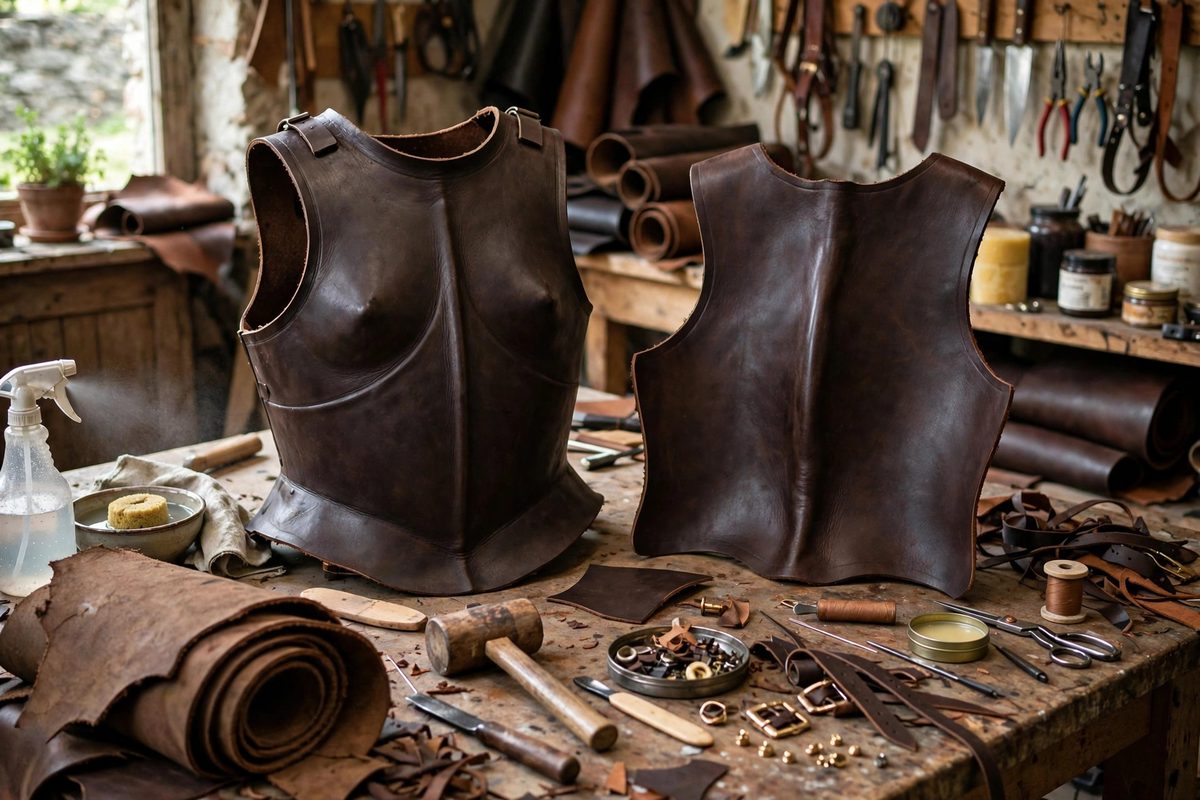
A cuirass, the torso armor of breastplate and backplate, demands leather that is thick enough to hold a shape under its own weight and shaped closely enough to move with the wearer. Heavy saddle skirting, the dense, firm leather cut from the outer regions of the hide, is one of the best materials for the job: it is thick, it molds well when wet, and it hardens into a shell that keeps its form. Molding it into the compound curves of a torso is a wet-forming discipline, part sculpture and part patience.
Why Saddle Skirting Suits Armor
Saddle skirting is cut thick, often in the 12 to 14 ounce range, from the bend and butt of the hide where the fibers are tightest. That density is what makes it moldable: wet it, shape it, let it dry, and the compressed fibers lock the new shape in. Thinner leather will not hold a cuirass curve under gravity; it sags and oil-cans. Skirting weight holds.
The fiber structure matters as much as the thickness. Skirting from the butt has interwoven fibers that resist stretching in any one direction, which means the molded shape stays put instead of slowly relaxing. Belly leather, by contrast, stretches and will not hold a crisp armor curve. Choose the cut for the job, not just the weight.
Soaking and Casing
Soak the leather until it is pliable through its full thickness, which for heavy skirting means a real soak, not a wipe-down. Lukewarm water penetrates fastest; hot water can shock the fibers and cold water takes noticeably longer. The leather is ready when it bends easily without cracking at the surface and feels uniformly damp, not wet on the outside and dry in the middle.
After soaking, let it case: wrap it in plastic or a damp towel and rest it until the moisture equalizes through the thickness. Casing is the step most people skip and most shapes punish. Uneven moisture means uneven molding; the wettest areas stretch and the drier areas resist, and the result is a lopsided cuirass. An hour of casing saves an hour of fighting.
Forming Over the Body Form
Mold over a form that matches the wearer's torso: a dress form adjusted to measurements, a duct-tape dummy of the actual wearer, or a carved wooden torso. The form must be slightly smaller than the finished armor to account for the leather's thickness and for any lining. Work the breastplate and backplate as separate pieces; trying to mold a cuirass as one piece fights the leather's refusal to stretch in two directions at once.
Start at the center of the chest and work outward, pressing and smoothing the leather into the form's curves. Use your hands, bone folders, and smooth modeling tools; avoid anything sharp that could cut the damp fibers. Work the leather into the waist suppression and out over the chest, letting the material tell you where it wants to go and easing it where it resists. Heavy skirting will not stretch much, so plan the pattern with enough material to reach without forcing it.
- Keep the leather damp while forming; re-wet areas that start to dry and stiffen.
- Smooth from the center outward to push wrinkles toward the edges, where they can be trimmed away.
- Check the fit against the wearer or the measurements often; wet leather is forgiving and dry leather is not.
- Form both plates before either dries, so the pair matches.
Drying in Shape
Let the molded pieces dry on the form, slowly and at room temperature. Heat drying shrinks and hardens the leather unevenly and can warp the shape you just built. Good air circulation helps; direct sun or a heater does not. The piece is dry when it feels room temperature to the touch all the way through and rings slightly when tapped.
Do not rush this. A cuirass plate that looks dry on the surface can still be damp in the middle, and removing it from the form early lets it relax out of shape. Heavy skirting can take a full day or more to dry through. The wait is part of the process.
Hardening and Finishing
Once dry and holding shape, the plates can be hardened further if the armor needs it. Traditional cuir bouilli, boiling or hot-water hardening, makes the leather remarkably rigid but also brittle and dark; modern makers often prefer a wax impregnation, warming the piece and working in a beeswax blend that stiffens the fibers without the brittleness. Either way, test on scrap first, because hardening is irreversible.
Edge the plates, punch for straps and buckles, and consider a lining: a cuirass worn against the body wants a soft liner for comfort and to protect the molded leather from sweat. The armor is done when it holds its shape off the form, fits the wearer through a full range of motion, and looks like it was always that shape. That is what the skirting was for.
Soak it through, case it evenly, mold it patiently, and dry it slowly. Heavy leather rewards every minute of patience with a cuirass that holds its line like it was born armored.
Related Guides
- Hot Water Hardening of Heavy Skirting Armor Leather: Vegetable-tanned skirting leather can be hardened into rigid armor plates with nothing but hot water, a technique as old as armor itself. The heat
- Pricking Iron Pitch Angles for Flawless Saddle Stitches: The saddle stitch's signature slant, those perfect angled stitches marching down a leather edge, comes from the pricking iron, not from the needles
- Cast Stitch Tension on Diamond Chisel Spacing: The saddle stitch is the strongest hand stitch in leatherwork, and its strength lives or dies on tension. Each stitch is a small knot of thread
- Deglazing Vegetable Tanned Hides Before Dye: Vegetable tanned leather arrives from the tannery with a glazed surface: a smooth, slightly sealed finish from the final rolling and burnishing that
- Swivel Knife Depth Control on Casing Leather: The swivel knife is the pencil of leather tooling: every carved line starts as a swivel knife cut, and every bevel, background, and decorative stamp