
Fieldstone walls stand on mortar, and mortar stands on water: the right amount, held for the right time. Hydration is the chemical reaction between water and cement that gives mortar its strength, and it is a Goldilocks process. Too little water and the cement never fully hydrates, leaving a weak, crumbly joint. Too much and the mortar is soupy, shrinks as it dries, and bonds poorly to the stone. Fieldstone, with its irregular shapes and thirsty faces, makes the balancing act harder than brickwork ever does.
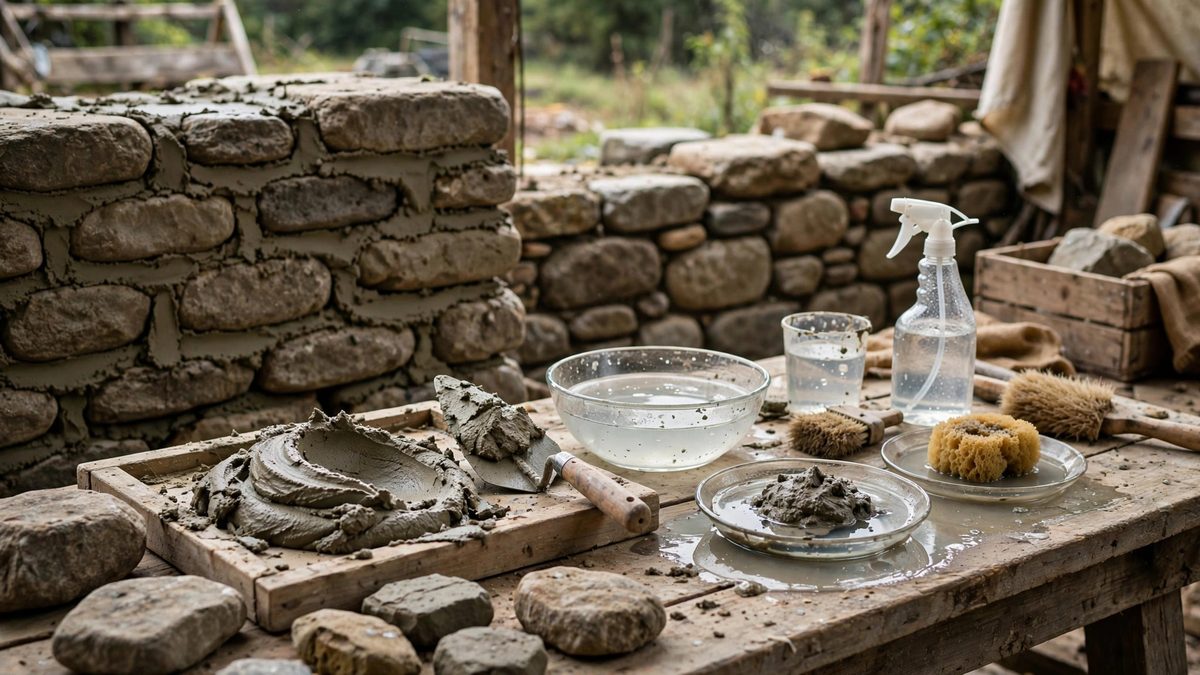
Why Fieldstone Is Thirstier Than Brick
Fieldstone presents far more surface area per unit of wall than cut stone or brick, and every square inch of that irregular surface wicks water out of the mortar. A porous sandstone or limestone fieldstone can suck the mix dry in minutes, pulling water out faster than the cement can use it. The mortar stiffens prematurely, the bond to the stone never develops, and the joint ends up as a dry-packed filler rather than a structural bond.
The fix starts before the mortar is mixed: wet the stone. Pre-wetting fieldstone, soaking it or at least thoroughly dampening it, satisfies the stone's thirst so it stops stealing water from the mortar. The stone should be damp but not dripping; surface water standing on the stone dilutes the mortar at the interface just as surely as a thirsty stone dehydrates it.
Mixing to the Right Consistency
Fieldstone mortar wants to be stiffer than brick mortar, roughly the consistency of thick peanut butter: it should hold its shape on the trowel, stand in a peaked pile without slumping, and press into the irregular joints without running. Wetter mixes are tempting because they are easier to work into the nooks of fieldstone, but the extra water evaporates and leaves shrinkage cracks and weak bonds.
Mix in batches sized to the work pace. Mortar begins hydrating the moment water hits cement, and its workability has a clock on it, typically a couple of hours depending on temperature. Re-tempering, adding water to stiffened mortar, is the classic shortcut that destroys strength: once hydration has started, extra water disrupts the crystal structure forming in the mix. Mix what you can lay before it stiffens.
Reading the Joint During Laying
The mortar tells you about its hydration as you work. When you press a stone into its bed, a properly hydrated mortar squeezes out slightly and holds the stone without the stone sinking or sliding. If the stone slides, the mix is too wet; if the mortar crumbles instead of squeezing, it is too dry or has gone past its working time.
- Butter the stone, not just the wall; full contact between mortar and stone is what bonds.
- Work the mortar into the joint with the trowel; voids are future water entry points.
- In hot or windy weather, mist the wall lightly as you go to slow surface drying.
- Do not lay fieldstone in freezing conditions; frozen mortar never hydrates properly.
Curing: Keeping Water In, Not Letting It Out
After laying, the mortar needs to stay damp while it cures. Hydration continues for days, and if the joint dries out in the first day or two, the reaction stops with unhydrated cement remaining, permanently weakening the mortar. Cover fresh fieldstone work with damp burlap or plastic sheeting, and mist it in hot weather. The goal is to slow evaporation so the chemistry can finish.
This feels backwards to beginners, who want the wall to dry and harden. But mortar hardens by chemical reaction, not by drying; drying is what stops the reaction. A wall kept damp for several days after laying will be dramatically stronger than one left to bake in the sun. Patience here is structural.
Diagnosing Hydration Failures
Mortar that powders when scratched with a nail after full cure was under-hydrated: too dry a mix, too thirsty a stone, or too fast a dry-out. Mortar with shrinkage cracks around every stone had too much water. Joints that never bonded to the stone, where the mortar pops cleanly away, usually suffered from dry stone sucking the mix dry at the interface.
Each failure has its fix in the next batch: wetter stone, stiffer mix, slower cure. Fieldstone masonry is forgiving of ugly joints but unforgiving of bad hydration, because the wall's strength is entirely in the mortar's chemistry. Balance the water, and the stones will stand for generations.
Wet the stone, mix it stiff, lay it before the clock runs out, and keep it damp while it cures. Hydration is invisible chemistry with visible consequences, and the fieldstone wall is its final exam.
Related Guides
- Hydraulic Lime Ratios for Historic Fieldstone Pointing: Pointing historic fieldstone with modern Portland cement is one of the fastest ways to destroy an old wall; the cement is harder than the stone and
- Pneumatic Pitching Chisel Angles on Limestone: Pitching is the rough removal of stone with a chisel struck along the edge, breaking off controlled flakes to shape the block. Done by hand it is
- Undercutting Depth Limits in Marble Sculptures: Undercutting, carving back beneath an overhanging form to create shadow and separation, is what gives marble sculpture its sense of depth and life. A
- Relief Carving Clearance Angles in Carrara Marble: Relief carving in Carrara marble is a negotiation between the design's depth and the stone's willingness to hold a crisp edge. Clearance angles, the
- Tuning Pneumatic Bushing Hammers for Granite Dressing: A bushing hammer, the pneumatic tool with a grid of pyramidal teeth, dresses granite by crushing the surface into a uniform textured finish. Tuning