
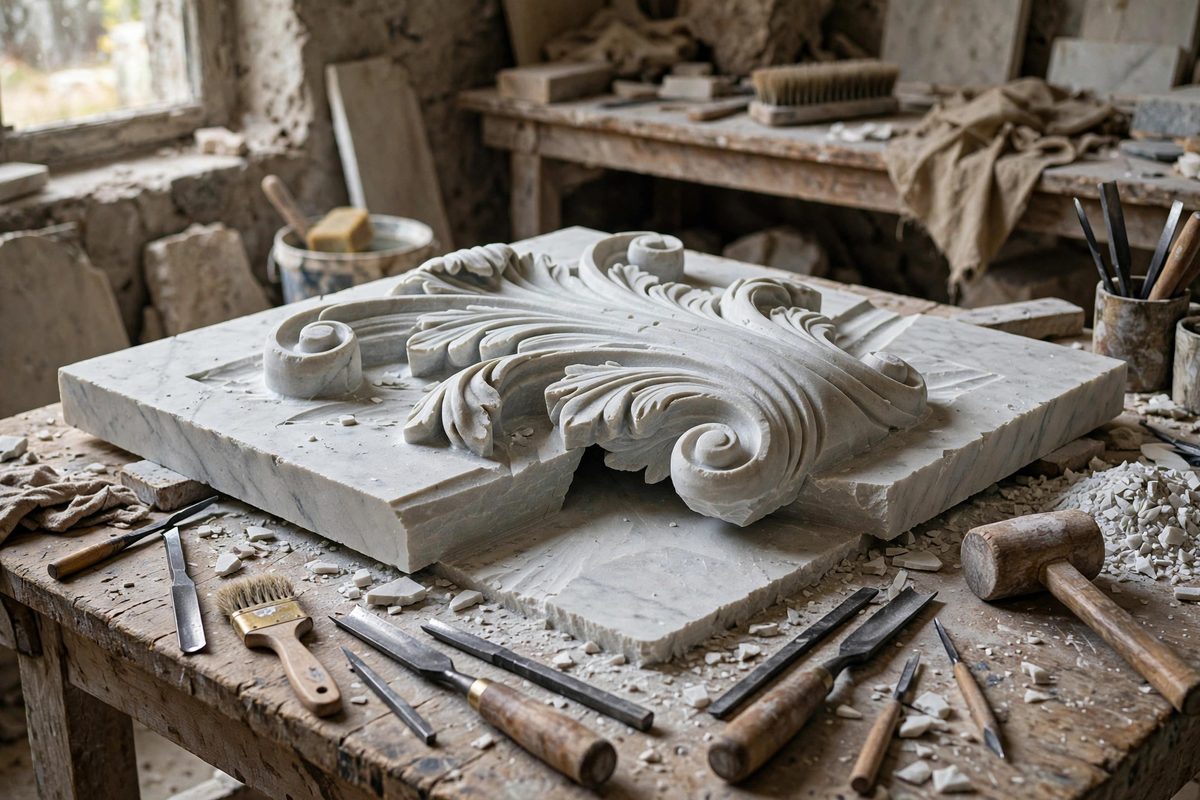
Relief carving in Carrara marble is a negotiation between the design's depth and the stone's willingness to hold a crisp edge. Clearance angles, the undercut behind each carved element that lets it stand free of the background, determine whether the relief reads with sharp shadows or collapses into mush. Marble's crystalline structure rewards correct angles and punishes guesswork with spalls.
What Clearance Does in Relief
The clearance angle is the backward slope cut behind a raised element, separating it from the background plane. Without clearance, the element blends into the background and the relief looks flat; with proper clearance, a shadow line defines the form and the carving gains depth beyond its actual projection. The angle also has a structural role: it removes the weak feather edge where the element meets the background, replacing a fragile thin junction with a solid angled cut. In marble, that feather edge would chip at the first touch, so clearance is durability as well as aesthetics.
Choosing the Angle
The working clearance angle for Carrara marble typically runs from roughly fifteen to forty-five degrees behind the face, depending on the relief depth and the element size. Shallow relief wants modest clearance; the shadow line needs only a slight undercut to read. Deep relief with boldly projecting forms can take steeper clearance, which also reduces the stone left behind the element and lightens the visual weight. Delicate small elements need gentler angles because steep undercuts leave them attached by too little stone. Let the design's scale set the angle, and keep it consistent across similar elements so the relief reads as one coherent carving.
Carving the Clearance
Cut the clearance with the point or a narrow chisel, working from the background toward the element, so any slip moves away from the finished form. Take light controlled cuts; marble's grain can run unexpectedly, and a heavy blow at the wrong angle spalls the very edge you are defining. Work the clearance in stages, roughing it near the final angle and then refining with rasps and rifflers to a clean surface. The clearance cut should be smooth and even, because tool marks in the undercut catch light and distract from the form above.
Reading Carrara's Grain
Carrara marble has veining and a crystalline grain that affect how it carves. Veins can be planes of weakness; a clearance cut that follows a vein may split further than intended, while one crossing veins needs extra care at each crossing. Test the stone's behavior on a waste area before cutting critical clearances, noting which directions carve cleanly and which tend to flake. The famous even texture of good Carrara is what makes fine relief possible, but even good stone has its moods, and the carver who reads them keeps their edges.
Finishing and Protecting Edges
After the clearance is cut, refine the element's edges so they are crisp but not razor sharp; a microscopically eased edge resists handling damage far better than a knife edge, with no visible loss of sharpness. Finish the background to a consistent texture that contrasts with the modeled forms, since the background's quietness is what lets the relief speak. Seal the finished work appropriately for its setting, and handle it by the sturdy areas, never by the projecting elements. The clearance angles did their structural job in the carving; handling discipline does it afterward.
Cut the clearance behind every element at an angle suited to its scale, work from background toward form, read the marble's grain, and ease the final edges just enough to survive. The relief will hold its shadows and its edges, in Carrara's particular luminous white, for as long as anyone cares to look.
Related Guides
- Undercutting Depth Limits in Marble Sculptures: Undercutting, carving back beneath an overhanging form to create shadow and separation, is what gives marble sculpture its sense of depth and life. A
- Pneumatic Pitching Chisel Angles on Limestone: Pitching is the rough removal of stone with a chisel struck along the edge, breaking off controlled flakes to shape the block. Done by hand it is
- Mortar Hydration Balancing for Fieldstone Bonds: Fieldstone walls stand on mortar, and mortar stands on water: the right amount, held for the right time. Hydration is the chemical reaction between
- Hydraulic Lime Ratios for Historic Fieldstone Pointing: Pointing historic fieldstone with modern Portland cement is one of the fastest ways to destroy an old wall; the cement is harder than the stone and
- Tuning Pneumatic Bushing Hammers for Granite Dressing: A bushing hammer, the pneumatic tool with a grid of pyramidal teeth, dresses granite by crushing the surface into a uniform textured finish. Tuning