
A bushing hammer, the pneumatic tool with a grid of pyramidal teeth, dresses granite by crushing the surface into a uniform textured finish. Tuning it means matching the air pressure, the tooth geometry, and the working technique to the granite and the finish specified. A well-tuned bushing hammer works fast and leaves an even texture; a poorly tuned one chatters, bruises the stone unevenly, and wears its teeth prematurely.
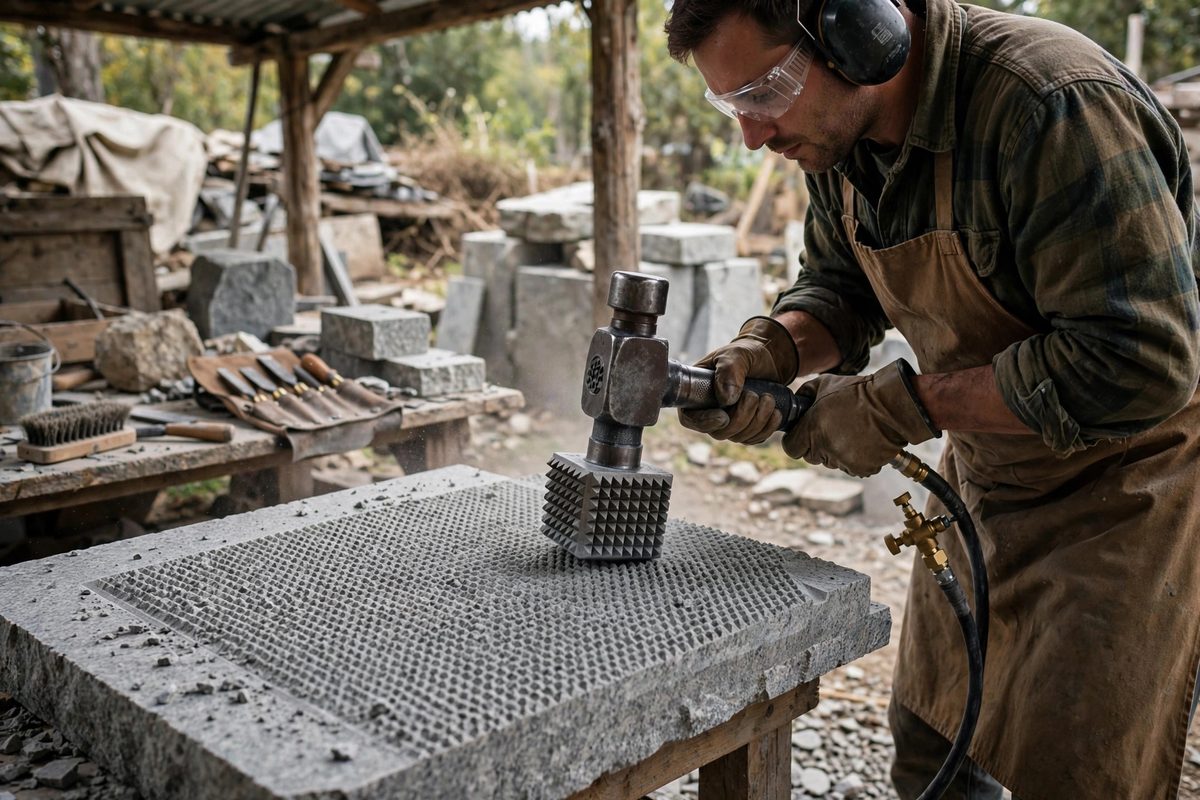
How the Bushing Hammer Cuts
Each tooth strikes the stone and crushes a tiny crater; thousands of overlapping craters become the dressed surface. The tool does not cut like a chisel, it pulverizes, which is why it works on granite that would destroy edge tools. The texture depth depends on the tooth size and the impact energy: coarse teeth at high pressure leave a deep rugged finish, fine teeth at moderate pressure leave a subtle uniform stipple. The finish is the product of tooth geometry times impact energy times coverage uniformity, and tuning addresses all three.
Air Pressure Tuning
Start at the manufacturer's recommended pressure and adjust by watching the stone. Too little pressure and the teeth bounce without crushing, polishing rather than texturing and wearing the teeth flat without doing work. Too much pressure and the tool chatters violently, bruises the stone deeper than specified, and beats itself to death. The right pressure shows as steady, controlled crushing with the tool feeding smoothly across the surface. Different granites want different pressures: hard dense granites need more energy to crush, softer ones less. Tune to the stone in front of you, not to the last stone you worked.
Tooth Selection and Condition
Bushing heads come in different tooth counts and sizes; match the head to the specified finish. Coarse heads remove material faster and are the choice for initial dressing; fine heads refine the surface toward the final texture. Inspect the teeth regularly: worn teeth rounded from use crush unevenly and slow the work dramatically. Rotate or replace the head when the texture starts varying across the surface despite consistent technique. A fresh head on a tuned tool transforms the work; a worn head makes even perfect tuning look bad.
Working Technique
Keep the tool flat to the surface and move it in overlapping passes, like mowing, so every area gets equal coverage. Tilting the tool concentrates the teeth on one edge and gouges. Let the tool's weight and the air pressure do the work; bearing down hard adds nothing but fatigue and uneven crushing. Work systematically across the stone in a pattern so no area gets double coverage while another gets missed. The evenness of the finish comes from the evenness of the coverage, which comes from disciplined movement.
Dust, Noise, and Safety
Bushing granite generates enormous amounts of silica dust and serious noise. Wear a proper respirator rated for silica, not a paper dust mask, and use dust extraction or water suppression where possible; silicosis is the real hazard of this work and it is cumulative. Wear hearing protection rated for the tool's output, plus eye protection against flying chips. Take breaks to manage vibration exposure in the hands. The finish matters, but the worker matters more, and the safety gear is not optional equipment.
Tune the pressure to the granite, match the tooth head to the finish, keep the tool flat with overlapping passes, and protect your lungs and ears. The granite will take a uniform dressed texture efficiently, and you will still be healthy enough to admire it.
Related Guides
- Pneumatic Pitching Chisel Angles on Limestone: Pitching is the rough removal of stone with a chisel struck along the edge, breaking off controlled flakes to shape the block. Done by hand it is
- Mortar Hydration Balancing for Fieldstone Bonds: Fieldstone walls stand on mortar, and mortar stands on water: the right amount, held for the right time. Hydration is the chemical reaction between
- Undercutting Depth Limits in Marble Sculptures: Undercutting, carving back beneath an overhanging form to create shadow and separation, is what gives marble sculpture its sense of depth and life. A
- Hydraulic Lime Ratios for Historic Fieldstone Pointing: Pointing historic fieldstone with modern Portland cement is one of the fastest ways to destroy an old wall; the cement is harder than the stone and
- Relief Carving Clearance Angles in Carrara Marble: Relief carving in Carrara marble is a negotiation between the design's depth and the stone's willingness to hold a crisp edge. Clearance angles, the