
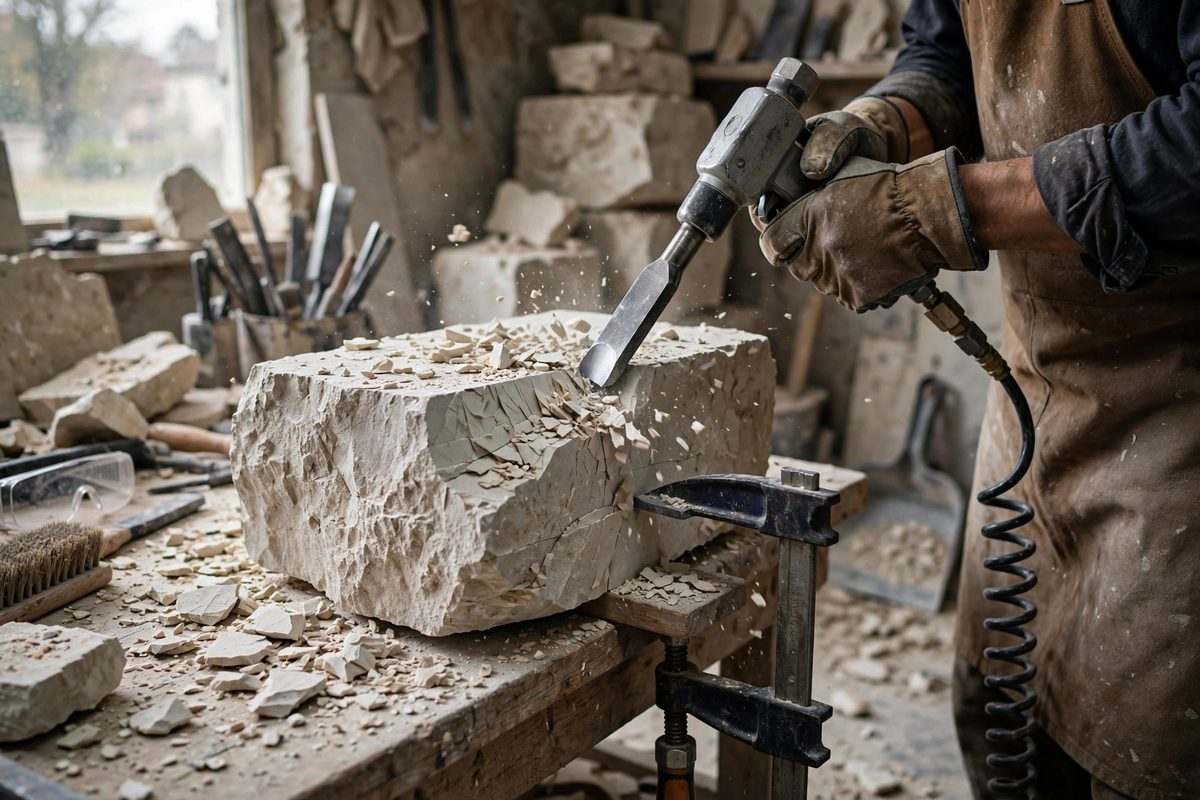
Pitching is the rough removal of stone with a chisel struck along the edge, breaking off controlled flakes to shape the block. Done by hand it is rhythmic work; done with a pneumatic hammer it is fast, powerful, and unforgiving of bad angles. Limestone, being relatively soft and bedded, responds beautifully to pitching when the chisel angle is right and punishes sloppy angles with deep fractures that run where they please. The angle of the chisel to the stone face is the entire technique.
How Pitching Removes Stone
A pitching chisel does not cut; it wedges. The chisel edge bites a short distance into the stone near the edge, and the force of the blow propagates a fracture from the bite point out to the edge, popping off a flake. The size and direction of the flake follow the angle of the chisel: a shallow angle peels thin flakes along the face, while a steep angle drives the fracture deep and risks running it into the finished surface.
Limestone's bedding planes add a directional variable. Stone splits most willingly along its bed, the sedimentary layers, and fights across them. Pitching with awareness of the bed direction lets the fractures run predictably; pitching across the bed without adjusting the angle produces ragged, unpredictable breaks.
The Working Angle Range
For controlled pitching on limestone, the chisel typically meets the stone at roughly 30 to 45 degrees to the face being worked, with the edge set back from the arris by a distance proportional to the flake you want to remove. A shallower angle, closer to 30 degrees, takes lighter passes and leaves a surface nearer to final; a steeper angle removes more aggressively but with less control over where the fracture stops.
The setback matters as much as the angle: placing the chisel too close to the edge with a steep angle blows out the arris, while placing it too far back with a shallow angle just bruises the surface without breaking a flake. The two variables work together, and the feel for their combination is the skill.
Reading the Stone's Response
Limestone talks back. A good pitching blow produces a clean crack sound and a flake that pops free with a satisfying release; the fracture face shows fresh, even stone. A bad angle produces a dull thud, a flake that hangs and has to be pried, or a fracture that dives inward instead of running to the edge. Adjust the angle toward shallower when fractures dive, and toward steeper when the chisel just skates.
- Work from the outside of the form inward, always pitching toward a free edge or face.
- Never pitch into an inside corner; the fracture has nowhere to exit and will run into the work.
- Keep the chisel edge sharp; a dull edge crushes instead of biting, and crushed stone fractures randomly.
- Let the pneumatic hammer's weight do the work; bearing down hard reduces control without improving the break.
Pneumatic Hammer Technique
The air hammer delivers far more energy per blow than a hand mallet, which means mistakes scale up too. Use the lightest blow that breaks the flake; the tool's power tempts over-hitting, and over-hit fractures in limestone run deep and fast. Feather the trigger rather than holding it wide open, and move the chisel between blows instead of dwelling in one spot.
Hold the tool firmly but not rigidly. A death grip transmits vibration to your hands and arms without improving the chisel's aim; a firm, guiding hold lets the tool work while you steer. Take breaks: pneumatic pitching is genuinely fatiguing, and tired hands lose the angle. The stone will still be there after a rest.
Safety With Pneumatic Pitching
Pitching throws chips at speed, and pneumatic pitching throws them faster. Eye protection is mandatory, and a face shield is wise for extended work. Hearing protection matters too; air hammers are loud enough to damage hearing over a session. Chips accumulate underfoot, so keep the work area clear to protect your footing, and be aware of where flakes are flying in relation to other people.
Secure the workpiece. A block that shifts under pneumatic hammering is dangerous and ruins the work; it should be bedded solidly on sand, timber, or a proper banker. The energy going into the stone has to go somewhere, and you want it going into fractures, not into moving the block.
Set the chisel shallow, stand it back from the edge, listen to the stone, and let the air do the hitting. Pitching is the fastest way to rough out limestone, and the angle is the difference between shaping the stone and fighting it.
Related Guides
- Tuning Pneumatic Bushing Hammers for Granite Dressing: A bushing hammer, the pneumatic tool with a grid of pyramidal teeth, dresses granite by crushing the surface into a uniform textured finish. Tuning
- Relief Carving Clearance Angles in Carrara Marble: Relief carving in Carrara marble is a negotiation between the design's depth and the stone's willingness to hold a crisp edge. Clearance angles, the
- Mortar Hydration Balancing for Fieldstone Bonds: Fieldstone walls stand on mortar, and mortar stands on water: the right amount, held for the right time. Hydration is the chemical reaction between
- Undercutting Depth Limits in Marble Sculptures: Undercutting, carving back beneath an overhanging form to create shadow and separation, is what gives marble sculpture its sense of depth and life. A
- Hydraulic Lime Ratios for Historic Fieldstone Pointing: Pointing historic fieldstone with modern Portland cement is one of the fastest ways to destroy an old wall; the cement is harder than the stone and