
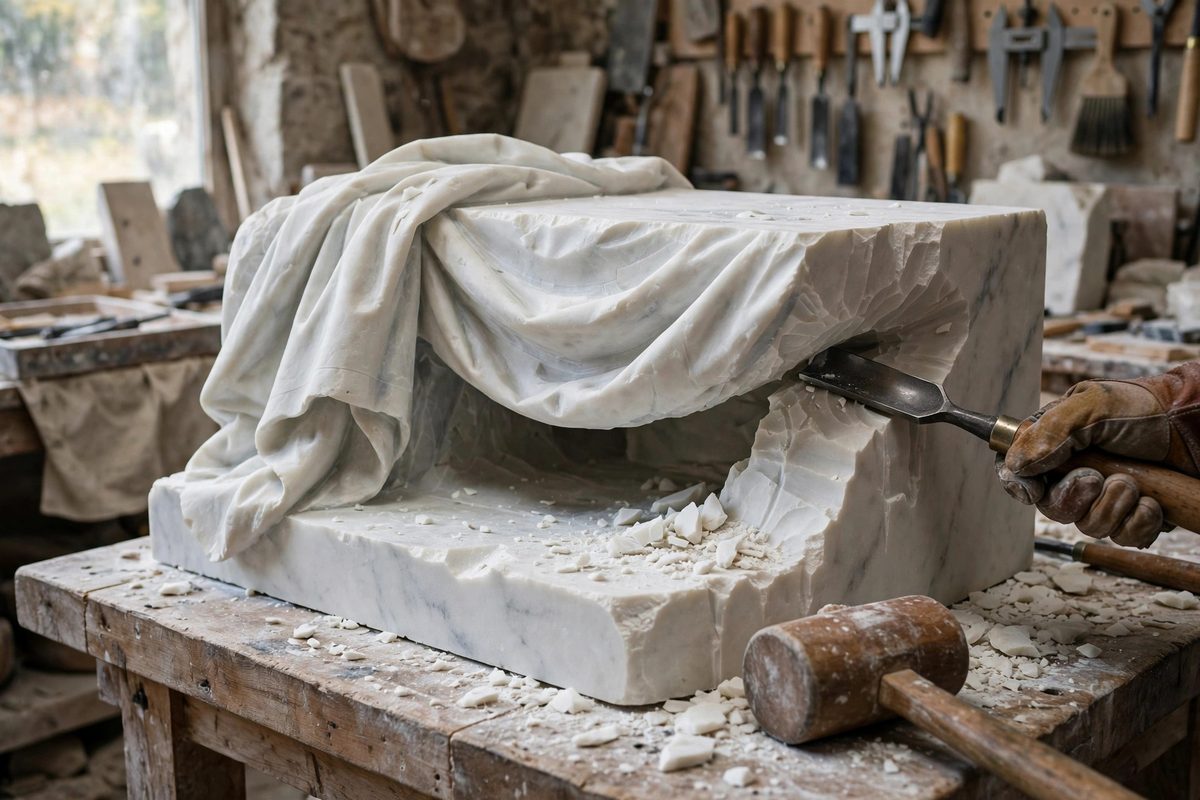
Undercutting, carving back beneath an overhanging form to create shadow and separation, is what gives marble sculpture its sense of depth and life. A drapery fold that is merely rounded looks soft; the same fold undercut so that shadow pools beneath it looks real. But marble has structural limits, and every undercut removes the stone that holds the overhang up. Push past the depth the stone can support and the form breaks, sometimes during carving, sometimes years later when vibration or a careless bump finds the weak point. Knowing the limits is what lets you carve boldly without carving foolishly.
Why Marble Tolerates Undercutting at All
Marble's crystalline structure gives it good compressive strength and reasonable tensile strength for a stone, which is why it has been the sculptor's stone for millennia. An undercut works as a small cantilever: the overhanging form is held by the stone remaining at its root. As long as the root cross-section is sufficient for the weight and leverage of the overhang, the form holds indefinitely.
The danger is leverage. A deep undercut on a projecting form multiplies the load at the root: the farther the form extends past its support, the greater the bending moment. Marble handles compression beautifully but is far weaker in tension, and a cantilever loads its root in exactly the tension-compression pair that tests the stone's weaker side.
Reading the Stone Before Committing
Not all marble is equal. Statuary marble with tight, uniform grain undercuts more aggressively than marble with open veins, sugary texture, or visible flaws. Veins are planes of weakness: an undercut that crosses a vein is betting the form's survival on the vein's strength, which is a bet the stone often wins. Examine the block for veins, dry seams, and soft spots before planning deep undercuts, and route the deepest cuts through the soundest stone.
Tap the stone and listen. Sound marble rings; flawed marble thuds. The tap test is ancient and reliable: a dull response marks a region to treat gently, with shallower undercuts and more supporting stone left at the root.
Depth Guidelines From Practice
There is no formula that covers every form, but working sculptors observe rough limits. Shallow undercuts, up to about the thickness of the overhanging form itself, are generally safe in sound marble. As the undercut depth approaches twice the form's thickness, the root narrows to a point where vibration from further carving becomes a real risk. Beyond that, the form needs either exceptional stone or a design reason strong enough to justify the gamble.
The critical dimension is the remaining root, not the removed depth. A deep undercut that leaves a generous root is safer than a shallow one that leaves a knife-edge. Always think in terms of what stays, not what goes: the supporting stone is the structure, and the undercut is just the absence around it.
- Leave the root wider than the eye says is necessary; the eye underestimates structural needs.
- Undercut symmetrically where possible; asymmetric roots twist under load.
- Finish the form's outer surface before deep undercutting; vibration from surfacing can crack a thinned root.
- Support projecting forms during carving; a form that will stand alone when finished may still need help while its root is being thinned.
Tool Technique for Safe Undercutting
Work the undercut with controlled, light cuts, not aggressive removal. Point chisels and toothed chisels used with restraint let you feel the stone's response; heavy pitching near a thinned root is asking for a fracture. Work from the outside of the undercut inward, always cutting toward the mass of the stone, never levering against the thin form.
Rasp and file work is the safest way to finish an undercut, because abrasion removes stone without impact. The final passes that define the shadow line should be abrasive, not percussive: files, rifflers, and abrasive pads shape the undercut's interior with zero risk of a stray blow snapping the form.
When Forms Break Anyway
Even careful sculptors lose forms. Marble hides flaws that no inspection finds, and a form that looked sound can let go at the root without warning. When it happens, the repair options are pinning with stainless or brass rod set in epoxy, or redesigning the form to work with the break. Neither is a disgrace; the history of sculpture is full of pinned noses and reimagined drapery.
The lesson from a break is information, not failure. Note where the root was thinnest, what the stone looked like at the fracture, and whether a vein or flaw was involved. That knowledge goes into the next undercut, which goes deeper with more confidence because the limit is now measured, not guessed.
Undercut for the shadow, but engineer for the root. The boldest undercuts in marble history were cut by sculptors who understood exactly how much stone they were leaving behind, and that understanding is the real technique.
Related Guides
- Relief Carving Clearance Angles in Carrara Marble: Relief carving in Carrara marble is a negotiation between the design's depth and the stone's willingness to hold a crisp edge. Clearance angles, the
- Mortar Hydration Balancing for Fieldstone Bonds: Fieldstone walls stand on mortar, and mortar stands on water: the right amount, held for the right time. Hydration is the chemical reaction between
- Pneumatic Pitching Chisel Angles on Limestone: Pitching is the rough removal of stone with a chisel struck along the edge, breaking off controlled flakes to shape the block. Done by hand it is
- Hydraulic Lime Ratios for Historic Fieldstone Pointing: Pointing historic fieldstone with modern Portland cement is one of the fastest ways to destroy an old wall; the cement is harder than the stone and
- Tuning Pneumatic Bushing Hammers for Granite Dressing: A bushing hammer, the pneumatic tool with a grid of pyramidal teeth, dresses granite by crushing the surface into a uniform textured finish. Tuning