
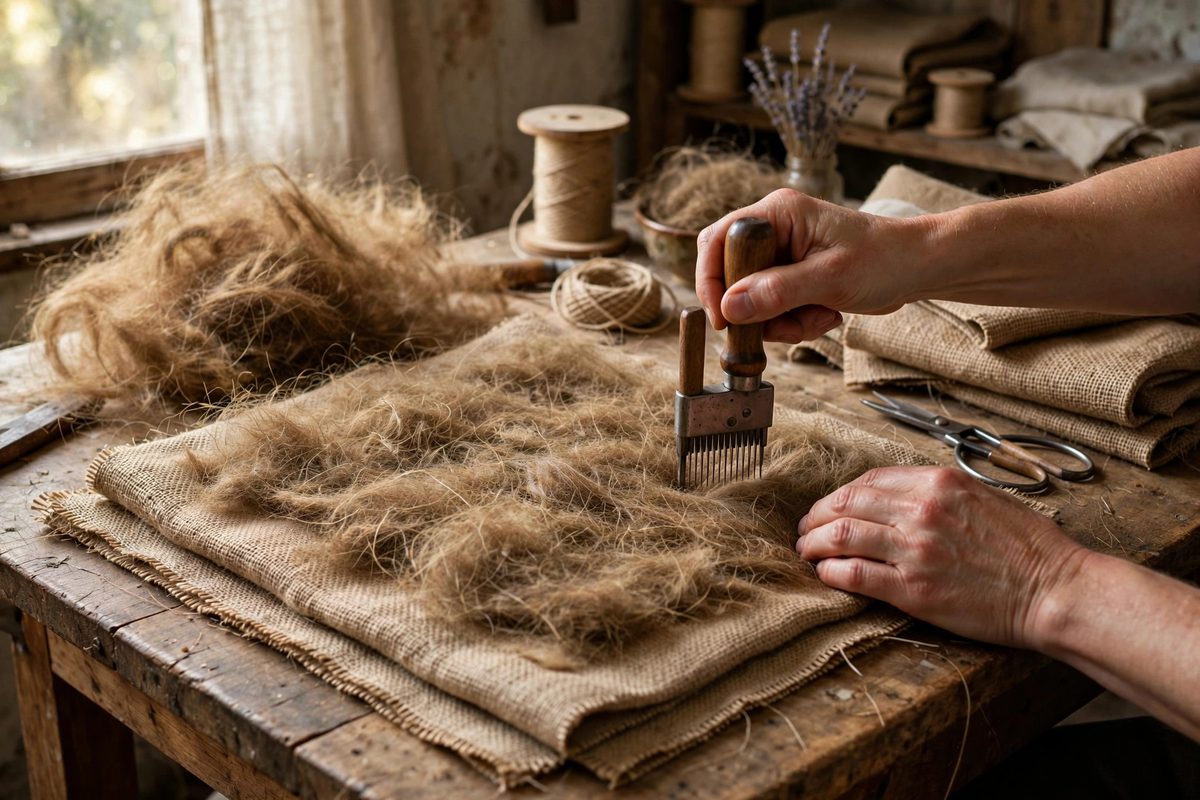
Traditional upholstery builds its comfort from natural materials layered with intention, and the horsehair-over-burlap sandwich is one of the oldest and best. Loose horsehair provides resilient, breathable padding that springs back for decades; burlap contains it and gives the next layer something to stitch to. Needle punching, driving barbed needles through the layers to entangle the fibers, locks the sandwich into a stable pad that will not shift or migrate inside the finished piece. It is the mechanical bond that makes the traditional build last.
Why Horsehair and Burlap Belong Together
Horsehair, specifically the tail hair used in upholstery, is naturally crimped and springy. Unlike foam, which breaks down and takes a set, horsehair returns to shape essentially indefinitely; there are century-old chairs still sitting on their original hair. It also breathes, moving moisture and air through the seat instead of trapping them, which is why traditional seats stay comfortable in a way foam struggles to match.
Burlap is the structural partner. Woven jute burlap is strong, open enough to stitch through, and rough enough to grip the hair. It forms the envelope that holds the loose hair in place and provides the foundation the upholsterer stitches the edge rolls and ties to. Without the burlap, the hair migrates; without the hair, the burlap is just a sling.
The Needle Punching Process
Needle punching uses barbed needles, the same principle as felting needles, driven through the layered materials. Each penetration catches fibers and drags them through adjacent layers, entangling horsehair with burlap and hair with hair. Repeated punching across the whole pad builds a three-dimensional fiber lock that holds the sandwich together without adhesive.
Work from one side, punching through the burlap into the hair layer and back. The barbs do the work on the withdrawal stroke, pulling fibers down through the layers. Punch in a dense, overlapping pattern; sparse punching leaves unbonded regions where the hair can shift. The pad is done when it holds together as a unit when lifted by the burlap edge.
Layer Order and Thickness
The typical build stacks burlap on the bottom, a generous layer of horsehair in the middle, and burlap on top, though variations exist for different applications. The hair layer's thickness sets the loft and firmness of the finished seat: more hair means a softer, deeper sit, while less hair over a firm foundation gives a formal, supportive seat. There is no universal right thickness; it follows the piece's style and intended use.
- Tease the horsehair apart before layering; clumped hair punches into lumps.
- Distribute the hair evenly; thin spots become hard spots in the finished seat.
- Keep the burlap taut but not stretched while punching; stretched burlap relaxes later and wrinkles the pad.
- Punch the edges more densely; edges take the most stress in use.
Hand Punching Versus Machine
Hand needle punching with a single needle or a small multi-needle holder is slow but gives complete control, which matters for shaped pads, curved seats, and repair work where the pad must fit an existing frame. It is the right choice for one-off traditional builds and for learning the feel of the materials.
Needle punching machines, whether purpose-built or adapted, cover large flat pads far faster and with very uniform density. For production work or large pieces like sofa seats, the machine's consistency pays off. Either way, the principle is identical; only the speed and the arm fatigue differ.
Integrating the Pad Into the Build
The punched pad is not the finished seat; it is the core. It gets stitched to the frame's webbing or springs, shaped with edge rolls, and covered with progressively finer layers: more burlap, then cotton or synthetic batting, then the show fabric. Each layer is stitched or otherwise secured to the one below, so the whole build moves as a unit.
The punched pad's stability is what makes the upper layers behave. A pad that shifts will telegraph its movement through every layer above it, eventually working the show fabric loose. A well-punched pad stays put for the life of the piece, which, with horsehair, is measured in decades.
Tease the hair, layer it honestly, punch it densely, and build upward from a stable core. The traditional materials ask for traditional patience, and they repay it with seats that outlive their makers.
Related Guides
- Curled Hair Layering for Resilient Antique Seat Tops: Before foam, upholsterers built seat comfort from curled horsehair, and antique seats stuffed with it can still be comfortable a century later if the
- Pleating Heavy Velvets Around Curved Armrests: A curved armrest is one of upholstery's honest tests: the fabric must travel around a compound curve, which means it has to go somewhere, and pleats
- Stripping Lacquer Without Degrading Veneers: Old lacquer finishes fail in familiar ways: they craze, yellow, chip, and go cloudy, and the only real fix is removal. On solid wood, stripping is
- Solvent Gels for Stripping French Polish Safely: French polish, the traditional shellac finish built up in hundreds of thin layers, eventually needs to come off: alligatored, blackened, or damaged
- Tufting Button Pull Depth Limits on Heavy Damasks: Deep button tufting on heavy damask is the signature look of traditional luxury upholstery, but the pull depth, how far the button sinks below the