
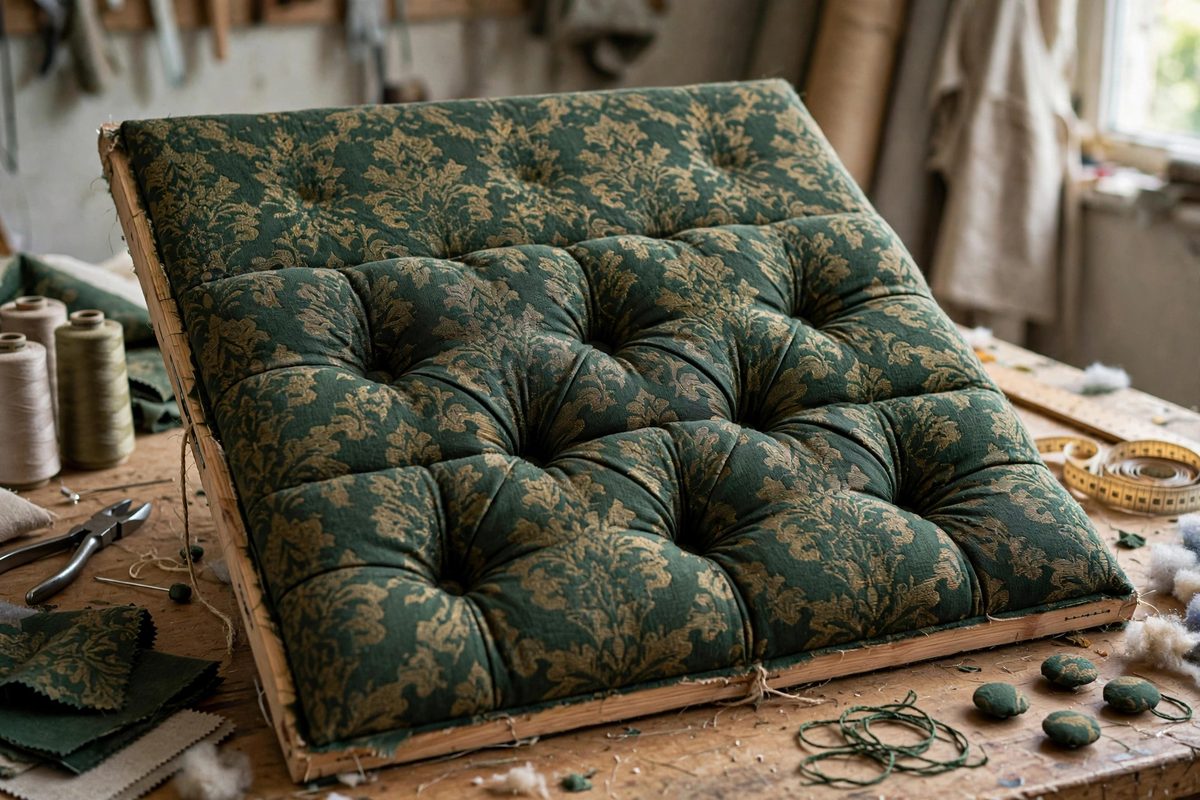
Deep button tufting on heavy damask is the signature look of traditional luxury upholstery, but the pull depth, how far the button sinks below the surface, has real limits. Pull too shallow and the tufting looks limp; pull too deep and the damask distorts, the pattern breaks, and the fabric fails at the buttons. Knowing the limits keeps the drama without the damage.
What Pull Depth Does
The button pull creates the tufting's characteristic valleys and puffs: the fabric is drawn down to the button, and the material between buttons billows into the diamond or biscuit pattern. Deeper pulls produce more dramatic sculpting with deeper shadows and fuller puffs. But every increment of depth stretches the fabric further, concentrates more stress at the button, and demands more material between buttons. The depth is set by the length of the tufting twine and the tension applied; once tied off, it is permanent, so the decision must be right before the knot.
Heavy Damask's Constraints
Damask is a woven patterned fabric, and its pattern is part of the design; deep pulls distort the weave and break the pattern's geometry around each button. Heavy damasks have limited stretch, so they reach their distortion limit sooner than plain or stretch fabrics. The fabric's weight also matters: heavy fabric needs a stronger pull to hold the tuft, which increases the stress at each button. As a working limit, the pull depth should not exceed what the fabric can take without visible weave distortion around the buttons or puckering that will not smooth. Test on a sample panel before committing the piece; the sample shows exactly where the fabric's limit lies.
Setting the Depth Consistently
Every button in the pattern must pull to the same depth, or the tufting looks lopsided. Use a gauge: a measured twine length, a depth block, or a marked regulator, so each button is set identically. Work the pattern systematically, setting and tying buttons in sequence rather than pulling them all roughly and adjusting later; adjustment after tying is nearly impossible without untying. Check the emerging pattern frequently from a distance, because the eye catches uneven depth across the whole piece better than close inspection of individual buttons.
Reinforcing the Buttons
The stress at each button concentrates on a tiny area of fabric, and heavy damask under deep pull can tear at the button over time. Reinforce each button position on the back with a small patch of sturdy fabric, canvas or ticking, so the twine bears against the reinforcement rather than the damask alone. Use proper tufting buttons with secure shanks, and tie the twine with knots that will not slip; a button that loosens after the piece is finished is a repair that requires opening the work. The back of the piece should show neat, secure knots, because the front's beauty depends on the back's integrity.
Balancing Drama and Durability
The most successful deep tufting finds the fabric's sweet spot: deep enough for the sculptural effect, shallow enough that the damask's pattern survives and the buttons hold for decades. When the design demands more depth than the damask allows, the honest solutions are a different fabric or a shallower interpretation, not forcing the pull past the limit. A tufted panel that is slightly less deep than the fantasy but intact in ten years beats a dramatic one that is tearing at year two. Respect the material and it will hold the shape you gave it.
Test the damask's pull limit on a sample, set every button to the same measured depth, reinforce behind each button, and tie securely. The tufting will have the deep sculptural richness damask promises, without asking the fabric for more than it can give.
Related Guides
- Pleating Heavy Velvets Around Curved Armrests: A curved armrest is one of upholstery's honest tests: the fabric must travel around a compound curve, which means it has to go somewhere, and pleats
- Needle Punching Horsehair Into Burlap Layers: Traditional upholstery builds its comfort from natural materials layered with intention, and the horsehair-over-burlap sandwich is one of the oldest
- Stripping Lacquer Without Degrading Veneers: Old lacquer finishes fail in familiar ways: they craze, yellow, chip, and go cloudy, and the only real fix is removal. On solid wood, stripping is
- Curled Hair Layering for Resilient Antique Seat Tops: Before foam, upholsterers built seat comfort from curled horsehair, and antique seats stuffed with it can still be comfortable a century later if the
- Solvent Gels for Stripping French Polish Safely: French polish, the traditional shellac finish built up in hundreds of thin layers, eventually needs to come off: alligatored, blackened, or damaged