
Phantom power, the 48 volts that travels up the microphone cable to energize a condenser mic, is supposed to be pure DC. In practice, cheap supplies and long cable runs let alternating-current ripple ride along on that DC, and the microphone faithfully amplifies it as hum. The result is a noise floor that no amount of gain staging can fix, because the noise enters at the most sensitive point in the chain. Filtering ripple out of the phantom supply is straightforward electronics, and it is one of the highest-value upgrades in a DIY microphone setup.
Where ripple comes from
Phantom power starts as mains AC, gets transformed down, rectified, and regulated to 48 volts DC. Every stage can leave residue. Rectification produces ripple at twice the mains frequency, 100 or 120 hertz depending on your region, and inadequate filtering after the rectifier lets that ripple through. Cheap switching supplies add higher-frequency noise on top. Long cable runs and shared ground paths invite additional interference. The microphone's internal circuitry has some power-supply rejection, meaning it ignores a certain amount of supply noise, but that rejection is finite, and it is weakest exactly where ripple lives: at low frequencies and their harmonics. When the ripple exceeds what the mic can reject, it appears at the output as hum, sometimes with a buzzy harmonic character that is far more audible than its measured level suggests.
How RC filtering cleans the supply
The classic ripple filter is embarrassingly simple: a resistor in series with the supply line followed by a capacitor to ground. The resistor and capacitor form a low-pass filter that passes DC freely but increasingly blocks alternating current as frequency rises. The resistor drops a small amount of voltage, which is fine because phantom power has generous headroom and condenser mics draw only a few milliamps. The capacitor shunts the AC ripple to ground before it reaches the microphone. Larger capacitance filters lower frequencies better, which is exactly what mains ripple needs. A two-stage filter, resistor-capacitor followed by another resistor-capacitor, multiplies the effect and can take a visibly rippled supply down to essentially clean DC. This is not exotic engineering; it is the same technique used inside every well-designed piece of audio gear.
Building the filter in practice
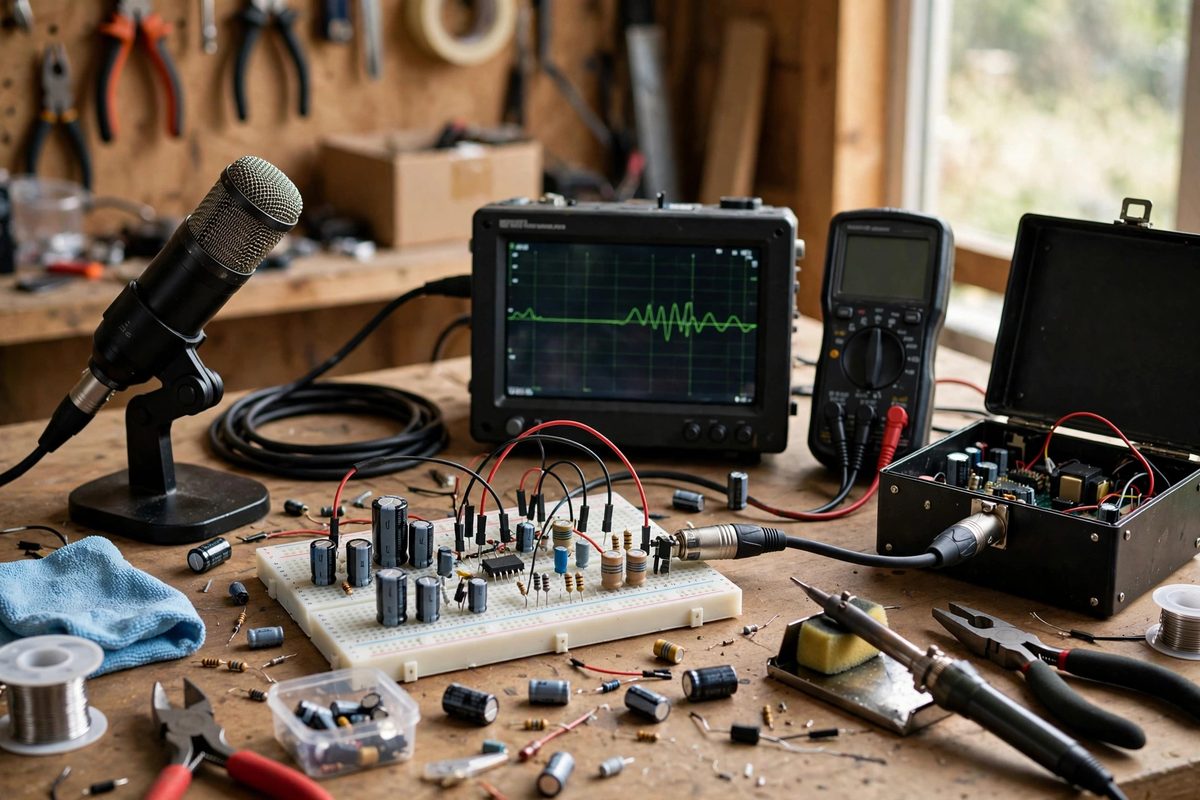
Build the filter as close to the microphone as practical, ideally in a small box at the mic end or inside the mic body itself, because filtering at the load protects against noise picked up along the cable run. Use a series resistor sized so the voltage drop at the mic's current draw stays small: with typical condenser current draw in the low milliamps, a resistor in the low hundreds of ohms drops only a volt or two, leaving plenty of the 48 volts intact. Follow it with an electrolytic capacitor of generous value for the low-frequency ripple, plus a small film capacitor in parallel to handle higher-frequency switching noise that the electrolytic is too slow to catch. Observe capacitor polarity on the electrolytic; reversed electrolytics fail dramatically. Keep lead lengths short and the layout tidy, because a filter built with long, loopy wiring can pick up the very noise it is meant to remove.
Grounding and the rest of the noise picture
Filtering the supply addresses ripple, but hum has other doors. Star grounding, bringing all ground connections to a single point rather than daisy-chaining them, prevents ground loops that inject hum independently of the supply. Keep the phantom supply and its filter away from power transformers and wall warts, whose magnetic fields induce hum directly into nearby circuitry. Use proper shielded microphone cable with the shield connected at both ends for phantom power (the shield carries the return current, so lifting it is not an option here the way it sometimes is with line-level signals). If hum persists after filtering, suspect the grounding before adding more filter stages; beyond a point, more filtering treats a symptom whose cause is elsewhere.
Safety around phantom voltage
Forty-eight volts will not shock you under normal conditions, but the supply behind it deserves respect. Never open a phantom supply while it is plugged in, and remember that its filter capacitors store charge after power-off: verify with a meter before touching. Phantom power can damage ribbon microphones and some vintage dynamics, so never apply it to a mic unless you are certain the mic is designed for it, and never hot-plug microphones with phantom engaged. These are simple habits, and they protect both the builder and the microphones.
A resistor, a capacitor or two, and tidy construction: that is all that stands between a humming condenser mic and a quiet one. Filter the supply at the microphone, ground everything to one point, and let the mic's own noise floor, not the power supply's, set the limit.
Related Guides
- Tuning JFET Bias Voltage in DIY Condenser Mics: The JFET (junction field-effect transistor) is the heart of most DIY condenser microphone circuits: it converts the capsule's tiny, high-impedance
- Center-Tapped Isolation Transformers in DIY Mics: A microphone's output transformer does quiet, critical work: it isolates the mic electrically from the preamp, balances the signal for long cable
- Electret Capsule Diaphragm Dampening for DIY Mics: Electret condenser capsules are the tiny microphones inside nearly every inexpensive mic, headset, and phone: cheap, sensitive, and surprisingly
- Center-Tapped Transformer Balancing in Ribbon Mics: A ribbon microphone produces a tiny, delicate signal from a thin metal ribbon moving between magnets, and the transformer sitting right behind that
- Shielded Capsule Enclosure Baffling for DIY Condensers: A DIY condenser microphone is a high-impedance circuit sitting next to a sensitive capsule, and both of them are antennas for every hum, buzz, and