
A heavy timber post does not forgive being out of plumb. Once it is set and the joinery is cut, a lean you can barely see at the base becomes inches of error at the top of a ten-foot post. A plumb bob is the oldest reliable way to check vertical, and on big timbers it beats a level in one important way: it never lies about gravity.
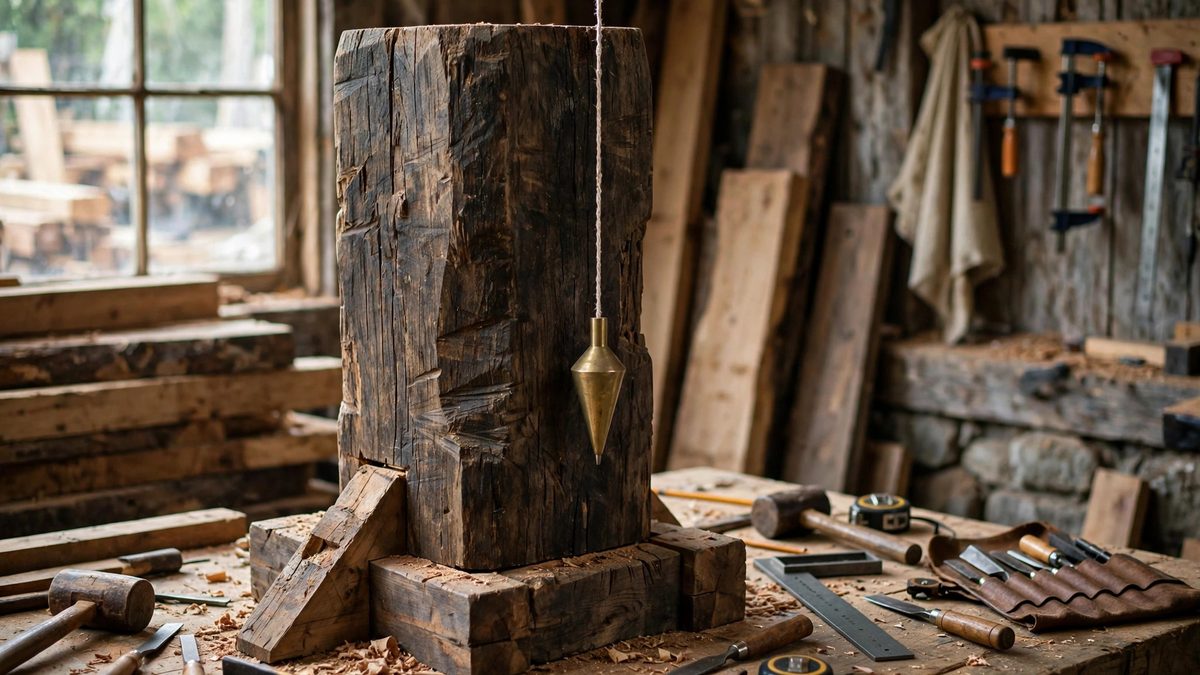
Why a plumb bob on big timbers
A four-foot level is fine for studs. On a rough-sawn 8x8, the faces are rarely flat enough for a level to sit true, and holding a level steady against a post that weighs a couple hundred pounds is its own problem. A plumb bob hangs from a string and points straight down, always. It does not care about the surface. It reads gravity directly, which is the actual reference you want.
What you need
- A plumb bob, brass or steel, heavy enough not to swing in a breeze. Eight ounces or more for outdoor work.
- Mason's line or braided nylon string. Avoid stretchy twine.
- A small board or block to hook the string over the top of the post.
- A tape measure and a pencil.
Setting up the reading
Hook the string over the top of the post so the bob hangs free alongside one face, a finger's width off the surface. Let it settle completely. Wind will keep it moving, so work in calm air or shield it with your body. When the bob hangs still, measure the gap between the string and the post face at the top and at the bottom. Equal gaps mean plumb on that face. A wider gap at the bottom means the post leans toward you at the top.
Check two adjacent faces, not just one. A post can be plumb on the north face and leaning on the east face. Both readings have to agree before you call it good.
Adjusting the post
With the post braced loosely, nudge the base or the top based on your readings. Move in small amounts and re-hang the bob after each adjustment. It is tempting to adjust by eye once you are close, but re-hanging takes thirty seconds and guessing wrong means re-cutting joinery. On a post that is already carrying load, adjust with wedges and check both faces again before tightening anything.
Common mistakes
The biggest one is checking only one face. The second is impatience with the swing. A bob that is still moving gives a reading that is wrong in a random direction, which is worse than no reading at all. Wait for it to stop. The third is using a light bob outdoors. A two-ounce bob in a five-mile-an-hour breeze never settles, and you will chase it all afternoon. Use enough weight for the conditions.
When the timber itself is the problem
Sometimes the post is plumb and the face is not. Rough-sawn timbers twist, cup, and taper. If your string gap changes along a face that reads plumb at top and bottom, the timber has a bow or twist in it. Note where it is. You can work around a bow by orienting it into the structure, but you cannot straighten it with the bob. The bob tells you about vertical. Straightness of the timber is a separate check with a string line along the face.
The bottom line: hang the bob, wait for stillness, measure top and bottom on two adjacent faces, and adjust in small moves. It is slow work, but a plumb post makes every joint above it fit the way it was drawn.
Related Guides
- Calculating Tie Beam Tension in Heavy Timber Trusses: The tie beam is the unsung hero of the timber truss: while the rafters push outward under roof load, the tie beam pulls inward, holding the walls
- Point Load Transfer Through Bearing Partition Walls: Most walls in a house carry distributed loads: the weight of the floor or roof above spread along their length. But beams, girders, and headers
- Cantilever Deck Joist Overhang Limits and Ratios: A cantilevered deck joist extends past its supporting beam, creating the clean, post-free overhang that makes decks look like they float. It is an
- Scarf Joint Incline Angles for Structural Beam Splices: When a beam must be longer than the available lumber, the scarf joint splices two timbers end to end with long, overlapping angled cuts. The incline
- Cantilever Joist Deflection Ratios for Balconies: A balcony framed as a cantilever, joists extending past the building's support with no posts at the outer edge, is an elegant structure and an