
End walls take the brunt of wind loads on a building, and in high wind zones every framing connection matters more. Stud splices, where two shorter studs join to make a tall wall, are weak points by nature. Staggering them so they never line up is a simple layout discipline that keeps the wall acting as a unit instead of hinging at a line of splices.
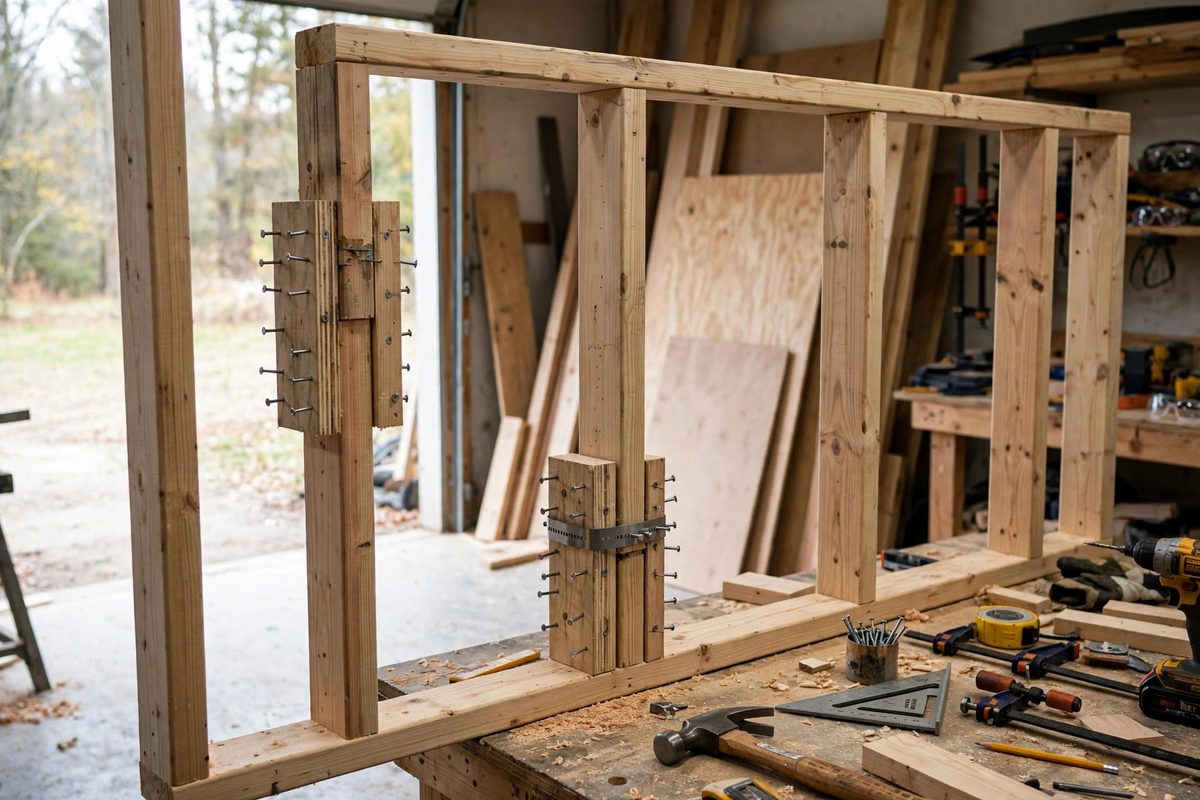
Why Splices Are Weak Points
A splice interrupts the continuous grain of the stud. Even a well-made splice with proper nailing and backing is less stiff and less strong than solid lumber, because the connection relies on fasteners and friction rather than continuous fibers. Under wind load, an end wall bends like a sail; the bending stress is highest at the mid-height of the wall, which is exactly where a careless framer puts all the splices. If every stud is spliced at the same height, the wall develops a hinge line: a horizontal plane where the whole wall wants to fold. Staggering the splices distributes the weak points so no single horizontal line concentrates them, and the wall's strength comes from the solid studs bridging past each splice.
The Staggering Layout
The rule is straightforward: no two adjacent stud splices at the same height, and splices kept away from the mid-height zone where bending stress peaks. In practice, this means planning the cut list so splice heights vary across the wall, typically by at least a couple of feet between neighbors. Mark the splice heights on the plates during layout so the crew can see the stagger before nailing begins. For very tall walls that require splices in most studs, alternate the splice heights in a deliberate pattern rather than letting them fall randomly; random often clusters. The layout takes a few extra minutes with a tape and a pencil, and it is the cheapest structural upgrade in the wall.
Making Each Splice Strong
Staggering distributes weakness; good splice detailing reduces it. Back every splice with a solid stud or a scab: the splice should never float between supports. Nail the splice with an adequate pattern on both sides, using nails long enough to penetrate the backing fully. Some builders add construction adhesive at splices in high wind zones; the glue plus nails approach the strength of solid lumber far more closely than nails alone. Keep splices out of the zones where hold-downs and shear connectors attach, since those connections need solid wood to develop their rated capacity. A splice under a hold-down is a connection attached to a weak point, which defeats the hardware.
High Wind Zone Considerations
High wind zones demand a continuous load path from roof to foundation, and the end wall studs are links in that chain. Beyond staggering splices, verify that the wall has the sheathing, hold-downs, and top plate connections the local code requires for the wind speed zone. Sheathing nailed to a proper schedule turns the stud wall into a shear panel, which braces the splices laterally; an unsheathed wall under construction is at its most vulnerable, so brace tall end walls temporarily until the sheathing is on. Pay attention to the gable end framing above the top plate, which catches the most wind and often gets framed as an afterthought. The whole end wall system works together, and the staggered splices are one part of it.
Inspection and Common Mistakes
Walk the wall before sheathing and look at the splice pattern; the stagger should be visible and deliberate. Common mistakes include splices all landing at the same height because the lumber came in one length, splices floating between studs with no backing, and splices placed at mid-height out of convenience. Fix these before the sheathing goes on, because afterward they are hidden and permanent. Check that every splice is nailed on both faces and that no splice sits where a hold-down needs solid wood. A few minutes of inspection catches the errors that wind would eventually find.
Stagger stud splices so weak points never align, back every splice solidly, keep them clear of mid-height and hardware zones, and brace until sheathed. In high wind country, the wall is only as strong as its worst horizontal line; make sure there isn't one.
Related Guides
- Diagonal Wall Bracing for Tall Shed Framing: A tall shed, with walls eight feet or more and a roof catching wind like a sail, needs more than studs and sheathing to stand straight: it needs
- Crown Orientation in Dimensional Floor Joists: Every dimensional lumber joist has a crown: a slight bow along its length, a legacy of how the tree grew and how the board dried. Installed
- Rim Joist Fastening Schedules on Foundation: The rim joist caps the ends of the floor joists and ties the floor system together at the foundation, forming the perimeter that the walls sit on
- Calculating Rim Joist Shear Capacities on Rim Sills: The rim joist is the quiet workhorse of floor framing. It caps the ends of the floor joists, ties them together, and transfers the edge loads of the
- Structural Top Plate Lap Spices on Load Bearing Walls: The top plate ties a framed wall together and carries the loads from above into the studs below. Where two plate sections meet, the splice must