
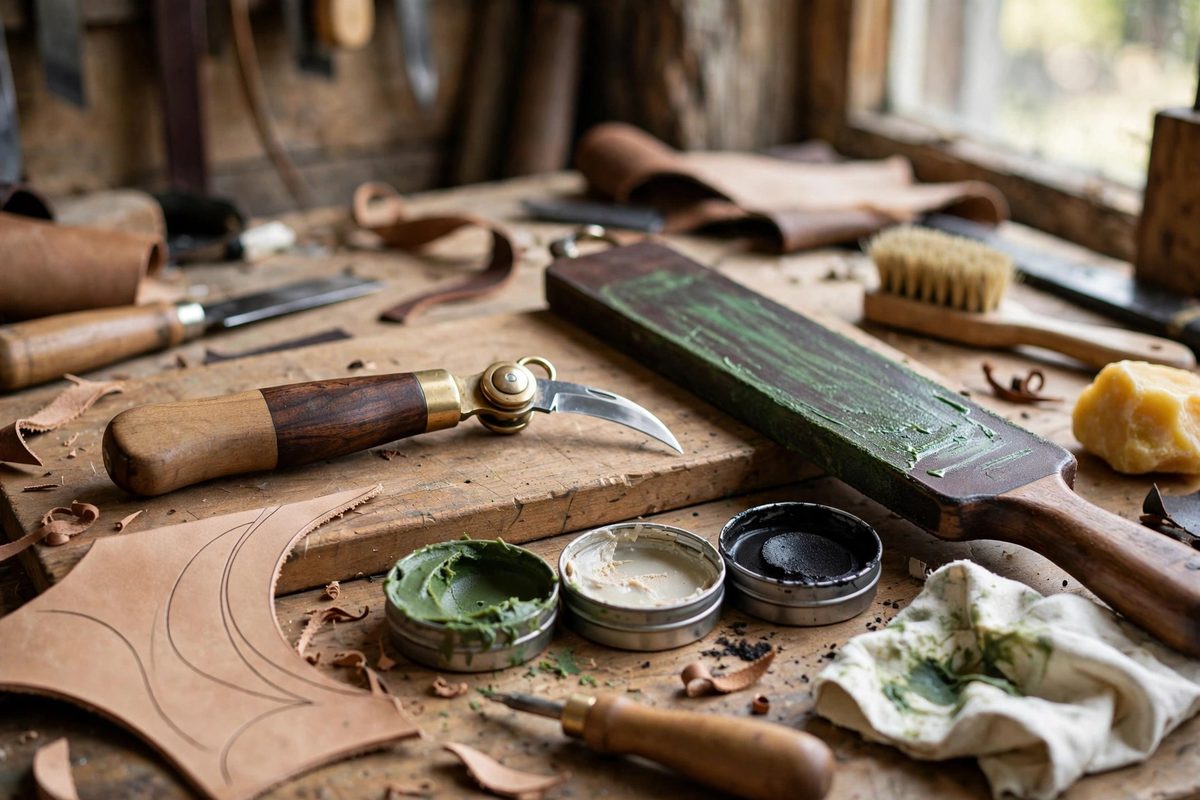
A swivel knife is the leatherworker's pencil, and its blade needs to be scary sharp to cut clean curves without dragging. Stropping maintains that edge between sharpenings, and the strop dressing, the abrasive compound on the strop, determines how effectively the strop refines the edge. The right dressing for swivel blades is finer and less aggressive than what you would use on a shop knife.
Why Swivel Blades Need Special Attention
Swivel knife blades are thin, with a delicate bevel that must stay crisp to pivot smoothly through curves. A coarse dressing rounds that bevel quickly, turning the precise cutter into a dull wedge that tears instead of slicing. The blade's edge geometry is also unusual: it cuts on a pull with a slicing motion, so the very apex of the edge does the work. Stropping must polish that apex without reshaping the bevel behind it, which calls for fine compounds and light pressure.
Choosing the Dressing
For swivel blades, fine polishing compounds are the working choice: white rouge, green chromium oxide, or dedicated fine honing compounds. These cut slowly and polish highly, which is exactly what a thin blade needs. Coarse compounds like black emery are for repairing damaged edges on heavier tools, not for maintaining a swivel blade; using them on the swivel blade is like using a grinder where a file belongs. Some leatherworkers keep two strops, one with a medium compound for occasional refreshing and one with a fine compound for regular maintenance, which covers the blade's whole life without ever reaching for anything aggressive.
Strop Construction
The strop itself matters as much as the dressing. A firm leather strop, smooth side up, gives the blade a stable surface that polishes without rounding; a soft, spongy strop lets the blade sink in and rounds the edge. Glue the leather to a flat board so it cannot flex, and keep the strop clean; metal particles embedded from previous sessions turn the strop into a coarse abrasive regardless of the dressing. Dedicate the swivel-blade strop to that job alone, because one session with a shop knife contaminates it for fine work.
Stropping Technique
Strop with the blade trailing, edge away from the direction of motion, so the edge never digs into the leather. Use light pressure and consistent angle, matching the blade's bevel; rocking the angle rounds the apex you are trying to polish. A dozen or so passes per side, alternating, is usually enough for maintenance stropping. The test is in the cutting: a properly stropped swivel blade glides through the leather with the yoke barely needing guidance, while a neglected one drags and requires force. Strop often, before the edge degrades, because maintaining sharp is far easier than restoring sharp.
When Stropping Is Not Enough
Stropping maintains an edge; it does not create one from a damaged blade. If the blade is nicked, rolled, or has lost its bevel geometry, it needs stones first: a fine stone to reestablish the bevel, then the strop to polish it. Recognize the difference between a blade that needs stropping (cuts okay but not great) and one that needs stones (will not cut cleanly no matter how much you strop). Forcing a damaged blade on the strop just wastes time and rounds the bevel further. Stones for repair, strop for maintenance, and the swivel knife stays the precision instrument it is meant to be.
Fine dressing on a firm dedicated strop, light trailing strokes, and frequent maintenance keep the swivel blade at its peak. The blade stays scary sharp, the curves stay clean, and the tooling looks effortless because the edge is doing its job.
Related Guides
- Swivel Knife Depth Control on Casing Leather: The swivel knife is the pencil of leather tooling: every carved line starts as a swivel knife cut, and every bevel, background, and decorative stamp
- Cast Stitch Tension on Diamond Chisel Spacing: The saddle stitch is the strongest hand stitch in leatherwork, and its strength lives or dies on tension. Each stitch is a small knot of thread
- Deglazing Vegetable Tanned Hides Before Dye: Vegetable tanned leather arrives from the tannery with a glazed surface: a smooth, slightly sealed finish from the final rolling and burnishing that
- Molding Heavy Saddle Skirting for Cuirasses: A cuirass, the torso armor of breastplate and backplate, demands leather that is thick enough to hold a shape under its own weight and shaped closely
- Hot Water Hardening of Heavy Skirting Armor Leather: Vegetable-tanned skirting leather can be hardened into rigid armor plates with nothing but hot water, a technique as old as armor itself. The heat